Modern Buyer Journeys
Welcome to the Course
As a demand generation manager, you build entire programs around a mental model of how buyers move toward a purchase. If that model is wrong, every downstream decision (channel mix, content sequencing, budget allocation) inherits the error. This course replaces the tidy funnel diagram with a truer picture of how modern buyers actually behave, so your strategy is calibrated to reality rather than to a slide.
By the end of this course, you'll be able to:
- Explain why traditional linear funnels misrepresent how modern buyers behave
- Analyze the decision dynamics and velocity factors that accelerate or stall progression
- Apply multi-touch attribution theory to credit cumulative influence across the journey
- Diagnose the highest-impact optimization and retention leverage points
- Design a retention funnel that extends demand generation into customer expansion
This first unit sets the foundation: why the linear funnel breaks down, and what the buyer journey looks like once you stop forcing it into a straight line.
Where the Linear Funnel Breaks Down
The classic funnel (awareness, then consideration, then decision) is a useful teaching device and a poor map of behavior. It rests on three assumptions worth naming. First, it assumes buyers move in one direction and never loop back. Second, it assumes they pass through every stage in order. Third, it assumes each buyer is a single decision-maker progressing alone.
Modern B2B behavior violates all three. Buyers loop backward from decision to consideration when a new competitor appears. They skip stages entirely when a trusted peer referral compresses months of evaluation into a single conversation. And they rarely act alone: a buying group of five or six people each runs their own partial journey, and your funnel is really several overlapping journeys stacked on top of each other.
The blind spots this creates are practical, not academic. When a segment stops engaging with your tracked assets, a linear model tells you they dropped off, so you mark them lost or dump them into a re-engagement flow. In reality they may be deep in evaluation on channels you cannot see, like review sites, Slack communities, or private peer conversations. The linear funnel misreads invisibility as disengagement, and that single misread quietly distorts your reporting, your nurture logic, and your budget defense.
The Consideration Paradox and Choice Architecture
The messiest part of the journey is the middle, and there is a reason. The Consideration Paradox holds that the consideration stage creates psychological complexity because buyers must evaluate options while simultaneously managing choice pressure and uncertainty. The more options and information you give a buyer, the more capable they should feel, yet in practice the added choice often raises anxiety and slows them down. Evaluation and hesitation grow together, which is why the "middle" of your funnel is where deals stall, go quiet, and loop back on themselves.
This is where Choice Architecture becomes your lever. Choice architecture is how you structure and present options so buyers can evaluate them more clearly. A cluttered comparison page, ten undifferentiated content offers, or a pricing model that requires a spreadsheet to decode all amplify choice pressure. A clean comparison framework, a recommended path, or a single well-timed decision aid reduces it. You are not removing the buyer's need to evaluate; you are lowering the cognitive cost of doing so.
Consider how this reframes a familiar dashboard moment.
- Ryan: This segment went quiet after the webinar, so I flagged them as lost.
- Jessica: Did they actually disappear, or just leave our tracking? A few of them showed up on a review site three weeks later.
- Ryan: So they were still evaluating, just not where we could watch.
- Jessica: Right. That silence wasn't disengagement, it was choice pressure. They were weighing options, not gone.
Notice that the behavior only looks like a drop-off through a linear lens. Through the consideration paradox, the silence and the detour to review sites are exactly what active evaluation looks like.
Mapping the Non-Linear Journey
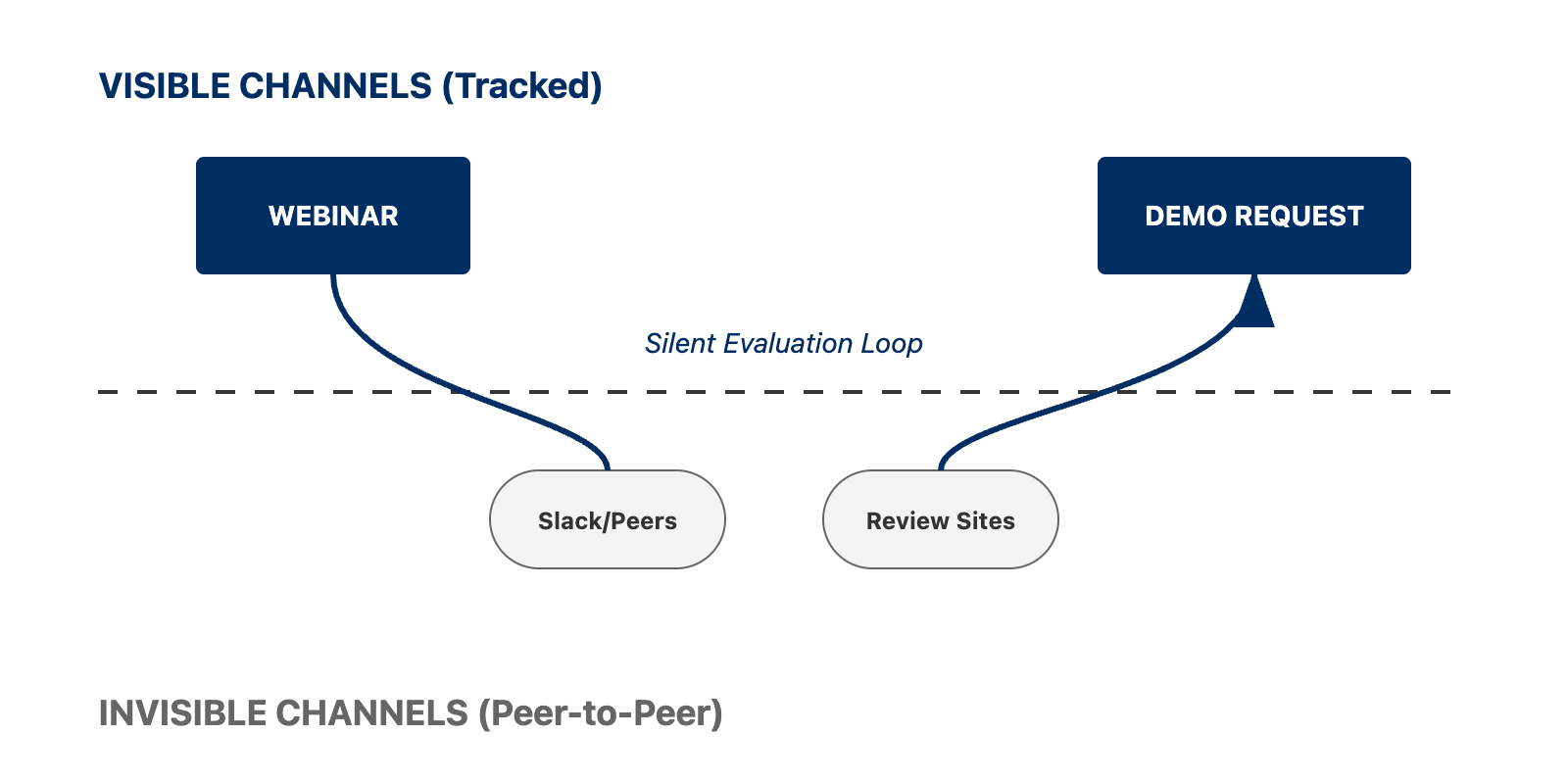 Rejecting the linear funnel does not mean abandoning structure. Your team still needs something to plan and report against. The goal is a map that stays faithful to real behavior while remaining usable.
Start by treating stages as buyer states rather than sequential steps. A buyer can occupy problem recognition and consideration at the same time, or return to consideration after a decision-stage objection. Then annotate the map with the three behaviors a linear model hides: repeated moments (a buyer attends two webinars months apart), skipped moments (a referral that jumps straight to a demo), and overlapping moments (three stakeholders in different states at once). Rather than a single arrow, you are describing the likely paths and the points where buyers loop, leave, and re-enter your visible touchpoints.
The practical trick for reporting is to keep the familiar stage labels as buckets for aggregate health, while acknowledging in your narrative that individual paths cross those buckets freely. That gives leadership a clean scoreboard without pretending every buyer walked a straight line.
The core insight to carry from this unit: the funnel is a lens, not a law, and the buyers who look "lost" are often the ones evaluating hardest where you cannot see. Next, a quick self-check will test whether you can spot exactly where a linear model would mislead you, before you move on to putting that diagnosis into writing and defending a faithful-but-usable journey map in a live conversation.
