Optimizing Demand and Retention
The Optimization of Demand and Retention
The last unit taught you to credit cumulative influence honestly. Attribution tells you what moved buyers; this unit tells you where to act on what it reveals. In a non-linear journey with dozens of touchpoints, you cannot optimize everything at once, and you shouldn't try. The discipline here is spending finite effort where it returns the most, and then recognizing that demand generation doesn't stop at the signed contract. It extends into expansion.
Finding the Highest-Impact Leverage Points
A leverage point is where a small, achievable improvement produces an outsized downstream return. The instinct is to chase the biggest number on the dashboard, but the largest drop-off is not automatically the best place to work. Impact is a product of three things: how many buyers a change would touch, how much you can realistically move the metric, and how valuable the outcome sitting beyond that point is. A modest lift on a high-value, recoverable stage beats a heroic effort on a stage that either can't improve much or feeds low-value outcomes.
- Milo: Top-of-funnel traffic is down eight percent. That's our biggest miss, so let's pour budget there.
- Ryan: It's the biggest number, but the funnel isn't starved for entrants. The real bleed is consideration-to-demo, where two-thirds drop off.
- Milo: Fixing that is harder than just buying more traffic, though.
- Ryan: Harder, but every buyer we recover there is already qualified. Same effort, far more pipeline than topping up a funnel that's already full.
- Milo: So the biggest drop isn't the point. The most valuable recoverable drop is.
Notice how Ryan reframes "biggest" into "most valuable and recoverable." That reframing is the whole skill.
Diagnosing Where Drop-Off Signals Opportunity
Once you accept that leverage isn't the same as size, diagnosing drop-off becomes a matter of weighting rather than alarm. Not every drop is a problem: some are healthy qualification, buyers self-selecting out who were never a fit, and forcing them forward only pollutes pipeline. To locate the strongest opportunity, weigh each drop by its size, its addressability (can marketing actually influence it, or does it live in procurement?), and the value locked behind it.
Crucially, optimization signals point in two directions. A leak is one kind of signal; a proven strength is another. If a cohort expands reliably after adopting a second feature, that pattern is as much an optimization opportunity as any leak, because you already know it works and can scale it. So your diagnosis should hold the acquisition leak and the expansion pattern side by side and ask honestly which one, for a given unit of effort, produces more growth. Resource constraints force the choice, and the answer is not always "fix the leak."
Extending Demand Generation into a Retention Funnel
That expansion pattern is where the Retention Funnel comes in: the extension of demand generation beyond the initial purchase into post-purchase growth and account expansion. The mistake is treating the sale as the finish line and handing everything after it to customer success. Expansion is demand creation among people who already trust you. The psychology you've studied all course still applies: a customer must recognize a new problem worth solving (a second use case), consider the upgrade against alternatives (including doing nothing), and commit. Those are the same cognitive and emotional states, now aimed at an existing account where trust is already established and acquisition cost is effectively zero.
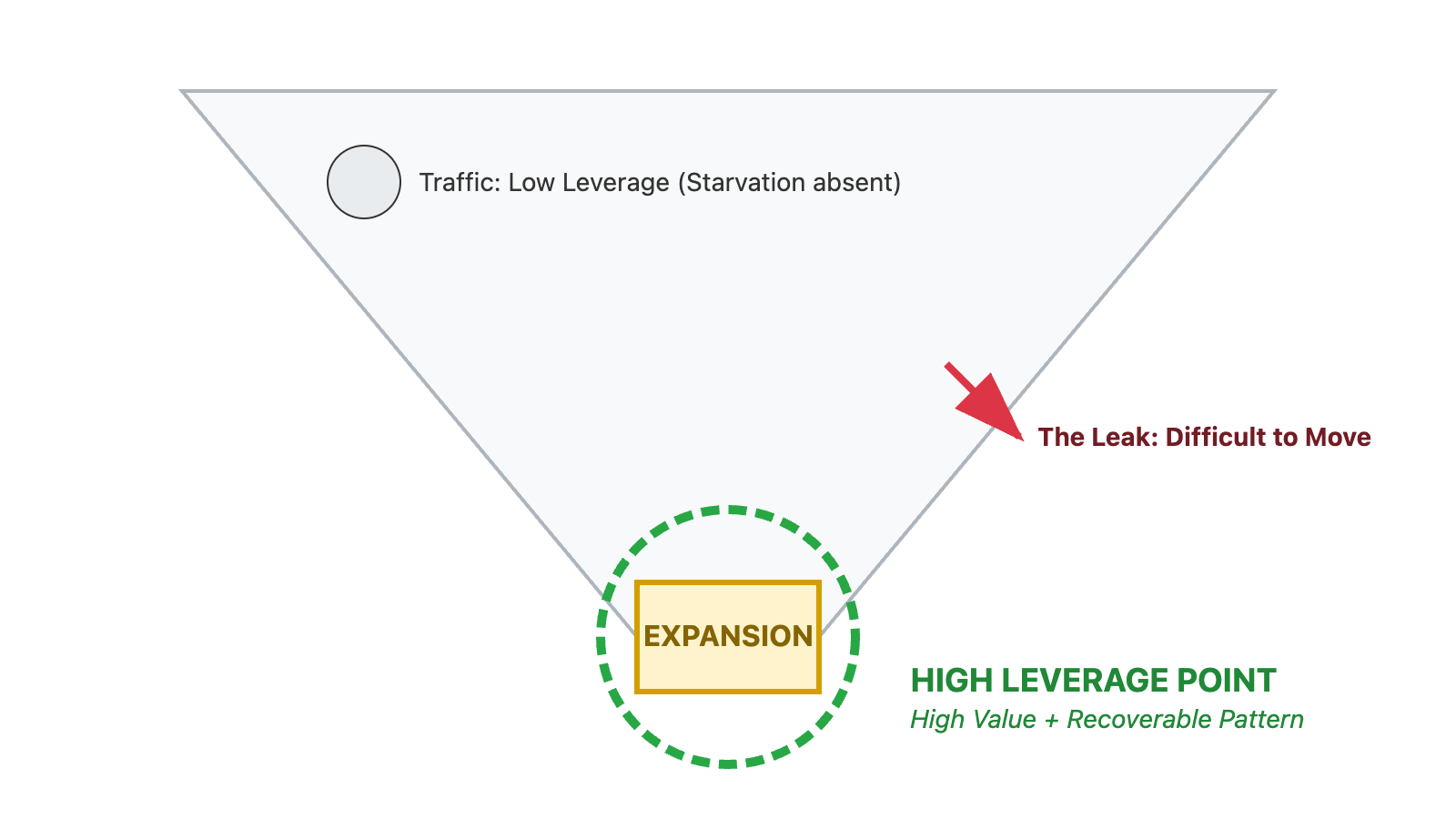 This doesn't mean abandoning new-logo goals. It means claiming a proportional stake in the growth that compounds fastest, and arguing for it with the expansion evidence rather than a turf claim.
The takeaway to carry: optimization is prioritization, not repair, and demand generation's job doesn't end at purchase, it compounds after it. What comes next puts that to the test in sequence: a quick pattern-spotting check on choosing the highest-impact leverage point, a written diagnosis you could hand to a resource-constrained leader, and a live conversation defending a retention funnel against someone convinced expansion isn't marketing's business.
