Connecting Correlation to Plots
Introduction
Welcome back to The Correlation Coefficient! In the first lesson of this course, we learned how to read the correlation coefficient — checking its sign for direction and its magnitude for strength.
In this second lesson, we flip the process around. Instead of starting with a number and describing the pattern, we will start with a scatter plot and estimate what should be. By the end, you will have a dependable visual feel for correlation values — a skill that makes you a sharper, more critical reader of data.
What Different Values of r Look Like
Recall that near means points cluster tightly around a line. However, it is important to remember that only measures linear (straight-line) relationships. While near often looks like a loose, scattered cloud, it can also occur when points follow a strong curved pattern.
| Visual pattern | Approximate |
|---|---|
| Points fall exactly on an upward line | |
| Tight oval tilted upward | to |
| Clear upward trend, noticeable scatter | to |
| Roughly circular cloud OR a strong curve | |
| Tight oval tilted downward | to |
| Points fall exactly on a downward line |
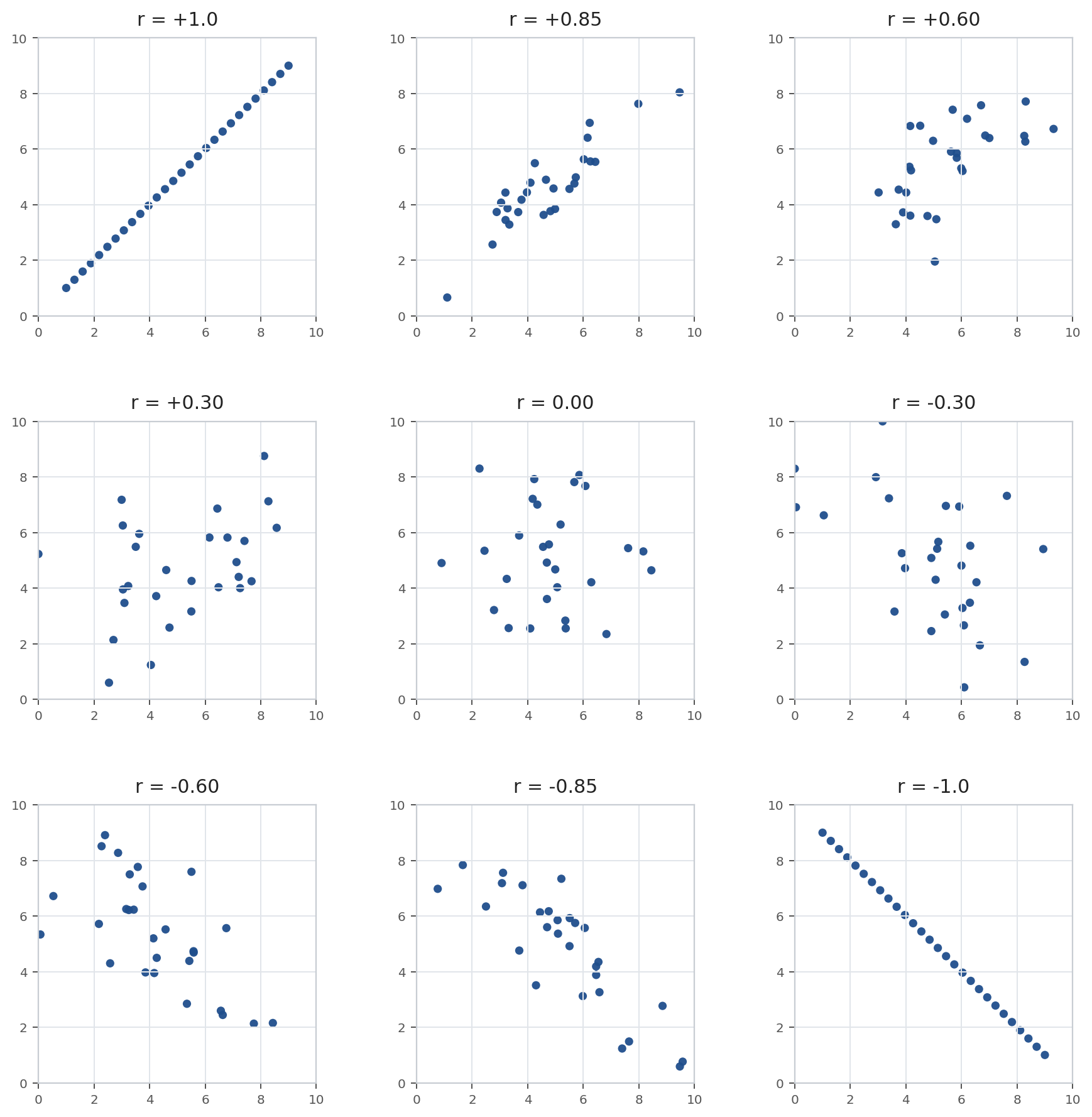
Estimating r from a Scatter Plot
When you look at a scatter plot and want to estimate , follow this three-step routine:
- Check for linearity. Is the trend roughly a straight line? If the points form a curve (like a "U" shape), will be close to regardless of how "tight" the curve is.
- Determine the sign. If the trend is linear, does it slope upward (positive) or downward (negative)?
- Judge the tightness. Imagine an oval around the points. A slim oval suggests a high magnitude (), while a wide, blobby cloud suggests a low magnitude ().
Spotting a Mismatch
Estimating also serves a protective purpose: it lets us catch values that do not match the data. A mismatch is a red flag. Watch for:
- Wrong sign: Plot slopes up, but is reported as negative.
- Magnitude too high: Plot is a wide cloud or a distinct curve, but is reported as 0.95.
- Magnitude too low: Plot is a tight line, but is reported as 0.15.
