Reading Ordered Pairs
Introduction
Now that the grid is in place, the next question is how to give a point a clear address. In the second lesson of The Coordinate Plane, you’ll read ordered pairs as horizontal position first and vertical position second—and see why switching unequal values identifies a different point.
Read and Locate an Ordered Pair
Consider a seating chart: a seat is identified by a column and a row. One number alone could match several seats, but together the column and row identify one location. A coordinate plane works similarly: each point needs a horizontal position and a vertical position. The x-axis and y-axis introduced in the first lesson provide references for those two measurements.
A coordinate is a number that tells you a position. On a coordinate plane, we use two coordinates to describe a point: one for its horizontal position and one for its vertical position.
An ordered pair records these values in a fixed sequence: . The first number is the x-coordinate, or horizontal position; the second is the y-coordinate, or vertical position. For , the first value is and the second is . The order is part of the meaning, not just a writing preference.
Once you know each value’s role, use the axes to locate the point. For :
- Find on the horizontal axis.
- From , move vertically until you reach the horizontal level . This location is .
Keep the Coordinates in Order
Now compare a pair with its reversal: and .
| Point | Ordered pair | Horizontal position, | Vertical position, |
|---|---|---|---|
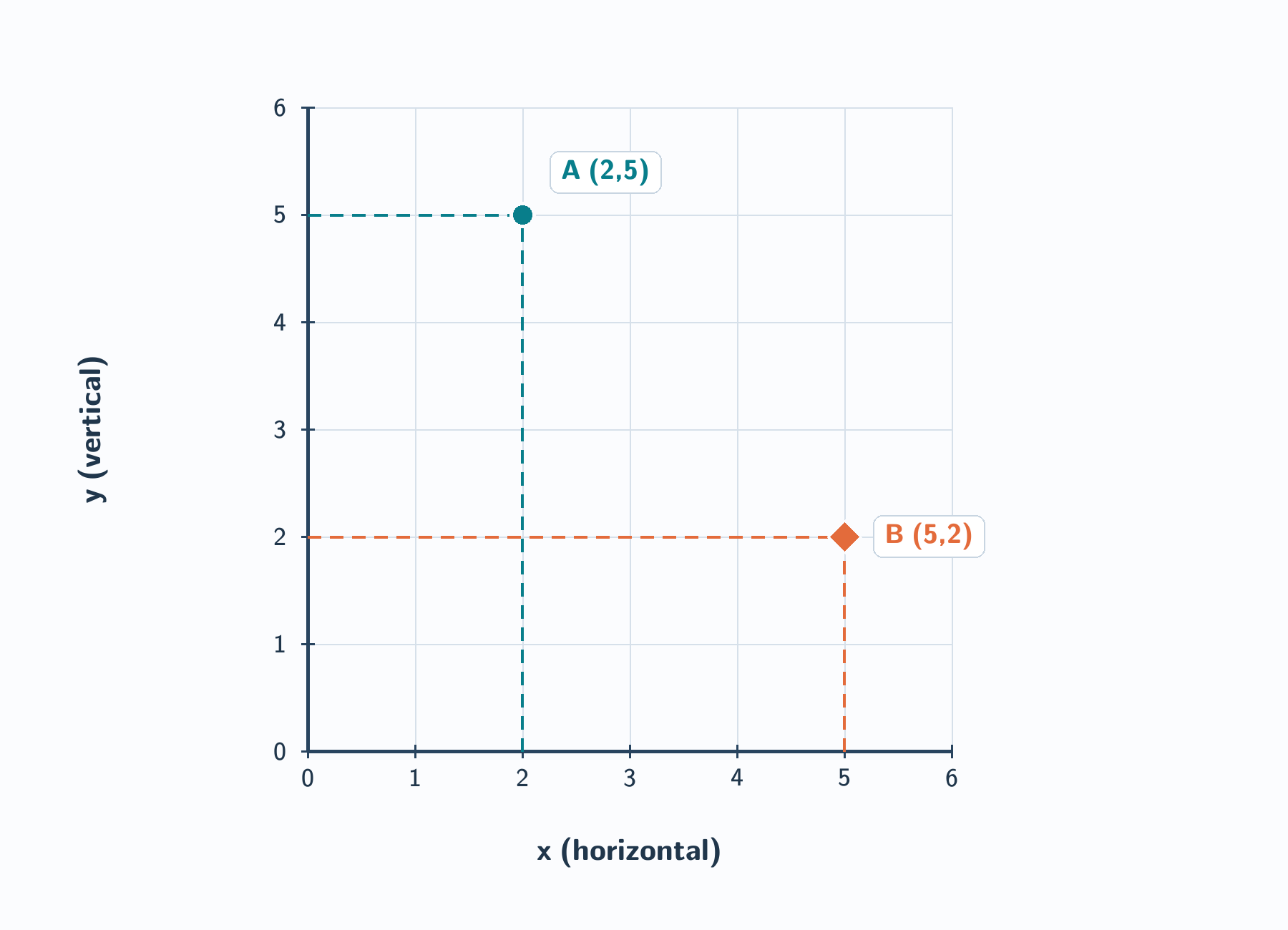
Because , and are at different grid intersections. More generally, and name different locations whenever ; if , as in , swapping the values leaves the pair unchanged.
You can also use the same convention in reverse: turn a verbal description into a pair. If is at horizontal position and vertical position , write ; the horizontal clue gives , and the vertical clue gives . Before writing, label each clue as horizontal or vertical to help keep the values in order.
Conclusion and Next Steps
An ordered pair is a point’s two-part address: the first value gives the horizontal -coordinate, and the second gives the vertical -coordinate. If the coordinates are unequal, swapping them names a different location; if they are equal, the pair stays the same.
In the practice ahead, you’ll match ordered pairs and position descriptions to points, identify and directly, and work through a seating-chart mix-up. Keep asking which value is horizontal and which is vertical to help preserve the correct order.
