Reading Coordinate Directions
Introduction
A street map is easier to use when you know which way is east, west, north, and south from a familiar starting point. In the third lesson of The Coordinate Plane, you’ll use the origin as that reference point to interpret positive, negative, and zero coordinates. You already know that an ordered pair lists before ; now you’ll use each coordinate to read a direction.
Use the Origin as a Reference Point
Imagine a street map centered on a plaza at the origin: right is east, left is west, up is north, and down is south. On the coordinate plane, right and up are positive directions, while left and down are negative. A coordinate’s sign tells the direction from the origin; its distance from zero tells how far along that axis the point is.
Read the Coordinates as Directions
The first coordinate, , tracks horizontal position. A positive -coordinate places the point to the right of the origin, while a negative one places it to the left:
For , the negative -coordinate places left of the origin, even though its positive -coordinate places it above. Focus on alone when deciding left or right.
The second coordinate, , tracks vertical position. A positive -coordinate places the point above the origin, while a negative one places it below:
For , puts below the origin, regardless of its positive -coordinate. Keep the two decisions separate: answers left or right, while answers up or down.
Combine the Two Signs
Now combine the directions in order: use the sign of for horizontal position and the sign of for vertical position. In the table, means positive and means negative.
| Sign pair | Horizontal direction | Vertical direction | Position |
|---|---|---|---|
| Right | Up | Upper right | |
| Left | Up | Upper left | |
| Left | Down | Lower left | |
| Right | Down | Lower right |
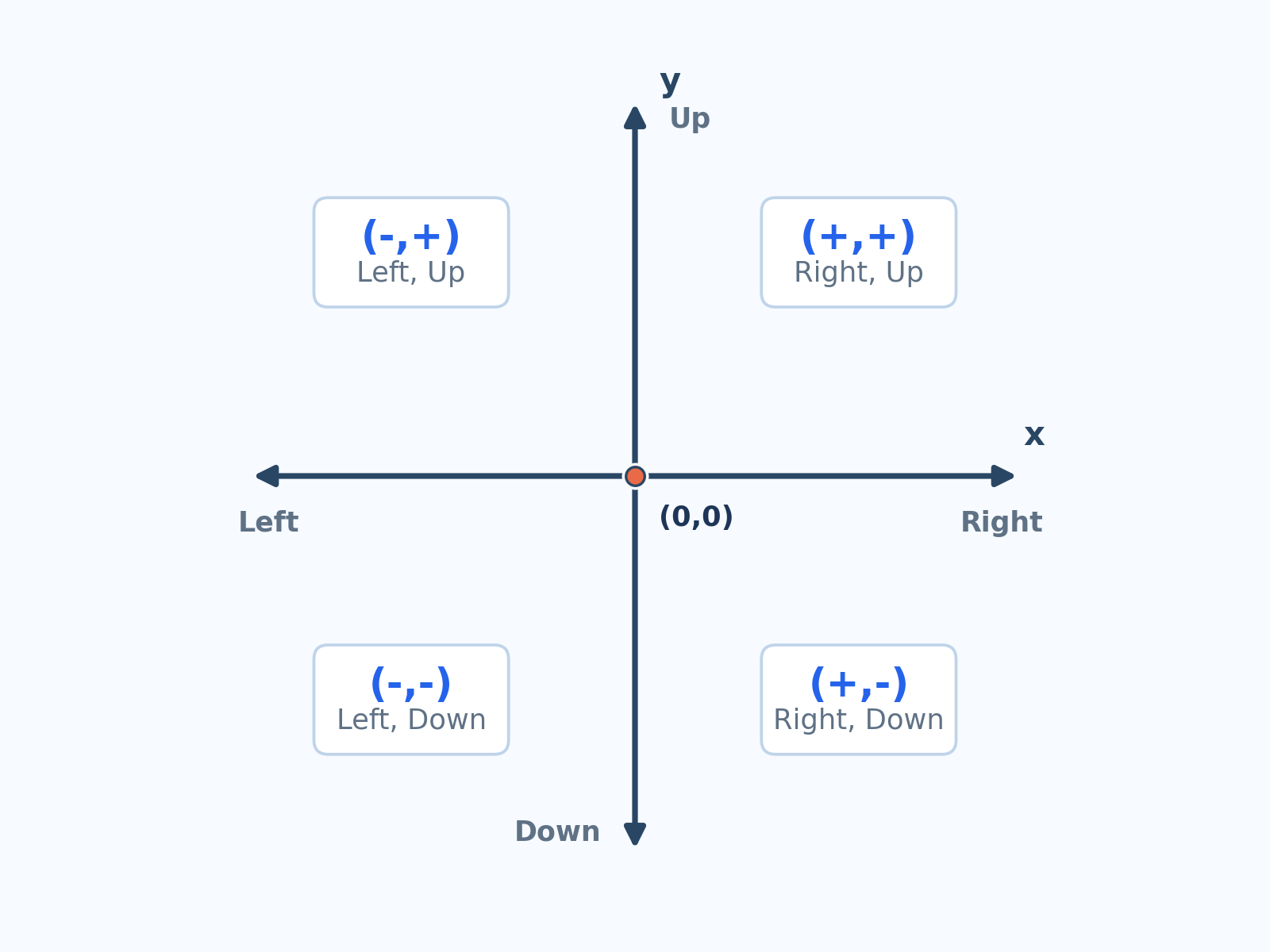
For , the sign pair is , so the point is left of and above the origin. Each sign gives information about its own coordinate.
Handle Zero Coordinates and Read Locations
The table covers cases where both coordinates are positive or negative. Zero is neither positive nor negative: if , there is no horizontal displacement from the origin, so the point is on the -axis; if , there is no vertical displacement, so the point is on the -axis.
Thus, is on the -axis, to the right of the origin, while is on the -axis, below the origin. If both coordinates are zero, is at the origin.
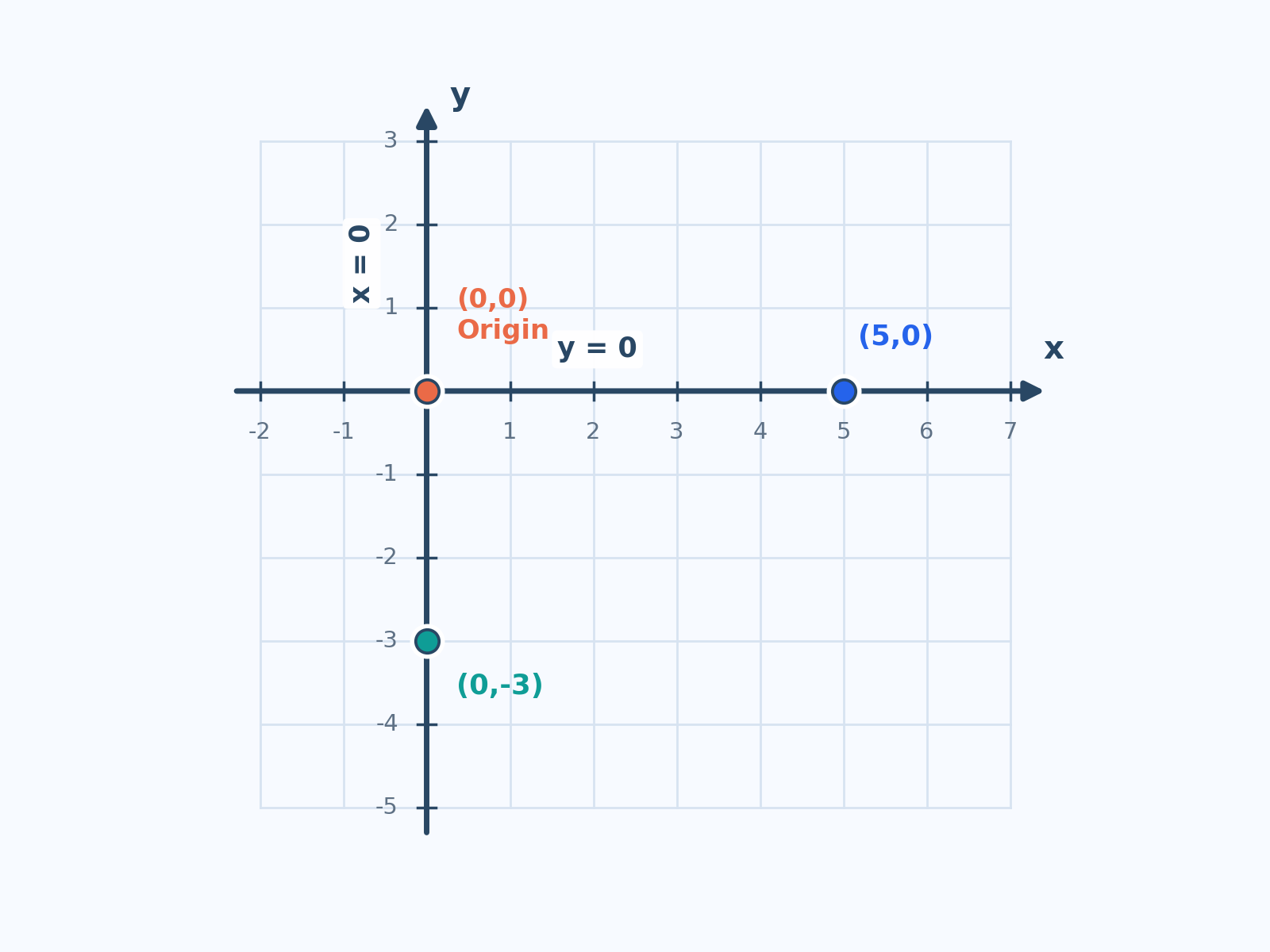
Read a sign pair in order: the first sign tells you left or right, and the second tells you up or down. For , look right and down; for , the point is on the -axis below the origin. A sign pair gives a direction, not an exact distance, so compare it with the labeled points on a grid or map to find a match.
Conclusion and Next Steps
The sign of tells whether a point is right or left of the origin, while the sign of tells whether it is above or below. If , the point is on the -axis; if , it is on the -axis, and if both are zero, it is at the origin.
In the practice ahead, you’ll read signs from plotted points, select locations from sign pairs, and connect each sign with its direction. You’ll also use this reasoning on a plaza-centered map, including a case with a zero coordinate.
