Coordinate Plane Foundations
Introduction
This is the first lesson in our course, The Coordinate Plane. We’ll start with the plane’s basic structure: two number lines and the point they share. By the end, you’ll be able to identify the origin, distinguish the horizontal x-axis from the vertical y-axis, and explain how the lines help organize a grid.
A coordinate plane is a flat, two-dimensional surface where two perpendicular number lines let us describe exact positions. We use it to locate points on maps and diagrams and to show relationships between numbers on graphs.
The Origin and Axes
On a warehouse floor plan, directions across the aisles and from front to back help distinguish one shelf location from another. A coordinate plane uses the same idea: two number lines—straight lines marked with numbers—provide horizontal and vertical references.
The point where these two number lines cross is the origin. Each line has its mark at this same point, making it their shared zero. The origin is a single point—not an entire line or a grid cell.
The horizontal number line is the x-axis, and the vertical number line is the y-axis. Both pass through the origin and continue in both directions. They are perpendicular, meaning they meet at a right angle of .
How the Axes Form a Grid
The perpendicular axes provide the plane’s main horizontal and vertical references. Many coordinate-plane drawings add lighter horizontal and vertical grid lines that run parallel to the axes. Grid lines are optional guide lines added to make coordinates easier to read; they are not part of the axes themselves. Together with the axes, they form rows, columns, and intersections that help organize positions.
Only the crossing of the two main axes is the origin. Other grid intersections are useful landmarks, but they are not extra origins.
In the diagram below, notice the horizontal x-axis, the vertical y-axis, and their shared zero at the origin. The lighter lines are grid lines.
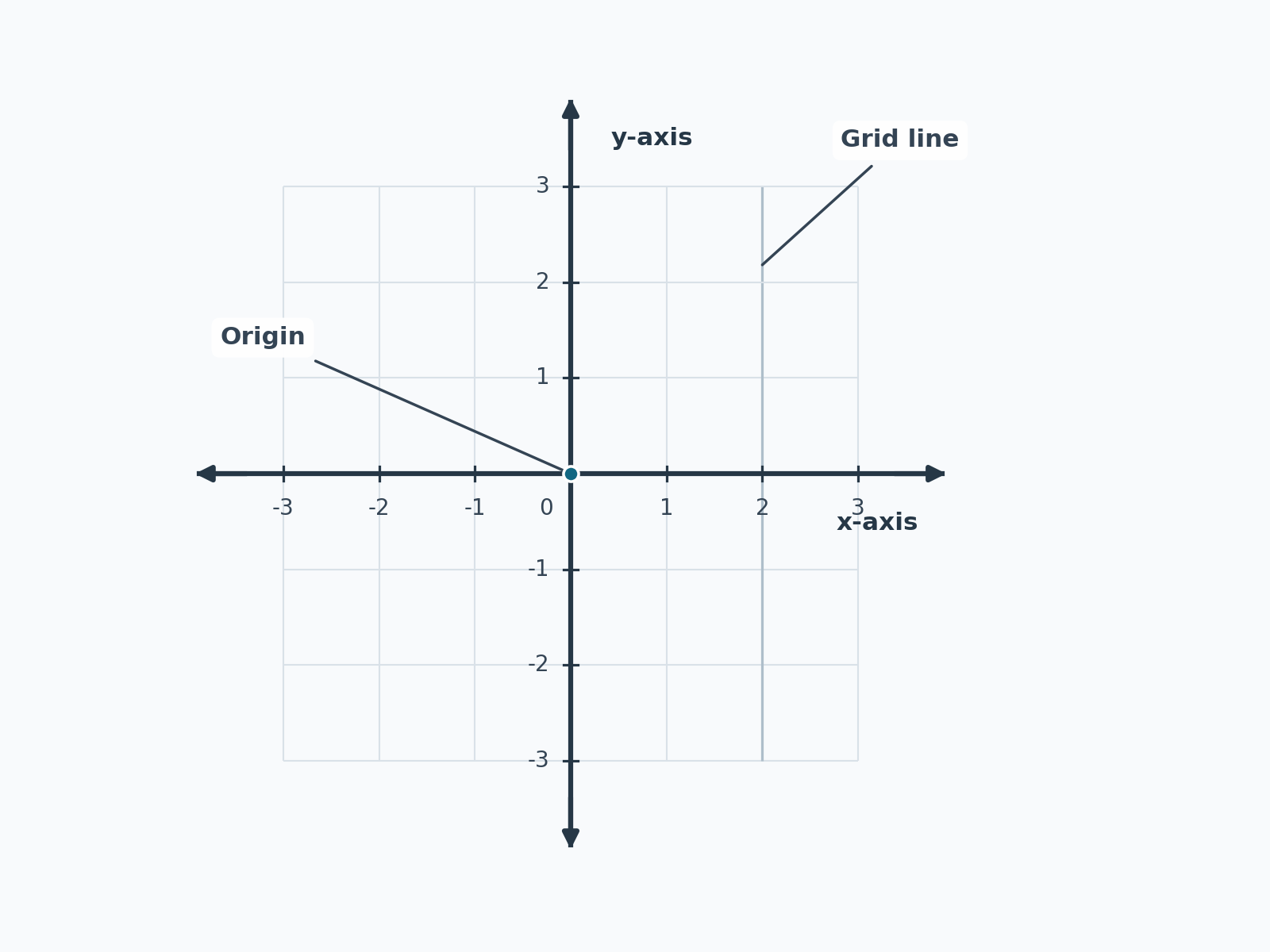
| Feature | How to recognize it |
|---|---|
| Origin | The one point where the x-axis and y-axis cross; both zero marks meet |
| x-axis | The horizontal number line |
| y-axis | The vertical number line |
| Grid line | An additional horizontal or vertical guide line |
Conclusion and Next Steps
The coordinate plane begins with two perpendicular number lines: the horizontal x-axis and vertical y-axis. Their shared zero is the origin, and optional grid lines make positions easier to read.
In the practice that follows, you’ll identify the origin, axes, and grid lines on a diagram. You’ll also match each axis to its direction and explain how the crossing lines organize positions.
