Aligning Objectives and Budgets
Aligning Campaign Objectives and Budgets
You've settled who to reach. The question now shifts to what you're asking them to do and how you'll pay for it. This unit turns a business goal into something a platform can actually execute: classify the objective, map it to the right campaign type and optimization, then fund it with a budget and bid that fit. The order matters more than any single setting.
Start by Classifying the Objective
When a stakeholder hands you a goal, resist the urge to jump to budget. First sort it into one of three buckets from the Campaign Objective Categories: awareness (reach and visibility), consideration (interest and engagement), or conversion (a specific desired action). "Get our name in front of more people" is awareness. "Get them watching our demo or reading the page" is consideration. "Get them to buy or sign up" is conversion. This one classification governs every setting downstream, which makes it the highest-leverage move you make.
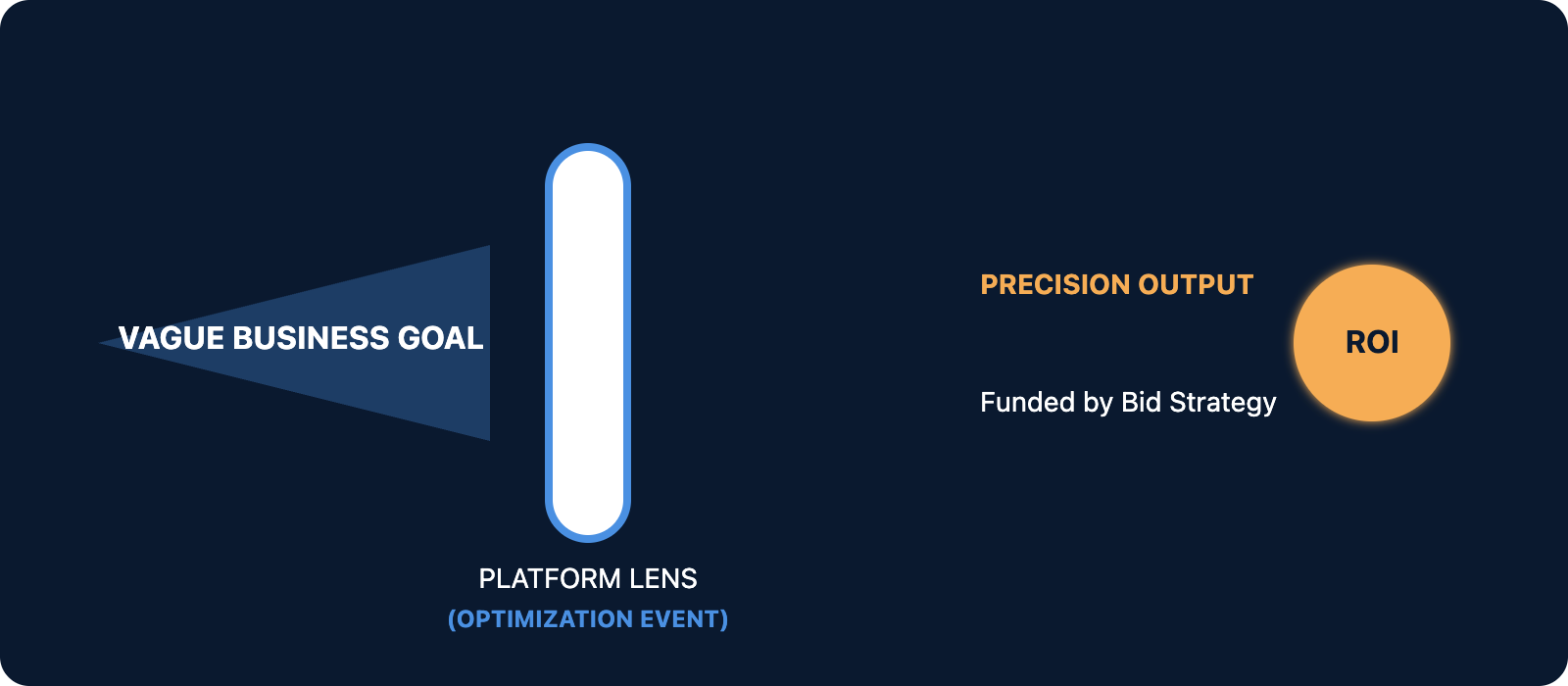
The catch is that goals arrive vague. "More sales" sounds like conversion, but you can't build on it until you know the exact action behind it. Push for the specific event: a free-trial signup, a completed purchase, a booked demo. The category tells you the campaign's shape; the specific action tells the platform what to chase.
Map the Objective to Campaign Type and Optimization
Once the category is clear, translate it into the platform's own language. Each platform offers campaign types that mirror the three categories: reach or brand-awareness for awareness, traffic or engagement or video-views for consideration, and conversion or sales for the bottom of the funnel. Picking the matching type is what points the algorithm at the outcome you care about.
Then set the optimization event, the single most consequential setting inside the campaign. This is where you tell the platform exactly which action to optimize delivery toward. A conversion campaign optimized for "add to cart" behaves very differently from one optimized for "purchase," even with identical targeting and budget.
- Jake: I just want more sales. Can we get this live today?
- Nova: Happy to. One question first: when you say sales, do you mean free-trial signups or paid subscriptions?
- Jake: Paid subscriptions. That's the number I report on.
- Nova: Then it's a conversion campaign optimized for the purchase event, not clicks or signups. Pin that down now and every dollar chases paying customers, not just traffic.
- Jake: So the specific goal actually gets me more of what I want.
- Nova: Exactly. Vague in, wasted spend out.
Notice Nova won't touch budget until the objective and optimization event are locked.
Fund It with the Right Budget and Bid
Only now does money enter. The Budget Controls give you two levers. First, choose between a daily budget, which caps per-day spend and paces evenly, and a lifetime budget, which spends across a set period and lets the platform push harder on high-opportunity days. Daily suits always-on campaigns where you want steady, predictable pacing; lifetime suits fixed flights tied to a launch, sale, or event window.
Second, align your bid strategy to the objective, usually anchored to a target CPA (the cost per acquisition you're willing to pay). The discipline here is realism. Set the target CPA far below what the campaign can actually deliver and you starve it: the platform can't find conversions at that price, volume dries up, and the learning phase stalls. Set it against evidenced performance and you get efficiency and volume together. Match the budget type to the campaign's shape, and the target CPA to what the funnel can genuinely support.
The throughline is sequence: classify the objective, map it to a campaign type and optimization event, then fund it with a budget and bid that fit. Three steps put this to work next: a quick sort to lock the awareness/consideration/conversion pattern, a live conversation where you'll pin a stakeholder's vague "more sales" down to a specific mapping, and an assessment of whether a lifetime budget and a strict target CPA will actually pace and perform. The habit to carry in: never let money enter the conversation until the objective and optimization event are settled.
