Crafting Creative Strategy
Crafting the Creative Strategy
You've settled who to reach and how you'll fund it. Now comes the part the audience actually sees: the creative. Great targeting can't rescue a weak ad, and a sharp ad wastes money if it points at the wrong action. This unit turns your objective and audience into a message that earns attention and a call-to-action that converts.
Run Every Ad Through Four Best-Practice Checks
Before you approve any creative, check that its four parts pull in the same direction: the message, the visuals, the ad copy, and the call-to-action. Each has a job, and a break in any one leaks performance.
The message carries a single clear idea, and that idea should be a benefit, not a feature. Customers don't buy "cold-press extraction"; they buy "brighter skin in two weeks." The visuals exist to stop the scroll: on-brand, native to the format, and readable in a fraction of a second. The ad copy is tight and scannable, leading with the payoff and trimming anything that doesn't earn its place. And the call-to-action names one action with a strong verb, so the viewer never has to wonder what to do next.
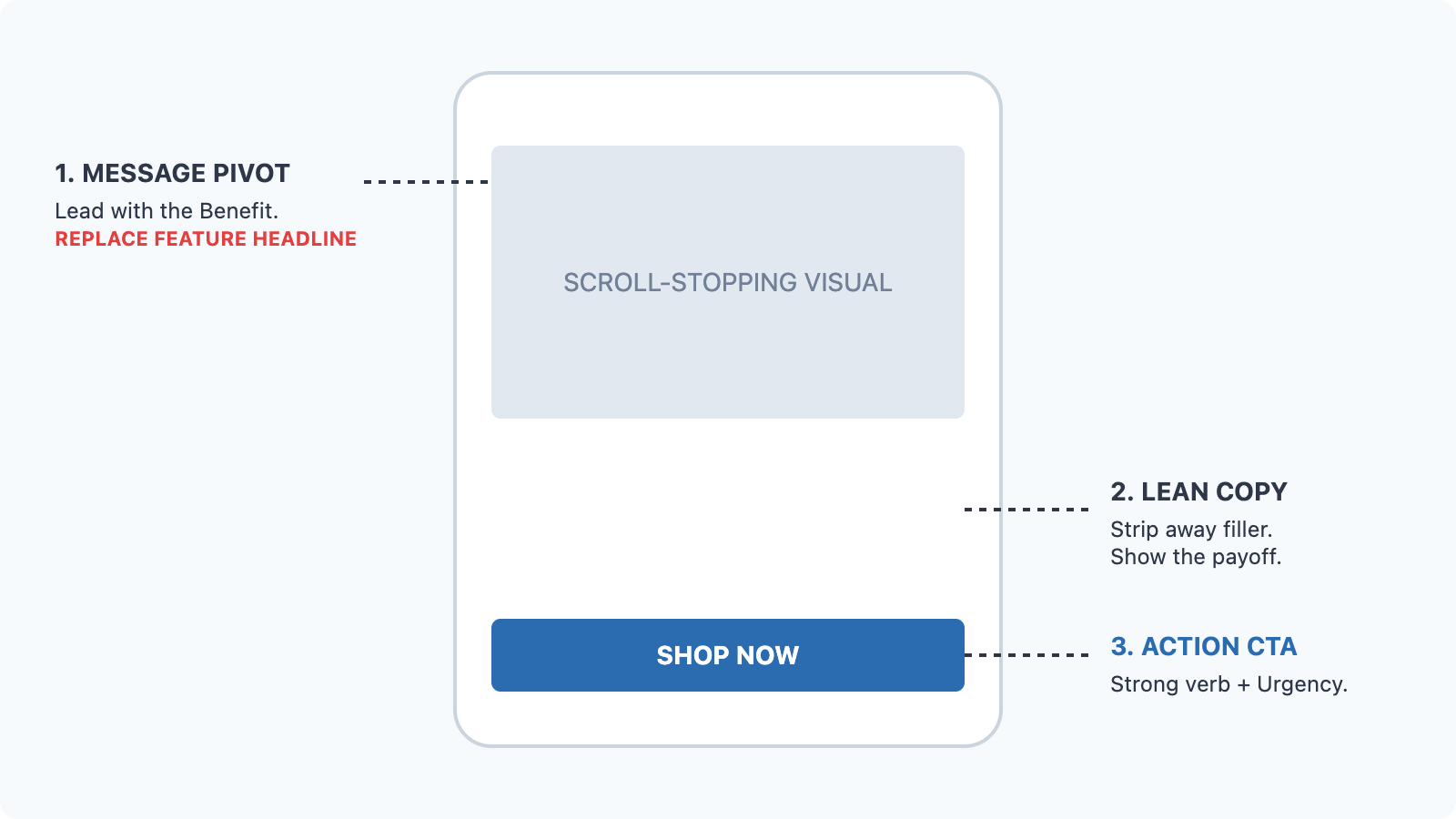
The practical habit here is simple: when a draft lands on your desk, don't react to whether you "like" it. Ask, in order, whether the message is a benefit, the visual stops the scroll, the copy is lean, and the CTA is a single clear action. If any answer is no, you know exactly what to fix.
Write Copy That Sells and a CTA That Moves
Most of your creative reviews will hinge on two moves: turning features into benefits, and turning passive buttons into action. Copy that lists what a product is underperforms copy that promises what the customer gets. So your first edit is almost always the same: find the benefit buried under the feature and lead with it. Then cut filler, swap weak verbs for strong ones, and match the urgency in the words to the reality of the offer. A flash sale deserves "ends midnight"; an always-on campaign does not.
- Dan: Draft copy's ready: "We use advanced cold-press extraction in our serum."
- Nova: That's a feature. What does the customer actually get?
- Dan: Brighter skin in about two weeks.
- Nova: Then lead with that: "Visibly brighter skin in two weeks." Let the tech support the claim, not headline it.
- Dan: And the button still says "Learn more."
- Nova: For a flash sale, make it act: "Shop the sale, ends midnight." Verb plus urgency.
Notice Nova doesn't rewrite the whole ad. She makes two surgical moves: benefit to the front, and a CTA that acts instead of sits. The CTA also has to fit the audience's mindset and the format's limits, so a tight headline built for a character cap reads differently from a spoken line in a video, even when the offer is identical.
Adapt One Message Across Platforms and Objectives
Your core message stays constant; its execution flexes to fit each platform and objective. This is where managers slip: they either run one identical asset everywhere, or they invent a brand-new message per channel and lose coherence. The discipline is to hold the idea steady and adapt the delivery.
On Instagram Reels, the format is visual-first and built for motion and sound, so you need a thumb-stopping hook in the first second and copy trimmed to almost nothing. On Google Search, the same message becomes text-driven and intent-matched, compressed into a tight headline and description that answer what someone actively typed. The objective shifts the CTA too: an awareness push might invite "Watch," while a conversion push demands "Buy now." Same promise, different clothes.
The single takeaway of this unit: a strong creative is a benefit-led message wrapped in a scroll-stopping visual and closed by a CTA that names one clear action, adapted (not rewritten) for each platform and objective. Next you'll spot the strongest message, visual, and CTA in a quick pattern-check, then draft and revise live copy under real deadline pressure, and finally package your direction into a brief a design team can execute. Start practicing the move now: on the next ad you review, find the benefit and sharpen the verb before you touch anything else.
