Selecting Audience Targeting Methods
Welcome to the Course
Every campaign you launch lives or dies on one decision made before a single dollar is spent: who sees it. Targeting is where your strategy meets the media buy, and getting it right is the difference between spend that compounds and spend that evaporates. This course takes you from choosing an audience all the way to defending your results.
By the end of this course, you'll be able to:
- Select the right targeting method for any audience and campaign goal
- Align campaign objectives with the budgets and bid strategies that fund them
- Match business goals to platform-specific campaign types and optimization settings
- Craft ad copy, visuals, and calls-to-action that perform across platforms
- Build privacy-first audiences that reduce reliance on third-party cookies
This first unit starts at the foundation: choosing who to target and how to define that audience precisely enough to protect your budget.
Knowing Your Five Targeting Methods
Before you set a single parameter, you need a mental menu of your options. The Digital Targeting Method Set gives you five, each defined by the data it draws on. Demographic targeting uses who people are: age, gender, income, education, and occupation. Geographic targeting uses where they are, scaling from an entire country down to a hyperlocal radius, geo-fencing around a specific location, or location extensions on an ad. Behavioral targeting uses what people do: their online activity, purchase history, site visits, and app usage. Interest-based targeting uses what people care about, drawn from the preference data platforms build from engagement. Finally, lookalike (or similar) targeting uses your existing customer data as a seed to find new people who resemble them.
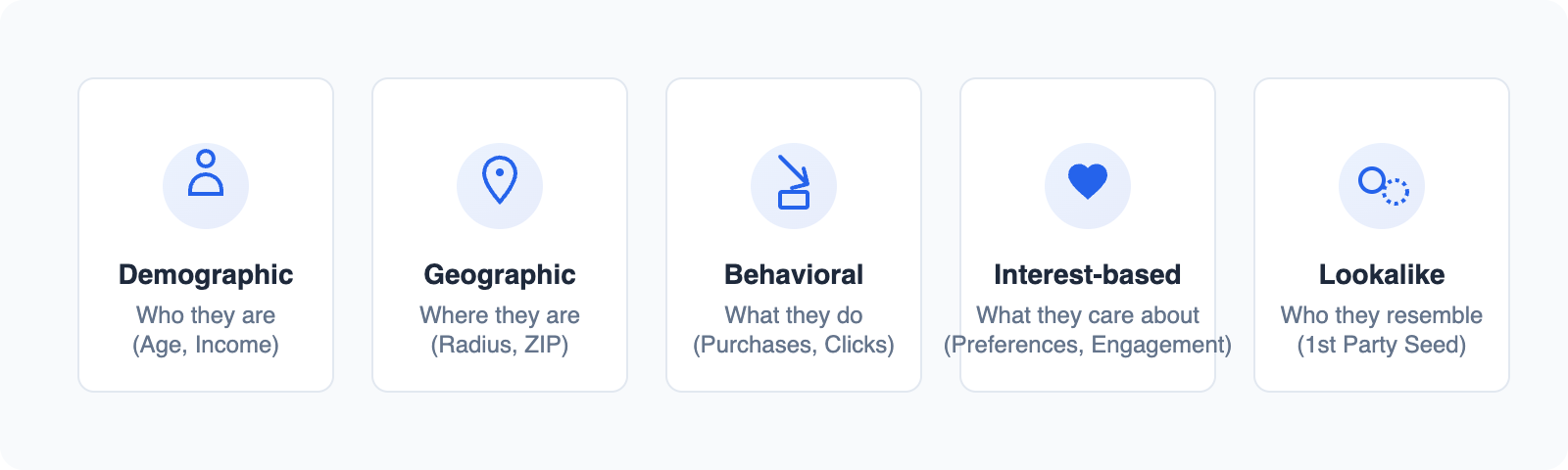 In practice, you rarely pick just one. A strong setup starts with a base layer (usually demographic and geographic) and then sharpens it with behavioral or interest signals. The skill is matching the method to what you actually know about the buyer. If intent is what matters, behavioral wins; if you're launching into a new market with no data, demographic and geographic give you a defensible starting point.
Applying Demographic and Geographic Targeting Without the Traps
Demographic and geographic are your workhorses, and they're also where the two most common mistakes live: lazy stereotyping and overbroad reach. Stereotyping happens when you swap real audience data for assumptions ("older buyers won't be online," "young parents only care about price"). Overbroad reach happens when you set parameters so wide that most impressions land on people who will never convert, quietly draining your budget.
The fix is precision with a reason behind every parameter. Set age and income bands around who actually converts, not who you imagine the customer to be. Tighten geography to a radius around your real service or feeder areas rather than defaulting to nationwide. And whenever you widen a setting, ask what it costs you in wasted spend.
- Dan: Client says target everyone 55 and up, nationwide. Easy, right?
- Nova: That's the trap. "Everyone 55 and up" burns budget on people nowhere near the offer.
- Dan: So tighten it?
- Nova: Tighten geography to a radius around the locations, hold the age band to who actually converts, and skip the cliché interests. Precise beats broad.
Notice that Nova never argues from assumption. She defends each parameter by what it excludes and why, which is exactly the discipline that keeps spend efficient.
Building Lookalikes from Your First-Party Data
Once your base targeting is tight, lookalike audiences are how you scale without losing that precision. A lookalike audience takes a seed (your first-party data, such as existing customers, inquiries, or high-value site visitors) and finds new people who share the same patterns. The quality of the output depends entirely on the quality of the seed: a list of proven buyers produces a far sharper lookalike than a broad list of anyone who ever visited.
The move that separates a decent lookalike from a great one is layering. Start with a strong first-party seed, then layer behavioral signals (site visits, content engagement, past purchases) and interest signals to refine fit. This keeps you reaching new people while filtering out the loosely-relevant reach that lookalikes can otherwise pull in. Done well, you expand volume and hold onto relevance at the same time.
The core takeaway of this unit: targeting is a deliberate stack of methods, base layer first, refined by data, never by assumption. Next, you'll run a quick matching exercise to lock in which method pairs with which data source and use case, the fast pattern recognition you'll lean on every time you scope an audience. As you work through it, try defending each match the way Nova did: name the signal, not the stereotype.
