Managing Mind Wandering
Working With a Wandering Mind
In the last unit, you learned to name which team is on the field: the prefrontal cortex when you're pushing forward, the default mode network when your thoughts have quietly drifted. Naming it is step one. This unit is about the move that comes next, built for the exact moments when your mind wanders on a task you'd rather not be doing. Because that is precisely when the rebel employee gets loudest, and knowing what to do about it changes everything.
Spotting the Interruptions That Come From Inside
Here's the pattern to watch for. You sit down to a repetitive report or a grinding stretch of a spreadsheet, and within a few minutes your brain quietly offers you something better: what's for lunch, that reply you never sent, a trip you're planning. No phone buzzed. Nobody walked by. These are internal interruptions, distractions your own brain generates from the inside.
The trigger is the task itself. When work is boring or genuinely difficult, your attention isn't getting much reward for staying put, so the default mode network fills the gap with something more interesting. That's why the driest hour of a spreadsheet is the exact hour your mind starts planning dinner. The rule of thumb: the duller or harder the task, the more thoughts your brain will serve up to pull you away. When you feel it happening, don't read it as weak discipline. Read it as a predictable signal that the task got boring, which is useful information, not a character flaw.
Catch It, Don't Fight It
So a wandering thought surfaces. What's the instinct? For most people, it's to shove it down and force focus back. That instinct backfires, and there's a simple demonstration of why.
- Dan: I'm an hour into this reconciliation and my brain keeps jumping to the trip I'm planning. I keep shoving it down and it just comes back louder.
- Victoria: That's the trap. Right now, try not to think about a pink elephant.
- Dan: ...and now it's all I can picture.
- Victoria: Exactly. Pushing a thought away makes it stronger. So don't wrestle it. Just note it: "that's a trip thought," and let it be there.
- Dan: And then what, ignore it?
- Victoria: Not ignore. Name it, then gently bring your eyes back to the row you were on. No fighting, no guilt.
Notice what Victoria does. She doesn't tell Dan to try harder or clear his mind. She names the mechanism, the pink elephant effect: the more you try not to think about something, the louder it gets. So the move is the opposite of suppression. You catch the thought, quietly label it ("that's a trip thought," "that's a lunch thought"), and let it exist without wrestling it away. Acknowledging a thought takes the charge out of it; fighting a thought feeds it.
When you're coaching a colleague through this, keep the language plain. Someone who's been gritting their teeth to stay focused doesn't need meditation talk. They need to hear that the wandering is normal biology, that fighting it makes it worse, and that a two-second acknowledgment is all it takes.
The Gentle Return
Acknowledging the thought is only half the move. Once you've named it, you redirect, gently, back to the exact spot you left. Not a dramatic "focus!" and not a self-scolding about lost minutes. Just a soft return: eyes back to the sentence, the number, the line you were on.
The word that matters here is gentle. Every time you snap back with frustration, you add a little stress to the task, which makes the task feel worse, which invites more wandering. A calm redirection breaks that cycle. Picture it as a loop you can run as many times as you need: catch the thought, name it, return to the work. It costs almost nothing, and you'll run it dozens of times an hour without drama.
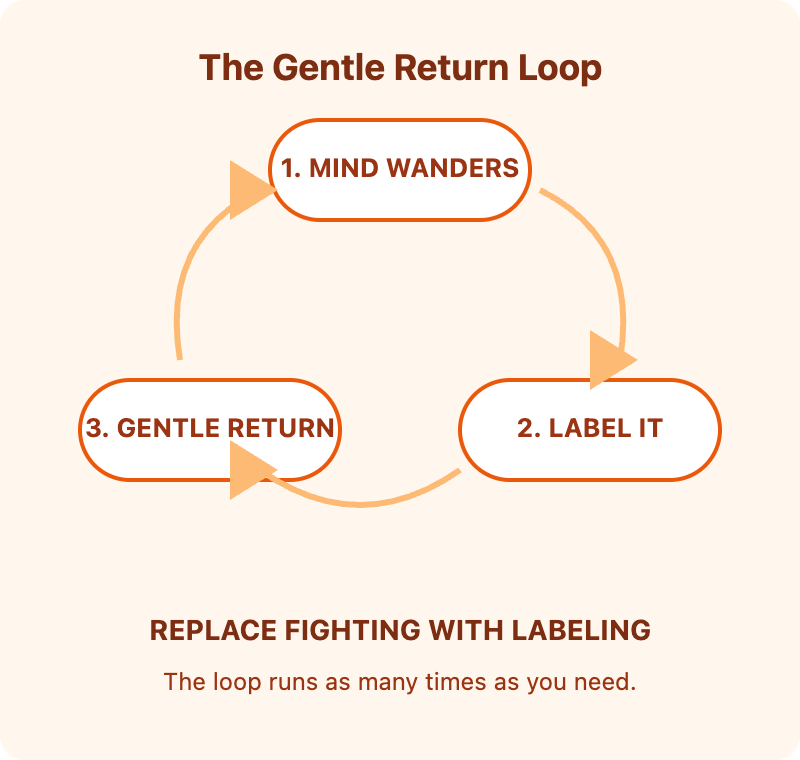 The single idea to carry out of this unit: when a boring task sends your mind wandering, don't suppress the thought, acknowledge it and gently steer back. That one move replaces the exhausting habit of fighting yourself. You'll practice it in three quick steps: first a fast pattern-spotting check to confirm you can pick out the moment a dull task triggers an internal interruption, then a live coaching conversation where you walk a colleague through the pink elephant point as a thought surfaces, and finally a short note they can glance at during their next tedious review. For today, try the loop yourself: next time a dull task pulls your mind away, silently name the thought and ease your attention back, no wrestling.
