Redirecting Novelty Attention
The Pull of Something New
In the last unit, the interruptions came from inside you: a boring task, and your own mind quietly serving up thoughts of lunch or the weekend. This unit flips the direction. Now the interruption comes from around you: a phone that pings, a notification sound, a coworker who walks past your desk. The thought didn't bubble up on its own. Something new appeared, and your attention snapped toward it before you decided anything. That reflex has a name and a reason, and once you understand it, you stop treating it as a personal failing.
Why New Things Hijack Your Attention
Your brain has a built-in habit of noticing anything new. Call it novelty-seeking attention: a reflex that automatically turns your focus toward fresh sights, sounds, and movement. It's ancient. For most of human history, a new sound in the grass or a flicker of movement at the edge of your vision could mean food or danger, so the brains that noticed first survived. You inherited that wiring. It doesn't care that the "new thing" today is a Slack ping instead of a predator.
That's why a single notification is so much harder to ignore than the spreadsheet in front of you. The spreadsheet is familiar and unchanging, so your brain files it as "known, no action needed." The ping is new and unpredictable, so your brain flags it as "might matter, check now." A phone buzz, a message tone, someone crossing the room: each one trips the same reflex. You're not choosing to get distracted. Your attention is being pulled by design, before your conscious mind gets a vote.
Catching the Pull Without Blaming Yourself
Here's where most people go wrong. When their focus snaps to a notification, they read it as proof they have no discipline. That story is both false and harmful, because it stacks a layer of stress on top of the interruption. A better frame comes from thinking of Focus-as-a-Muscle: controlling your attention is a learnable skill, not a talent you're born with or without. And like any muscle, effortful focus tires out. Holding your attention on a demanding task actively tires your prefrontal cortex, the part of your brain doing the concentrating. Switching to something new, by contrast, feels effortless, almost like relief. So when you drift toward the ping, you're not failing. You're doing the easy thing your brain is wired to do.
- Jessica: Every time my phone buzzes I look, and then I hate myself for it. I clearly have no focus.
- Chris: Hold on. When it buzzed just now, did looking take any effort?
- Jessica: No, it was automatic. That's the problem.
- Chris: That's not a flaw, that's biology. Your brain is built to snap toward anything new in case it matters. Staying on the hard task is the part that takes effort.
- Jessica: So the pull isn't me being weak?
- Chris: Right. Name it as the novelty pull, then just walk your eyes back to the line you were on.
Notice what Chris does. He doesn't tell Jessica to try harder. He points out that looking took no effort at all, which is the clue that novelty-seeking is doing the work, not weak willpower. Once she stops blaming herself, the interruption becomes something she can simply handle instead of something she has to feel bad about.
A Reset You Can Run Every Time
Handling the pull well comes down to a small, repeatable move you can run whenever something new yanks you away. It has three beats. First, catch the cue: name what pulled you, whether it was the phone, a sound, or movement nearby. Second, restate the task: remind yourself what you were actually doing before the pull ("I was working through the budget rows"). Third, redirect gently: bring your attention back to that exact spot, without scolding yourself about the seconds you lost.
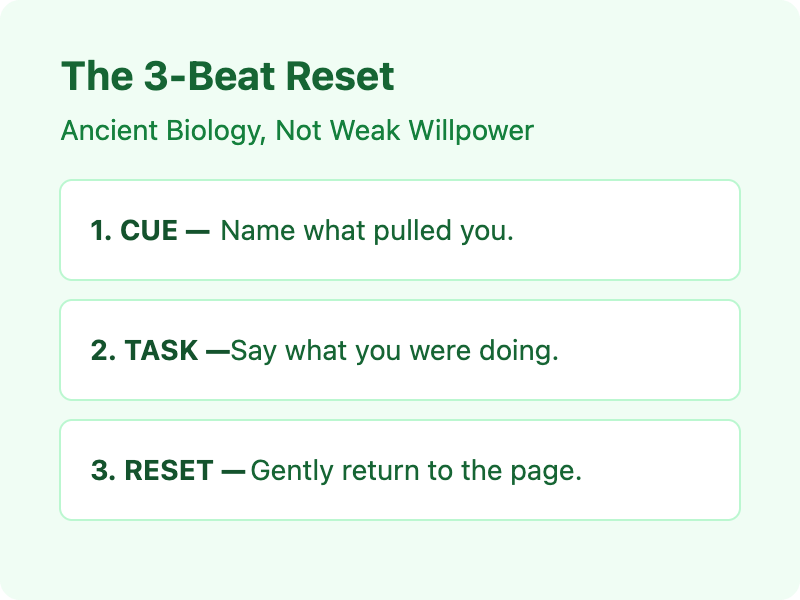
The gentleness matters as much as the steps. Every time you snap back at yourself with frustration, you make the task feel worse, which only invites the next distraction. A calm reset keeps the cost of each interruption tiny. And because this is a skill, not a trait, running the loop over and over is exactly how the muscle gets stronger. You won't stop noticing new things (nobody does), but you'll get faster and cleaner at returning.
The one idea to carry out of this unit: when a notification, sound, or movement grabs you, it's your novelty-seeking reflex doing its ancient job, not evidence of weak willpower, so name the pull and gently reset. Next, you'll run a quick self-check to spot the biological reason a new cue is harder to ignore than a familiar task, then take it live by catching a real novelty pull and reframing it on the spot, before packaging the reset into a reminder a colleague could tape beside their screen. For now, try it yourself: next time your phone pings mid-task, name the pull, restate what you were doing, and ease back.
