Directing Your Focus
Directing Focus with the Prefrontal Cortex
In the last unit, you saw who is competing for your attention from the outside. Now we turn the lens inward, because a big part of why focus slips has nothing to do with apps: it is how your own brain is wired. Once you can name what your brain is doing in the moment, you get a calm, practical way to steer it, and that is exactly what this unit builds.
Meet Your Brain's Two Attention Teams
Here is the most useful thing to know about your own concentration: it is not one thing. Your brain runs two very different systems, and understanding them is the whole game. Think of them as two teams that take turns being on the field.
The first is the prefrontal cortex, sitting right behind your forehead. Call it the "CEO of focus." This is the part that does the deliberate work: focus control, task attention, and mental effort. When you are pushing through a report, weighing two options, or forcing yourself to reread a tricky paragraph until it makes sense, your CEO is at the desk, running the show.
The second is the default mode network, which you can picture as the "rebel employee." The moment your CEO steps away from a task, this system fires up on its own and produces mind-wandering, daydreaming, and random thoughts. Suddenly you are thinking about lunch, replaying a conversation, or planning your weekend, without ever deciding to.
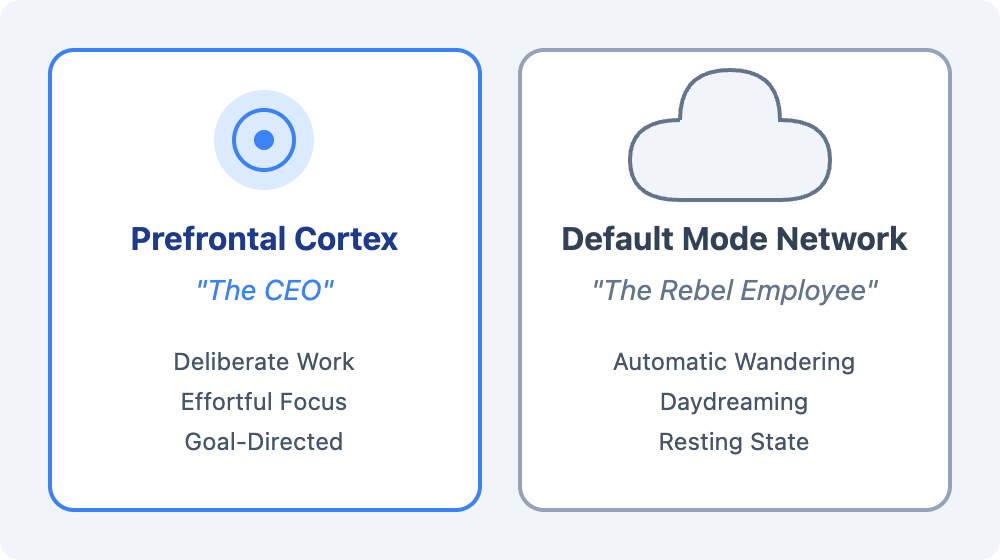
The key move is to stop treating the rebel employee as a defect. These two teams naturally take turns, and the wandering is not a sign of weak willpower. It is standard-issue biology that every brain does.
Spotting Which Network Is Running the Show
Naming which team is on the field is a skill you can practice in real time. The signs are actually easy to read once you know them. If it feels effortful, if you are consciously pushing toward a goal or holding your attention on one thing, that is your prefrontal cortex working. If your thoughts have quietly drifted, if you notice you have reread the same sentence three times or you are somewhere else entirely, the default mode network has taken over.
A simple coaching question makes this diagnosis easy, whether you are doing it for yourself or a colleague: "What did that moment actually feel like?" The felt sense (effortful and directed versus loose and drifting) tells you which network was running.
- Jessica: I sat down to write the report and twenty minutes later I'm planning dinner. What is wrong with me?
- Milo: Nothing. Two different systems were just taking turns. When you were actually drafting, that was your prefrontal cortex, the CEO of focus, doing real work.
- Jessica: And the dinner planning?
- Milo: That's your default mode network, the part that wanders the second the CEO clocks out. It's not a discipline problem, it's just which team was on the field.
- Jessica: So the trick is noticing which one's running?
- Milo: Exactly. Name it, and you can steer it.
Notice how Milo diagnoses without judgment. He does not ask Jessica to try harder; he just helps her see the switch, which is the first step to controlling it.
Reading What Each State Did to Your Progress
Once you can label the switches, you can honestly assess what each state did to your work. This is where the two teams show their different value. Time spent in prefrontal-cortex focus is where the actual output happens: paragraphs get written, problems get solved, decisions get made. Time in the default mode network usually stalls the visible progress, because no one is at the CEO's desk moving the task forward.
That does not make wandering worthless, and this is the part worth holding onto. Those drifting stretches often give your brain a moment of recovery, and sometimes a stray thought surfaces a genuinely useful idea. The goal of assessing a session is never to shame the wandering. It is simply to map where your focused effort pushed the work ahead and where the drift quietly stalled it, so you can plan a smarter block next time.
The single idea to carry out of this unit: your attention is two systems taking turns, and the moment you can name which one is on, you gain the lever to steer it instead of blaming yourself. This is where it gets concrete. First you will run a quick sorting exercise to lock in which functions belong to the CEO and which belong to the rebel employee, then you will put the diagnosis to work in a live conversation and a short written assessment. So the behavior to try today is small: next time your focus slips, quietly ask yourself, "Which team is on the field right now?"
