Valuing Your Attention
Welcome to the Course
If your day is a stream of reports, meetings, and messages, your attention is the one resource that actually gets the work done, and it's under constant attack. This course helps you understand why staying focused feels so hard and gives you plain, practical language for taking your focus back, without blaming yourself for having weak willpower. You'll see that the struggle is largely biology, not a character flaw.
By the end of this course, you'll be able to:
- Identify how the attention economy profits from capturing and extending your focus
- Distinguish your brain's focus network (the prefrontal cortex) from its wandering network (the default mode network)
- Diagnose which attention state is driving a work session in real time
- Catch a wandering thought and gently redirect it instead of forcing it away
- Reframe a novelty pull as normal biology and reset your focus quickly
This first unit starts with the big picture: who is competing for your attention, how they make money from it, and why guarding it matters to the goals you actually care about.
How Companies Profit From Capturing Your Focus
Here's a question worth sitting with: if an app is free, how does the company behind it stay in business? The short answer is that you are not the customer. Your attention is the product being sold.
This is what people mean by the attention economy: a marketplace where your focus is captured, measured, and sold to advertisers who want a moment of it. In this system, a company doesn't profit by making something you buy. It profits by keeping you looking for as long as possible, then charging someone else for the chance to reach you while you look.
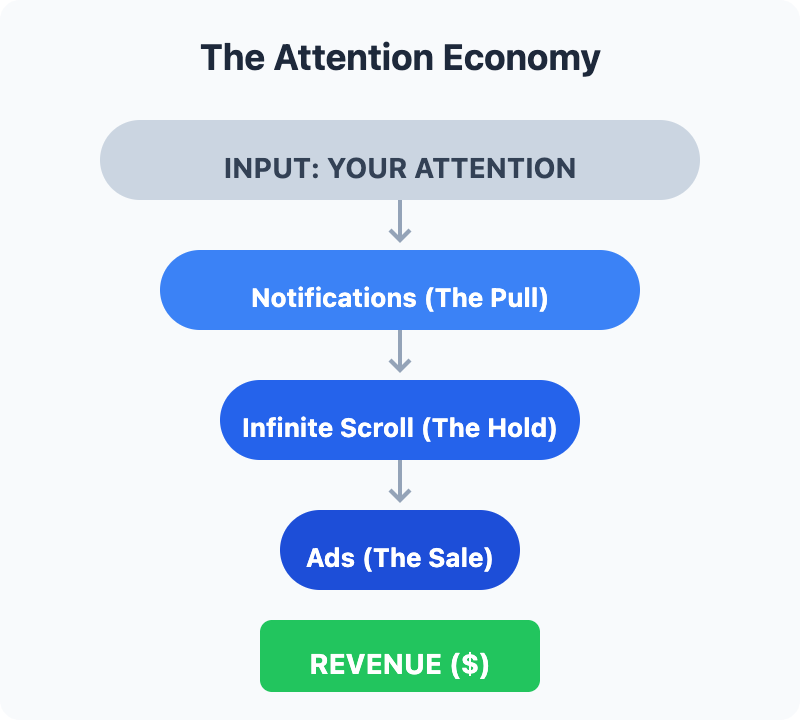
That reframe changes how you read your own workday. When you glance at a feed between two reports, it can feel like nothing, a harmless pause. But the design goal on the other side of the screen is not to give you a rest. It's to capture your focus and then extend it, because more time equals more money. Once you see that the whole system is built to hold you, your distraction stops looking like a personal weakness and starts looking like a predictable outcome.
How Ads, Notifications, and Scrolling Monetize Attention
So how does focus actually turn into revenue? Through three familiar mechanisms you meet every day.
The first is ads. Every ad you scroll past is a slot the platform sold to an advertiser, and it only has value because your eyes are there to see it. The second is notifications. That red badge or buzz exists to pull you back in after you've left, restarting the clock on your attention. The third is scrolling. A feed with no bottom removes any natural stopping point, so a "quick check" quietly stretches into ten minutes. Each mechanism does one job: get your focus, then keep it.
To make this concrete, consider a rough number often cited about large social platforms.
- Chris: These apps are free, so honestly nobody's making money off me.
- Victoria: That's the trick. You're not the customer, you're the product. A big social platform earns around $100 a year per user by selling that user's attention to advertisers.
- Chris: Wait, $100 just from me scrolling?
- Victoria: Every ad you pass, every alert that yanks you back, every extra minute you stay: that's the inventory they're selling.
- Chris: So my "quick break" is literally their revenue.
Notice how the number does the work. Chris doesn't feel scolded; he feels informed. That's the move to aim for when you explain this to someone: connect a habit to a revenue stream, and let the realization land on its own.
Why Protecting Your Attention Matters to Your Goals
Now the part that actually matters to you. If your attention has a dollar value to a company, it has an even bigger value to you, because it's the raw material for everything you're trying to accomplish. That report that needs deep thinking, the relationship you want to be present for, the health routine you keep meaning to start: all of it runs on focused attention. Every block you hand to a feed is a block you didn't spend on what you care about.
This is why the goal here is not guilt. When you talk to yourself or a colleague about focus, the frame that works is support, not scolding. Instead of "stop wasting time," try something like "Protecting this next hour is what gets the report done well and on time." You're naming focus as the tool that serves the goal, which respects the person and points at an outcome they already want.
The single idea to carry out of this unit: your attention is valuable enough that others build businesses on it, so treating it as something worth protecting is simply good sense, not self-denial. Next, you'll do a quick self-check to spot the difference between an ordinary business and one that runs on capturing your focus. As you go, ask yourself one thing about your own favorite app: what is it actually selling, and who is buying?
