Driving Governance Adoption
Driving Adoption and Facilitating Governance Decisions
You've now done the hard analytical work: scored maturity honestly and named the few gaps worth closing first. But here's the uncomfortable question that ends every assessment - so what? A prioritized list doesn't move anyone. The people who actually have to change still have their own reasons not to, and the meeting where decisions are supposed to get made still tends to wander. This unit is about that last mile: getting resistant colleagues to genuinely adopt a change, and turning a roomful of opinions into an owned decision.
Reading Resistance with ADKAR
When someone resists a governance change, the lazy move is to label them "difficult" and push harder. But push harder on what, exactly? Resistance is rarely one thing. The ADKAR Model (from Prosci's change-management work) gives you five distinct reasons a person can be stuck, and the whole point is that each one needs a different response. ADKAR stands for Awareness (they don't yet see why the change is needed), Desire (they see it but don't want to take part), Knowledge (they're willing but don't know how), Ability (they know how in theory but can't pull it off in practice), and Reinforcement (they did it once, but it isn't sticking).
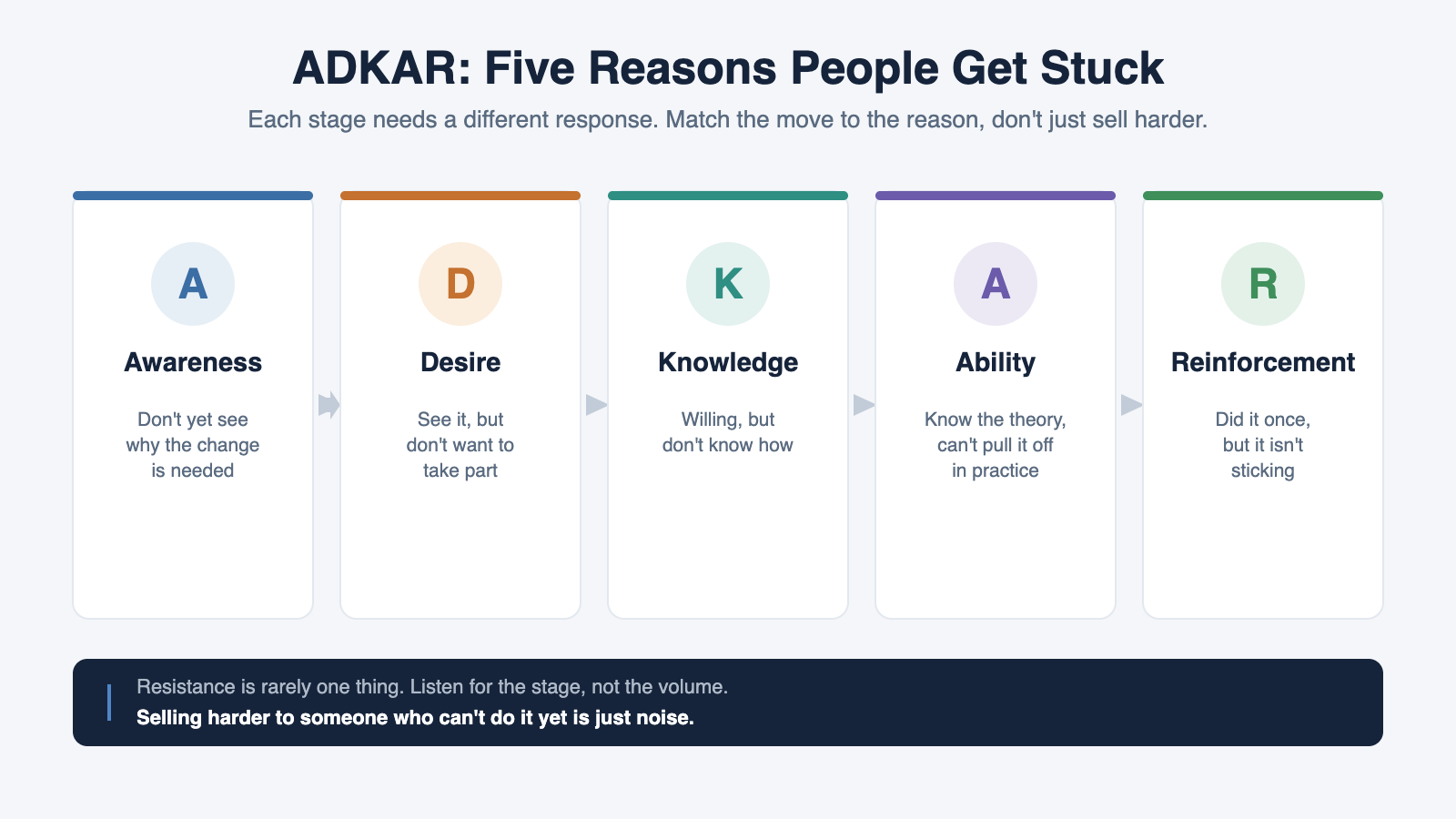
Here's the trap: most people treat every objection as a Desire problem - "they just don't want to" - and respond by selling harder. But selling harder to someone who already wants the change yet doesn't know how is just noise. The skill, at this introductory level, isn't running a full change program. It's listening to what someone actually says and recognizing which stage they're stuck at.
- Dan: I get that we need a single definition here. I'm just not the person to write it - I'd get it wrong.
- Natalie: So it's not whether we should fix it, it's that you don't feel equipped to be the one holding the pen?
- Dan: Right. I don't even know what a good definition looks like.
- Natalie: Then let's not start there. I'll bring a draft and two examples, and you react to them. You're not writing from scratch.
Notice what Natalie didn't do: she didn't re-explain why the change matters. Dan was already past Awareness and Desire. His words ("I'd get it wrong," "I don't know what a good one looks like") point straight at a Knowledge gap. Selling the why would have missed him entirely. Matching the response to the stage is the move.
Facilitating Decisions, Not Discussions
Now zoom out from one person to the whole room. You've called a governance review, and within ten minutes people are relitigating last quarter's argument and no decision is in sight. Why does this keep happening? Because most meetings are organized around topics, not decisions. A topic invites talk; a decision forces a choice.
The fix is structure, and the Governance Review Agenda supplies it. For each open issue you name eight things: the issue itself, its owner, the evidence on the table, the options, the decision needed, who holds the decision right, the next action, and the deadline. That last cluster does the real work. When someone drifts back to old grievances, you can gently ask, "That's useful context, but the decision in front of us is whether to adopt option A or B, and who actually holds that decision right?" Naming the decision needed and the decision right is what converts a discussion into an outcome.
This is also where ADKAR quietly re-enters. A participant who keeps reopening a settled point is often not being obstinate; they're showing an Ability or Reinforcement gap, afraid of committing to a decision that might later be held against them. Reassure them that a decision can be revisited with new evidence and you free them to commit now. Your job as facilitator isn't to win the argument. It's to leave the room with at least one issue resolved into a named owner, a next action, and a date.
Escalating What Won't Resolve
But what about the issue that simply won't resolve, no matter how well you facilitate? Sometimes the right call isn't to keep pushing, it's to escalate. And escalation has a bad reputation precisely because it's so often done badly: a vague "we couldn't agree, please advise" that dumps the problem on a busy leader with no way to act on it.
A clean escalation does the opposite. The Decision Brief packages an unresolved issue so a leader can decide in minutes: the context (why it stalled), the decision required, two or three real options, their impacts and risks, your recommendation, a proposed owner, and a deadline. The pivotal word there is recommendation. A brief that lays out options without a recommended path isn't escalation, it's abdication. Leaders reward the analyst who says "here's what I'd do and why," even when they overrule it, far more than the one who hands up a menu and walks away.
So the throughline of this unit is simple: adoption stalls for specific, diagnosable reasons, and your job is to match the move to the reason. Meet a person where ADKAR says they're stuck, structure a review so a decision is forced rather than discussed, and escalate with a recommendation rather than a shrug. Ahead, you'll first spot which ADKAR stage a stalled stakeholder reveals, then step into a live review where the talk wants to wander and your task is to leave with an owned, dated decision, and finally write the brief for the one issue that wouldn't close. As you go, keep asking yourself the question that separates a facilitator from a note-taker: what decision, exactly, is on the table right now?
