Building 90 Day Roadmaps
Building a 90-Day Governance Roadmap
You've done the slow work of this course: you've learned to spot vanity metrics, measure quality honestly, and rate maturity against evidence rather than optimism. But a prioritized list of improvements still sits there as a list. So here's the question that closes the whole path: if someone handed you 90 days to stand up governance for a domain, what would you actually do first, and how would you prove it was the right call?
Ninety days is a deliberate constraint. It's short enough to force choices and long enough to show something real. This is also where your portfolio finally pays off: the stakeholder map, the RACI, the standards, the catalog and lineage records, the classification and retention decisions you've built along the way become the raw material you sequence into a single, defensible plan.
Sequencing Quick Wins, Foundational Work, and Stakeholder Checkpoints
Start with a tension. Faced with 90 days, most people lunge for the hard foundational work first: clarify every role, define every term, write every standard. It feels responsible. It's also how initiatives quietly die, because three months pass with nothing anyone outside the project can see, and the sponsor stops returning your messages.
The opposite trap is just as real. Chase only quick, visible wins and you build a thin shell with no foundation underneath, so the same arguments come back the moment attention moves on.
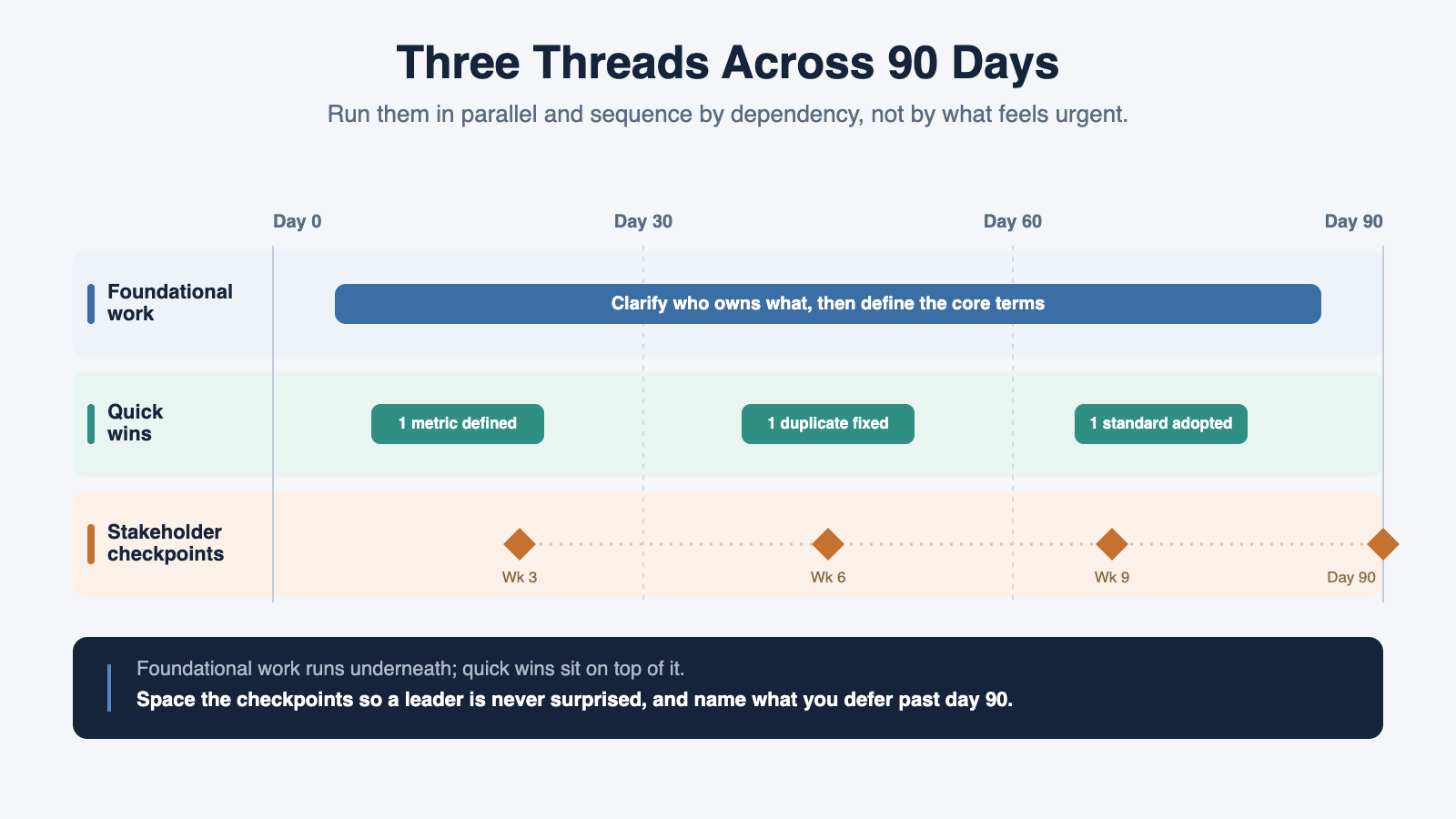
The way out is to run three threads at once rather than choosing between them. Quick wins are small, visible, low-effort fixes that build credibility early: one disputed definition agreed, one duplicate-record loop closed. Foundational work is the slow plumbing that runs underneath, mostly clarifying who owns what and what the core terms mean.
The third thread is the stakeholder checkpoint: the regular touchpoint, every few weeks, that keeps leaders bought in and lets you adjust before something drifts too far.
What decides the order isn't ambition, it's dependency. You can't standardize a definition before someone is accountable for it. You can't measure adoption before there's something to adopt. So foundational work tends to start early but finish late, quick wins sit on top of whatever foundation already exists, and checkpoints are spaced so a leader is never surprised. Sequence by what depends on what, not by what feels urgent.
Designing the Roadmap: Milestones, Owners, Measures, and Decisions
Once the sequence is clear, you shape it into the 90-Day Governance Roadmap. The framework walks through a familiar arc: define the scope and goals, confirm the priority data domains, clarify roles, identify the policy or artifact gaps, select your quick wins, schedule stakeholder checkpoints, define success measures, and name the decisions that will be needed along the way.
The part that separates a plan from a wish list is what hangs off each milestone. Every milestone needs three things: an owner (a named person, not a team), a success measure (how you'll know it's done, not just busy), and any decision required to move forward. A milestone without an owner is a hope. A milestone without a success measure is a guess. And a milestone that hides a decision (whose definition wins, who signs off) will stall the moment it gets there, because nobody saw the choice coming.
This is also where being explicit about what you're not doing matters. A credible 90-day roadmap names what's deferred past day 90 and why, so a reviewer trusts that you chose rather than ran out of room.
Defending Your Priorities and Trade-offs
Here's the part that tests everything else. A roadmap you can't defend isn't a plan, it's a slide. Leaders will push: compress the timeline, add scope, run it all in parallel. Caving to please them buys you a plan that fails publicly in week six. So the skill isn't presenting the roadmap, it's holding the line on the trade-offs that make it real.
- Chris: Why isn't the full glossary done by day 30? Just put more people on it.
- Natalie: Because the glossary depends on knowing who owns each definition, and we don't clarify owners until week three. Defining terms before that just creates definitions nobody will stand behind.
- Chris: So what do I actually get in the first 30 days?
- Natalie: A genuine quick win: one disputed metric defined and agreed, plus named owners for the top domains. Visible progress, and it lets the glossary move fast right after.
- Chris: Fine. But I want the checkpoint dates on the page.
Notice Natalie doesn't compress the timeline to keep the peace. She names the dependency, then offers a concrete early win instead, which is what turns pushback into agreement.
Defending the deferrals matters just as much as defending what's in. When you can say "I deferred X because it depends on Y, which isn't ready," you've shown you understand the system, not just the to-do list.
So the throughline of this final unit is simple: a 90-day roadmap is sequencing under constraint, made concrete with owners and measures, and only as good as your ability to defend its trade-offs out loud. Next you'll order a set of rollout activities into a realistic 90 days, then build a full roadmap you could actually hand to a sponsor, and finally defend it live against a leader who wants everything done by day 30. The question to carry in: when they push you to do it all faster, what's the one dependency you won't pretend away?
