Protecting Habits from Interference
Protecting Habits from Interference
Anticipation, which the previous unit covered, deals with discrete obstacles you can date on a calendar. Interference is different in shape. It is not one event but a sustained period during which the conditions around your habit degrade, and it undermines adherence not by removing the habit outright but by quietly outbidding it for the resources it needs. Understanding those resources is what makes protection possible.
Diagnosing Competing Priorities, Cognitive Load, and Environmental Change
There are three sources of habit interference, and they attack different things. Competing priorities attack the slot: something else now claims the same twenty minutes or the same position in your morning, so the habit is no longer the default use of that space. Cognitive load attacks the attention: an unresolved problem occupies working memory, and even a well-designed habit still requires a small amount of attention to initiate. Environmental disruption attacks the cue: the context that reliably triggered the behavior has changed.
The diagnostic question is therefore not "why did I stop?" but "which resource did I lose?" Did the habit lose its slot, its attention, or its context? That distinction matters because the remedies diverge. A slot problem is solved by re-prioritizing. An attention problem is solved by shrinking demand. A context problem is solved by re-anchoring the cue.
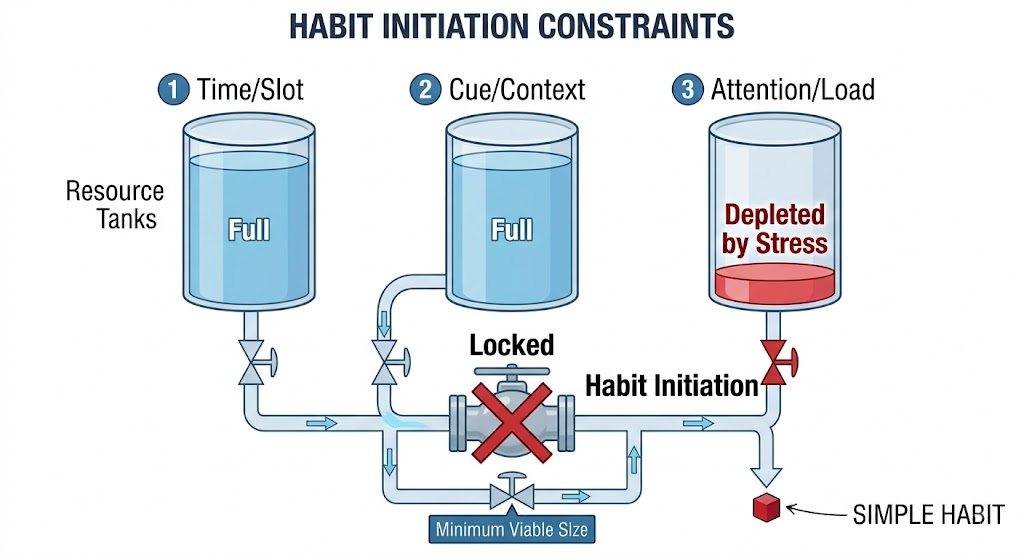 Cognitive load is the source most people misdiagnose, because it does not show up on a calendar. The clock says you have the time, so a miss looks like a choice rather than a shortage.
- Natalie: You said the evenings are still free. So what's actually stopping it?
- Chris: Nothing's stopping it. I sit down at eight and I just don't start.
- Natalie: What are you thinking about at eight?
- Chris: The thing I didn't finish at work. It runs on a loop.
- Natalie: Then the time is free and the attention isn't. That's cognitive load, not a scheduling problem, and shrinking the habit will help more than rescheduling it.
Notice that Natalie does not accept "free time" as evidence of available capacity. Attention is spent even when the hours are not.
Applying Load Reduction and Habit Prioritization
Once you know a high-stress period is arriving and roughly how long it lasts, treat it as a fixed capacity budget and spend it deliberately in advance. The logic is straightforward: capacity during the period is lower than usual, the number of habits you are running is unchanged, and attempting all of them guarantees that the cuts happen anyway, just unplanned and accompanied by guilt.
Load reduction means deciding, before the period begins, what gets cut entirely, what shrinks to a formally stated smaller version, and which single habit is prioritized. The prioritization criteria are cue reliability and cascade, not attachment. A habit whose cue still fires reliably under the new conditions, and which improves other behaviors downstream, protects more of your system than the habit you happen to like most.
Two disciplines make this hold. First, every decision is made against the energy you will actually have on the worst day of the period rather than the energy you intended to have when you designed the habit. Second, "keeping it a little" is not an option. A habit either shrinks to a stated version or it is cut, because an undefined reduction becomes an undefined miss.
Designing a Temporary Protection Protocol
The output of load reduction is a temporary protection protocol: a written, bounded agreement that preserves the minimum viable habit through the period. It specifies the smallest version of the protected habit, the cue that triggers it, and what counts as proof of completion, so nothing requires interpretation at the end of a bad day. It states explicitly which habits are paused, so those absences are planned rather than accumulating as evidence of failure. Crucially, it carries a hard expiry date on which normal size resumes, and it names what you want from an accountability partner in the meantime.
The expiry date is what separates protection from quiet abandonment. A reduction without an end date is simply a lower baseline you have not admitted to.
Interference wins not by defeating your habit but by outbidding it for a resource you did not know it needed. Ahead, you'll first sort short interference scenarios into their sources as a pattern check, then run a live load-reduction session where you spend a six-week capacity budget out loud, and finally write the protocol itself as a message a partner could actually enforce.
