Sustaining Habit Systems
Evolving Habits into Long-Term Systems
Everything in this course so far has been defensive: reading the curve, anticipating disruptions, protecting a habit under load. That work assumes the habit is still the right size and shape. Over a longer horizon, the more common failure is different. A habit runs fine for two years while the person running it changes, and nobody ever asks whether it still deserves its slot. Sustaining a system means periodically re-deciding, not just persisting.
Evaluating Whether a Habit Should Be Maintained, Modified, Scaled, or Stacked
The Habit Evolution Decision sorts an established habit into one of four verdicts, using three pieces of evidence: how automatic it is, whether its form matches the identity behind it, and how much of your capacity it currently uses.
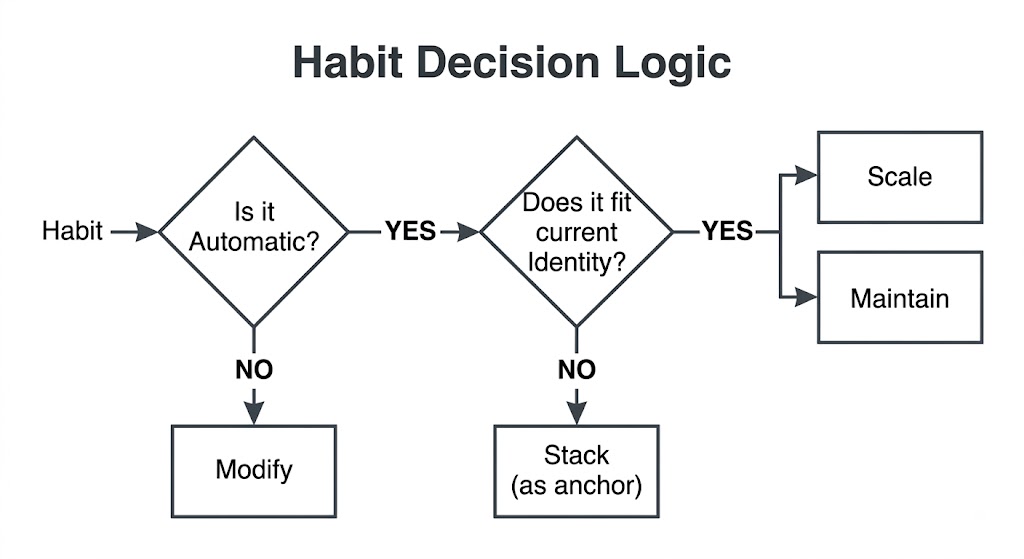
Maintain applies when the habit is automatic and sufficient: it fires without negotiation and delivers what you built it for, so the correct action is to leave it alone. Modify applies when the identity is still right but the form has drifted out of fit, which is the verdict that gets missed most often because adherence looks fine while relevance quietly erodes.
Scale and Stack both address habits that are automatic and under-loaded (they cost you almost nothing). Because this spare capacity can only be spent once, the framework requires a choice in strategy. Scale is the verdict when you want more depth—increasing the volume or intensity of the current behavior. Stack is the verdict when you want more breadth—using the existing habit as an anchor to trigger a new, separate behavior.
Note that only one of the four verdicts is "keep doing exactly this." The default assumption of long-term maintenance is adjustment, not preservation.
- Milo: You said the five minutes of reading is automatic now. How much does it cost you?
- Victoria: Honestly, nothing. I don't even think about it.
- Milo: Then "maintain" is the wrong call. Automatic plus under-loaded means you have a surplus. You need to choose: Scale or Stack.
- Victoria: What’s the difference?
- Milo: Scale if you want to read for twenty minutes. Stack if you want that five-minute read to trigger a new habit, like journaling. You have spare capacity—how are you going to spend it?
Notice that Victoria's evidence for maintaining—that it works effortlessly—is actually the evidence that she is under-utilizing the system's potential.
Integrating Established Habits into One Cohesive Routine
Individually established habits are more fragile than they appear, because each one depends on its own cue firing on its own schedule. Integration reduces that exposure: several behaviors are sequenced into a single chain anchored to one reliable cue, so one trigger produces the whole set. This is habit stacking applied at the level of a routine rather than a single addition.
Integration has two requirements. First, every habit in the chain must already be automatic on its own; sequencing does not stabilize an unstable behavior, it just hides it inside a longer one. Second, each transition must be physically specified. "It flows from there" is not a transition, because a routine is a chain and a chain fails at a link, not in the middle of a step.
The corollary is that integration concentrates risk as well as reducing it. When one anchor triggers three behaviors, an anchor that fails takes all three down. Consequently, a mature routine is one whose owner can name the link most likely to break first, rather than one whose owner believes it is robust.
Architecting a Periodic Audit and Update Cycle
The Long-Term Sustainability Model is what keeps the Habit Evolution Decision from being a one-time exercise: schedule recurring audits, review fit against your current identity statements, retire dead habits, then update cues, rewards, and environment.
Two design principles determine whether this holds over years. The audit needs a trigger of its own, anchored to a recurring date that arrives whether you remember it or not, because an audit that depends on noticing a problem only runs after the problem. And the retirement criteria must be written in advance, since defining the signal that a habit is dead rather than dipping is a judgment you cannot make fairly in the middle of a bad month. Identity statements, meanwhile, are treated as things that change across years, so the review checks fit against who you are now, not who you were when you designed the habit.
The lasting insight of this unit is that a long-run habit system is maintained by scheduled re-decision, not by loyalty to what you once built. A quick sorting exercise comes first, then you'll sequence real habits into a routine live and name its weakest link, and finally write the audit architecture that keeps the whole thing honest for years.
