Anticipating Habit Challenges
Anticipating Challenges Before They Disrupt Habits
The previous unit established that dips are driven by conditions rather than character. That has an obvious implication: if conditions cause dips, and conditions are often visible weeks in advance, then most dips are forecastable. The Challenge Anticipation Framework turns that forecast into a procedure: identify likely disruptions, categorize by type, rank by risk, then pre-commit a response. Notice that the sequence ends in a commitment, not an insight. Awareness of an obstacle offers no protection on the morning it arrives.
Conducting an Obstacle Scan Across Four Risk Categories
An obstacle scan is a deliberate sweep across four categories, matching the four failure types you already know: environmental, capacity, reward, and identity. Environmental risks threaten the cue context (a trip, a move, a schedule shift, the end of daylight saving). Capacity risks threaten available attention and energy (a deadline, a newborn, illness, a caregiving stretch). Reward risks threaten the payoff (the celebration goes flat, the novelty of the behavior fully expires, progress becomes invisible). Identity risks threaten the claim underneath the habit (a role change, a season ending, a shift in what you actually value).
The purpose of scanning by category rather than by brainstorm is coverage. Left to free association, almost everyone lists trips and deadlines, because those arrive with dates attached, and almost no one lists reward decay or identity drift, because those arrive without announcement. A scan that names only environmental and capacity risks isn't a scan. It's the two categories you find easiest to see.
- Jessica: Here's my scan for the next four months. Two-week trip in July, project deadline mid-August, and the clocks change in October.
- Milo: Solid. Which category is each one?
- Jessica: Environmental, capacity, environmental.
- Milo: So two categories are missing entirely. What happens to the payoff by month four? Is the celebration still doing anything?
- Jessica: Honestly, it went flat weeks ago. I just hadn't counted that as a risk.
- Milo: It's the one that kills habits quietly, because there's no date on the calendar to warn you.
The move to observe: Milo doesn't add obstacles, he audits the categories. The absent category is usually the more dangerous one.
Categorizing Disruptions by Type, Timing, and Likely Impact
A named obstacle becomes useful once you attach three attributes to it. Type is the failure category it maps to, which determines the shape of the response. Timing is where it lands on the calendar, which determines how much runway you have and whether two obstacles will overlap. Impact is which specific element of the habit it threatens: the cue, the available energy, the payoff, or the identity claim.
That third attribute is what makes impact ratings honest. "High impact" on its own is a feeling. "It removes the kitchen counter my cue lives on" is a claim you can act against. Additionally, expect some obstacles to span categories. A move is environmental (the cue context disappears) and also capacity (packing consumes attention for weeks). Recording both is more accurate than forcing a single label.
Ranking then combines likelihood with impact. A possible move that would destroy the cue outranks a certain trip you've already survived twice. The output of ranking is a shortlist, because contingency planning is expensive attention and you cannot pre-commit responses to nine scenarios.
Designing If-Then Contingency Plans for the Highest-Risk Scenarios
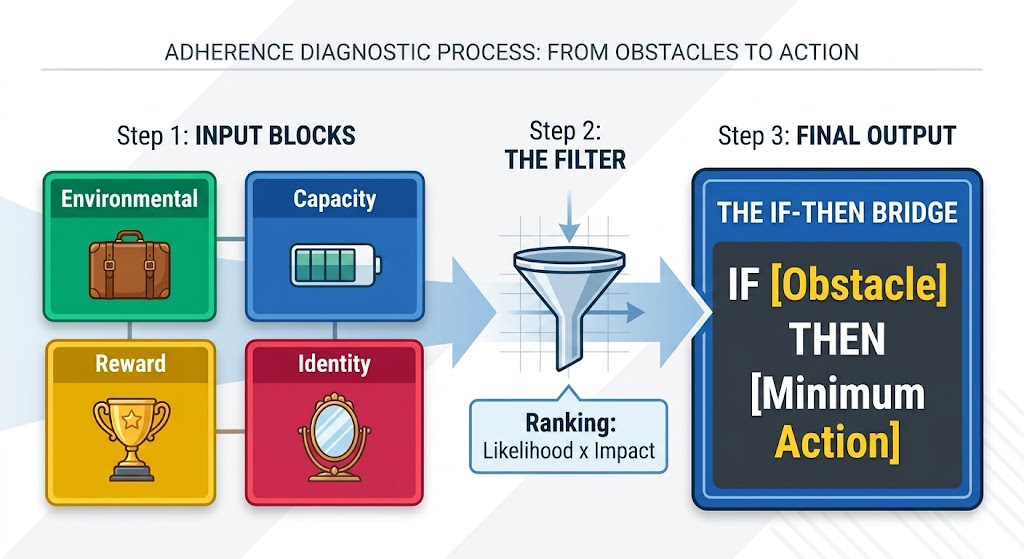 The final step converts a ranked risk into a pre-decided response using an If-Then Contingency Plan: "If [specific anticipated obstacle], then I will [pre-decided protective response]." The convention is to select your top three risks from the shortlist, ensuring these high-impact scenarios leave the session with a concrete protection rather than a worry.
The mechanism matters more than the wording. If-then plans work because they move the decision out of the moment of disruption, when your attention is already spent, and into a calm moment weeks earlier. Consequently, any plan that still contains a decision has failed. "If I'm travelling, then I'll adapt" is not a plan, because "adapt" is the thing you'll have no capacity for at 6 a.m. in an unfamiliar room. "If I'm travelling, then I will do the sixty-second version on the floor beside my suitcase before I open my laptop" is executable while exhausted.
The insight to carry from this unit is that most habit failures are scheduled events you declined to look at. The arc ahead moves through all four steps: a quick pattern-check on assigning obstacles to categories and spotting the one a scan skipped, then a risk register you could genuinely plan from, and finally a live session where each of your top three if-then plans gets stress-tested for whether you could actually execute it tired.
