Navigating the Habit Curve
Welcome to the Course
You've built a habit, designed it to be nearly effortless, and learned to recover it when it breaks. What's left is the least glamorous and most decisive part: keeping it alive for years, through moves, deadlines, dark winters, and the slow flattening of enthusiasm that every habit eventually hits. This course treats long-run maintenance as a predictable psychological process rather than a test of character.
By the end of this course, you'll be able to:
- Identify where a habit sits on the Habit Maintenance Curve and read dips as data rather than verdicts
- Distinguish a normal motivation dip from a genuine system failure requiring redesign
- Conduct an obstacle scan across environmental, capacity, reward, and identity risk categories
- Design if-then contingency plans for your highest-risk scenarios
- Apply load reduction and habit prioritization during a defined high-stress period
- Architect an audit and update cycle that keeps a routine current over years
This first unit establishes the shape of the curve you're on, and why the same person can be 90% consistent in one month and 20% consistent in the next without having changed at all.
Identifying the Phases from Initial Enthusiasm to the Maintenance Plateau
The Habit Maintenance Curve describes four phases in sequence: initial enthusiasm, effort dip, grinding consolidation, and maintenance plateau. Initial enthusiasm is cheap and misleading, because the behavior feels easy while novelty is doing the work. The effort dip arrives when novelty burns off but automaticity hasn't arrived yet, and this is where most habits die. Grinding consolidation follows: the behavior still costs something, but it costs less each week, and skipping starts to feel mildly wrong.
The maintenance plateau is where the habit runs with little conscious input and, notably, with little emotional reward. Boredom at the plateau is a sign of success, not decay—provided the behavior still serves its original purpose. You distinguish healthy boredom from system failure by looking at the result: if the act is unexciting but you still value the outcome, you’ve reached automaticity. If the outcome no longer feels worth even the minimal effort, the system has failed.
Critically, automaticity accrues unevenly. The popular "21 days to a habit" claim is false in both directions: a two-second behavior anchored to a rock-solid cue can feel automatic in a week, while a fifteen-minute behavior in an unstable context can still require conscious effort after six months. Consequently, you cannot date your progress from a calendar. You read it from the effort a repetition costs you today compared with a month ago.
Analyzing How Stress, Life Changes, and Seasonality Drive Predictable Dips
The second framework, Motivation Fluctuation, holds that motivation is a variable driven by external conditions, not a fixed character trait. Stress consumes the attention that habit initiation requires. Life changes (a move, a new schedule, a role change) remove or relocate the cue context the habit was built around. Seasonality alters daylight, energy, and the plausibility of certain behaviors entirely. Each of these produces adherence dips that are visible in advance if you're looking at a calendar rather than at your self-image.
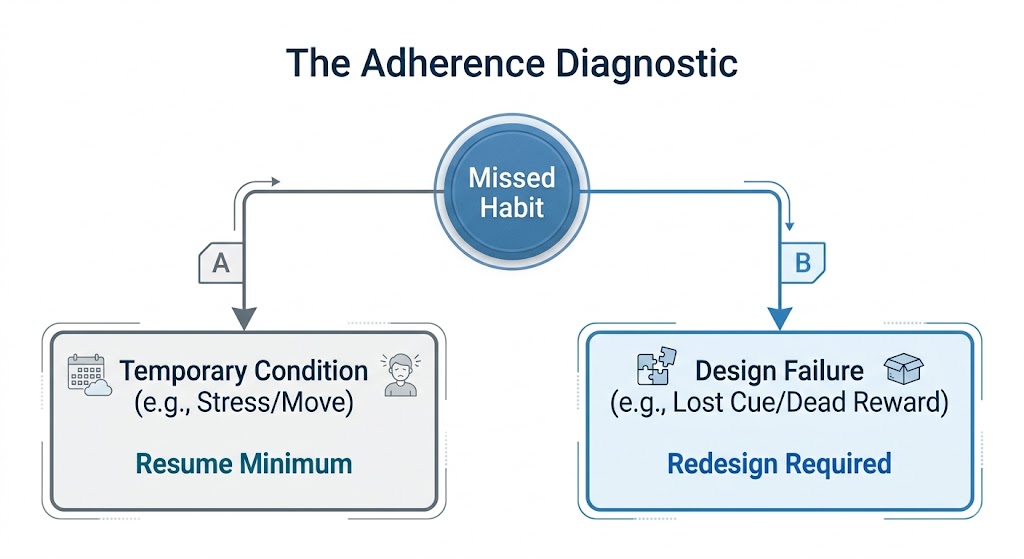 The analytical move is to correlate the dip with the condition. If your logs show adherence collapsing in the same three weeks you were living out of boxes, the explanation sits in the boxes, not in your discipline.
- Dan: I dropped to twice a week in November. Same thing happened when we moved in March. I think I just can't sustain anything.
- Nova: What was your adherence in the five months that weren't March or November?
- Dan: Around ninety percent, I guess.
- Nova: So the same person hit ninety percent for five months and thirty percent for two. A fixed trait doesn't produce that shape. Conditions do. What specifically changed in November?
- Dan: Dark by four-thirty, and the project deadline. My cue was an evening walk.
- Nova: Then the diagnosis is the cue and the load, not the person.
Notice that Nova doesn't argue about character. She asks for the numbers between the dips, because that contrast is what disproves the trait explanation.
Distinguishing a Normal Dip from a Genuine System Failure
Both a dip and a failure look identical on day four: the habit didn't happen. The distinction lies in the cause and the trajectory. A normal dip is time-bound, traceable to an identifiable external condition, and resolves when the condition passes or when you simply resume. A system failure persists after conditions normalize, which tells you the design itself is broken: the cue no longer exists, the reward has gone dead, or the identity behind it has shifted.
That gives you a practical test. Name the condition that changed, then ask whether it has ended. If it has ended and adherence hasn't returned, you have evidence for redesign. If it hasn't ended, you have a dip, and the correct response is to resume at minimum viable size rather than rebuild.
The insight to carry is that a missed day is data about conditions, not a verdict on you. Two practices follow: a quick pattern-spotting check on the phases of the curve, then a written analysis of dip data you could genuinely hand to an accountability partner, before you take the distinction into a live conversation where someone else's four missed days are on the table.
