Finding the Median
Introduction
Welcome back to Summarizing Sample Data! In this second lesson of the course, we shift our focus to another essential measure of center: the median. Last time, you learned how the mean summarizes a sample by spreading the total evenly across all data points. The median takes a completely different approach — instead of calculating across every value, it finds the center by position. By the end of this lesson, you will be able to find the median for any sample, whether it contains an odd or even number of values.
The Idea Behind the Median
When someone asks what is typical in a group, one natural answer is to line everyone up and point to the person in the middle. That is exactly what the median does. If you arranged five friends by height from shortest to tallest, the person standing in the third position is the median height — half the group is shorter and half is taller.
The median cares only about position in the sorted list, not about how large or small the other values are. This "middle of the line" idea is the core of what the median measures, and it makes the median especially useful when a data set contains a few unusually high or low values. You will explore that comparison with the mean in the next lesson.
Always Sort First
Before you can locate the middle, you need the values in order. This is the single most important step when finding the median, and skipping it is the most common source of errors.
Consider a sample of five quiz scores: . If you simply grabbed the middle entry from that list, you would pick — but that is only in the middle of the list as written, not in the middle of the values. Sorting from smallest to largest gives:
Now the values are in the right order, and we are ready to find the true middle.
Finding the Median With an Odd Count
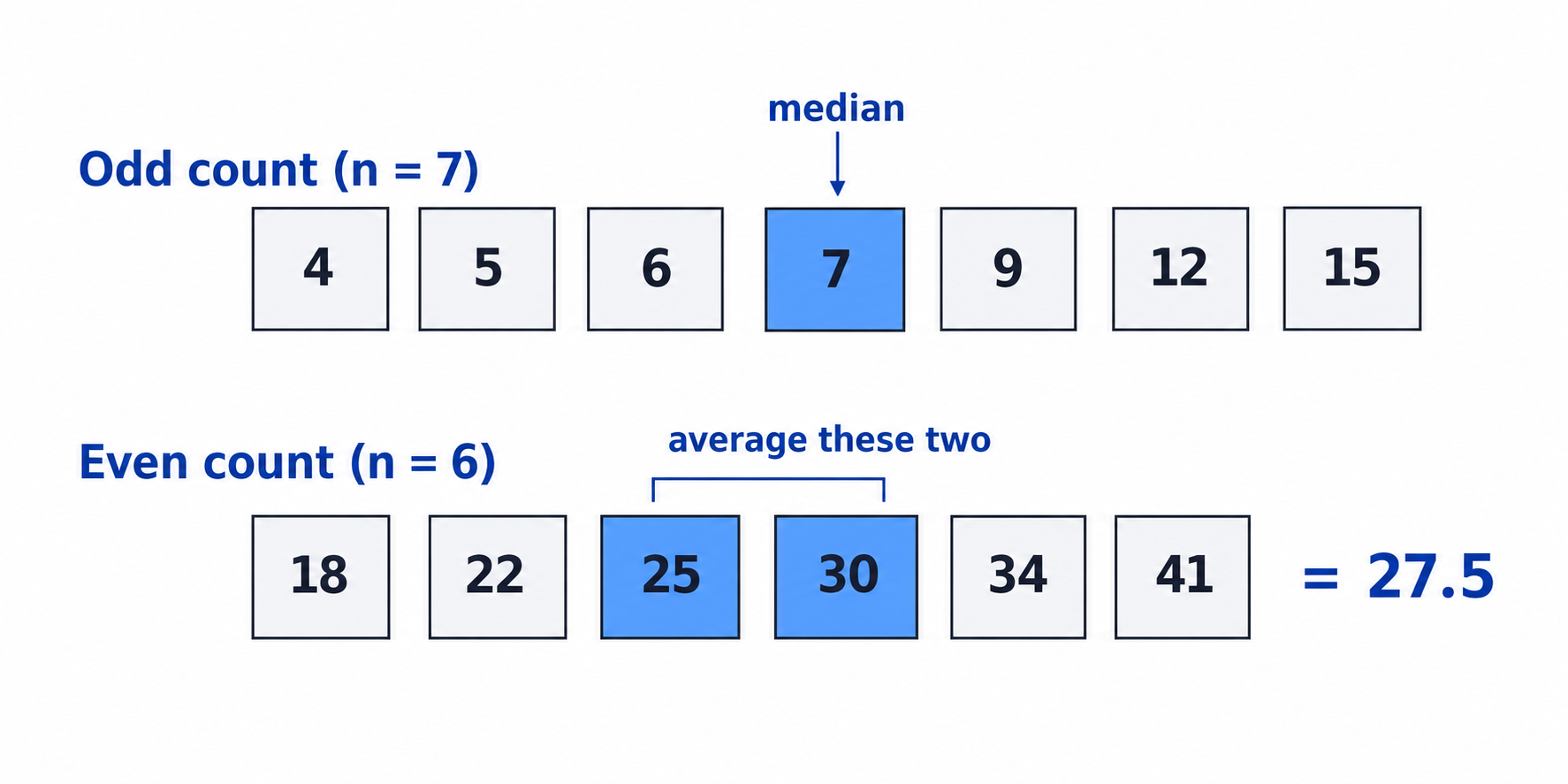
When the sample has an odd number of values, there is exactly one middle position. For values, that position is number .
Let us finish the quiz-score example. We have sorted values:
The middle position is , so the median is the 3rd value, which is .
Here is another quick example. Suppose we recorded the prices of seven menu items at a café (in dollars):
These are already sorted, and . The middle position is , so the median price is the 4th value: $7. Three prices fall below it and three fall above it — exactly what we expect from a middle value.