Finding the Sample Mean
Introduction
Welcome to Summarizing Sample Data, the third course in this learning path! In the first two courses, you explored what populations and samples are, why we collect samples, and how to choose samples we can trust. Now it is time to do something useful with the data a sample gives us. This course focuses on the basic tools for summarizing sample data, and in this first lesson you will learn one of the most common summaries in all of statistics: the mean.
Why Summarize a Sample?
Imagine you collected the daily high temperatures in your city for the past ten days. You now have ten numbers. If someone asks, "How warm has it been lately?", reading all ten numbers aloud is not very helpful. What the person really wants is a single number that captures the general picture.
That is exactly what a measure of center does — it condenses an entire set of values into one representative number. As you may recall from the previous courses, a sample is a subset of a larger population. Summarizing a sample with a central value lets you quickly describe what is typical for the data you collected, and later, make reasonable estimates about the population it came from.
What the Mean Is
The mean of a sample (often called the sample mean or average) is the value you get when you add up all the data values and divide by how many values there are. You can think of it as spreading the total evenly across every member of the sample.
We write the formula like this:
The procedure has just two steps:
- Add all the sample values together to get the total.
- Divide that total by the count of values.
No matter how large or small the sample is, the process stays the same.
A Worked Example
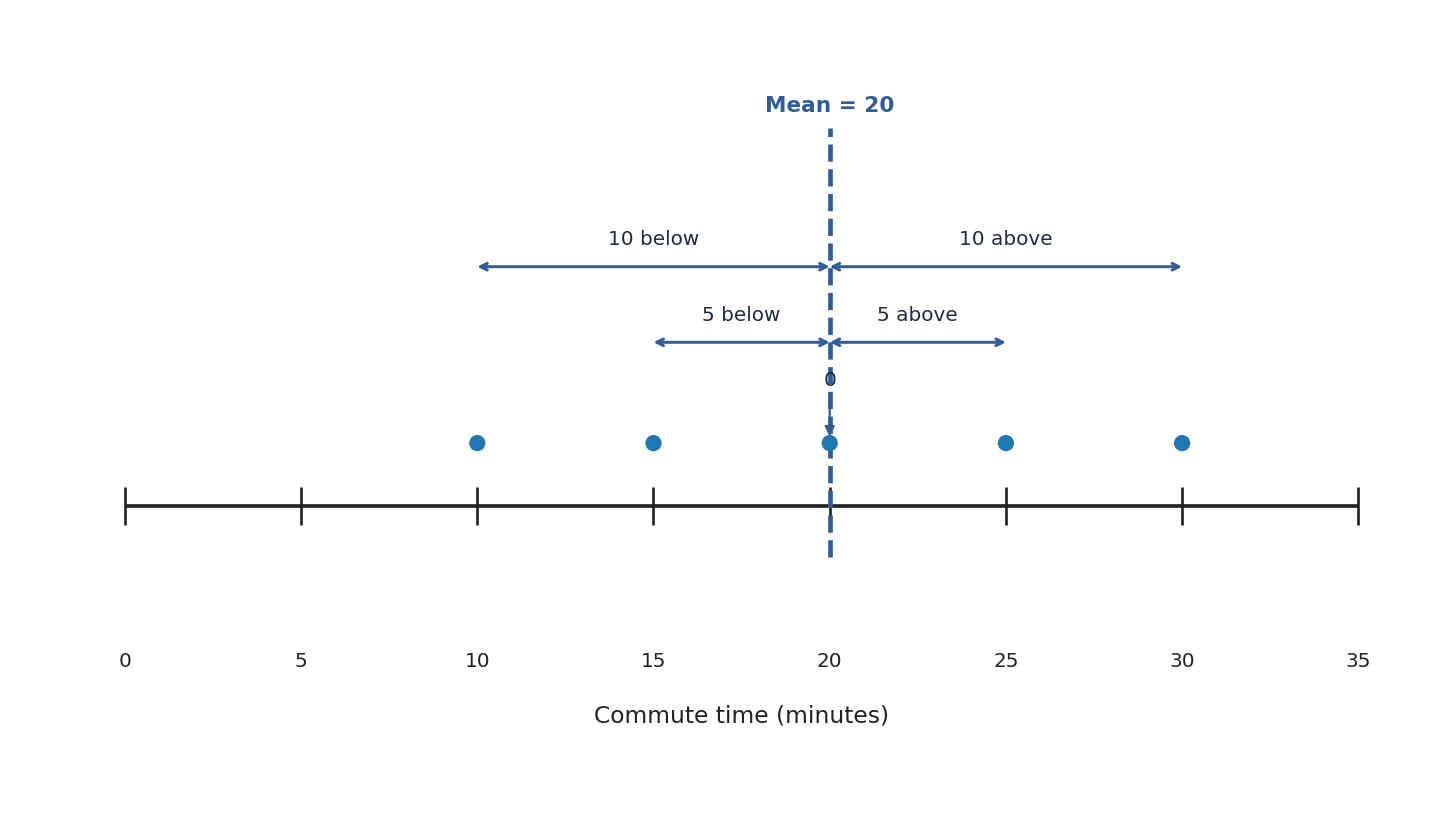
Suppose you surveyed five coworkers and asked each one how many minutes they spent commuting this morning. The responses were:
| Person | Commute (min) |
|---|---|
| A | 15 |
| B | 30 |
| C | 25 |
| D | 10 |
| E | 20 |
Step 1 — Find the sum. Add the five values:
Step 2 — Divide by the count. There are values, so:
The mean commute time for this sample is 20 minutes. With the calculation done, the natural next question is: what does this number actually tell us?