What is Empathy?
Welcome to the Course 📣
Welcome to Strengthening Empathy and Resilience! In this course, you’ll learn how to harness the power of empathy and resilience to become a more effective leader. By deepening your understanding of yourself and others, you’ll be better equipped to navigate challenges, build trust, and support your team—both in everyday interactions and during high-pressure moments.
Throughout the course, you’ll develop the ability to understand others’ perspectives while strengthening your own resilience. You’ll start by breaking down what empathy really is, explore how to build resilience, practice self-compassion, and discover the importance of recharging—all to see how empathy drives stronger connections.
In this lesson, based on insights from Daniel Goleman’s expertise in the HBR Guide to Emotional Intelligence, you’ll explore the three types of empathy and gain a clear, practical understanding of why empathy is essential for effective leadership.
Understand Empathy and Perspective-Taking 👓
Empathy is not a single skill, but a set of three related abilities that help you understand, connect with, and support others effectively. At its core, empathy means reaching toward others to build understanding and connection. It involves focusing your attention on someone else’s experience, seeing the world from their perspective, and responding in ways that strengthen your relationship.
You'll quickly discover that executives who can effectively focus on others stand out in any organization. These leaders naturally find common ground, their opinions carry weight, and others actively seek opportunities to work with them. What sets them apart isn't their formal rank or title but rather their mastery of "empathy triad"—three distinct types of empathy that each serve different purposes in leadership and relationships:
- Cognitive empathy: Your ability to understand another person's perspective and see the world through their eyes
- Emotional empathy: Allows you to actually feel what someone else feels
- Empathetic concern: Transcends both understanding and feeling by sensing what another person needs from you and taking appropriate action
The first of these is cognitive empathy. This skill enables you to grasp others’ mental models, explain yourself in meaningful ways, and get the best performance from your direct reports. Exercising cognitive empathy means thinking about feelings rather than feeling them directly, making it a skill you can deliberately develop and refine.
Cognitive empathy grows directly from self-awareness. The same neural circuits that allow you to think about your own thoughts and monitor your feelings enable you to apply similar reasoning to understand other people's minds. For instance, when someone on your team pushes back on a new process, cognitive empathy helps you understand their reasoning. Perhaps they're worried about losing autonomy or concerned that this will add three extra steps to an already complex workflow. This understanding transforms potential conflict into productive dialogue.
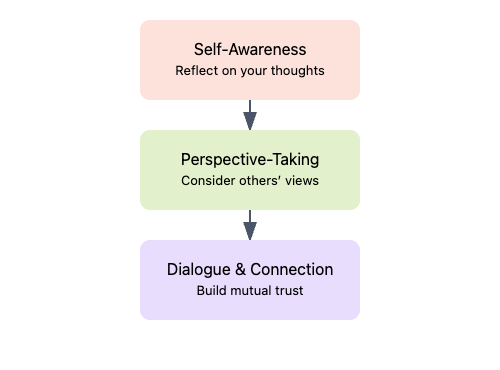
To strengthen your cognitive empathy, consistently practice perspective-taking in everyday situations. When a colleague disagrees with your proposal, pause and ask yourself: "What assumptions might they be making?" or "What past experiences could be shaping their view?" Through this practice, you might discover that their resistance to your feedback system stems from a previous job where constant monitoring felt oppressive, rather than from laziness or stubbornness. This insight completely changes how you approach the conversation and find solutions.
Apply Emotional Empathy 💞
While cognitive empathy is about understanding another person’s perspective, emotional empathy is about actually sharing their feelings. When you listen to someone describe a powerful experience, your brain can mirror their emotional state—so you might feel their pain, excitement, or frustration as if it were your own. This automatic, emotional resonance helps you connect more deeply and build trust and rapport.
Emotional empathy is essential for effective mentoring, managing clients, and reading group dynamics. To access it, you need to be aware of your own feelings while also paying close attention to the other person’s facial expressions, tone of voice, and other outward signs of emotion. This combination of self-awareness and attentiveness to others helps create strong, trusting connections.
However, emotional empathy requires careful management in the workplace. If you become too absorbed in another person’s emotions, you may find yourself overwhelmed or unable to respond effectively. For example, if a team member is upset about a project setback, you might start to feel their frustration as your own. While this can help you connect, it can also make it difficult to stay objective and provide support.
In these situations, it’s important to recognize your own emotional responses and, when needed, create a bit of distance so you can remain helpful. This might mean pausing to notice your feelings, taking a deep breath, and shifting your focus from simply sharing their emotions to maintaining enough perspective to guide the conversation constructively. For instance, if you notice yourself becoming irritated or anxious during a conversation, that could be a sign that the other person is feeling the same way.
Consider this real-world conversation:
- Milo: I just found out that Jake got promoted to senior developer. I've been here longer and my performance reviews have been just as good. I don't understand why I was passed over.
- Victoria: I can hear the frustration in your voice, and I imagine this feels really disappointing—especially when you've been working so hard.
- Milo: It's more than disappointing. It feels unfair. I've been putting in extra hours, mentoring new team members...
- Victoria: You're right. You have been doing all those things. From your perspective, with all the extra effort you've been putting in, it must feel like your contributions aren't being recognized. I can understand why you'd see Jake's promotion as unfair.
In this conversation, Victoria uses emotional empathy to recognize and reflect Milo's feelings, helping him feel heard and understood. She connects with his emotions while also maintaining enough perspective to keep the conversation productive. This balance of sharing someone’s feelings while staying grounded enables you to support others without becoming overwhelmed yourself.
Show Empathetic Concern 🤗
While cognitive empathy is about understanding another person’s perspective and emotional empathy is about sharing their feelings, empathic concern is about sensing what someone needs and feeling motivated to help. This type of empathy moves you to take supportive action, combining your understanding and emotional connection to respond in ways that truly make a difference for others.
This type of empathy is rooted in our natural drive to care for others, prompting us to notice when someone is struggling and to feel a sense of responsibility for their wellbeing. As a leader, finding the right balance is crucial: if you absorb others’ distress too deeply, you risk becoming overwhelmed or experiencing compassion fatigue, which can make it hard to function or make decisions. On the other hand, if you distance yourself too much to protect your own feelings, you may lose touch with empathy altogether and fail to support those who genuinely need it. Effective leadership means recognizing others’ struggles while also considering your own capacity, so you can respond with care without losing your ability to lead.
The key lies in managing your personal distress without numbing yourself to others' pain. When a team member shares that they're struggling with workload, empathic concern helps you recognize both their emotional state and their practical needs. You might respond by acknowledging their feelings: "I can see you're overwhelmed, and that must be really stressful" while also taking concrete action: "Let's look at your priorities together and see what we can adjust." This combination of emotional validation and practical support exemplifies effective empathic concern.
Empathetic concern often requires you to slow down and fully consider what someone is experiencing before deciding how to respond. In complex situations, it can be tempting to jump to conclusions or offer quick fixes, but taking the time to truly understand both the emotional and the practical needs of others leads to better decisions and stronger support. As a leader, this thoughtful approach helps you respond with care and integrity, especially when team members are facing challenges that aren’t immediately obvious.
Practicing cognitive empathy, emotional empathy, and empathic concern will help you build stronger relationships and support your team more effectively. Next, you’ll apply these skills in practical scenarios to make empathy part of your everyday leadership.
