Strategic Content Architecture
The Strategic Content Architecture
Last unit you narrowed a crowded channel list down to the few that cover the buyer's whole journey. But a channel is just a pipe. What travels through it, and whether it actually moves a buyer forward, is content. This unit shifts from where you show up to what you say once you get there, and it reframes content from a production backlog into a system that carries psychological influence.
Lead with the buyer's state, not the format
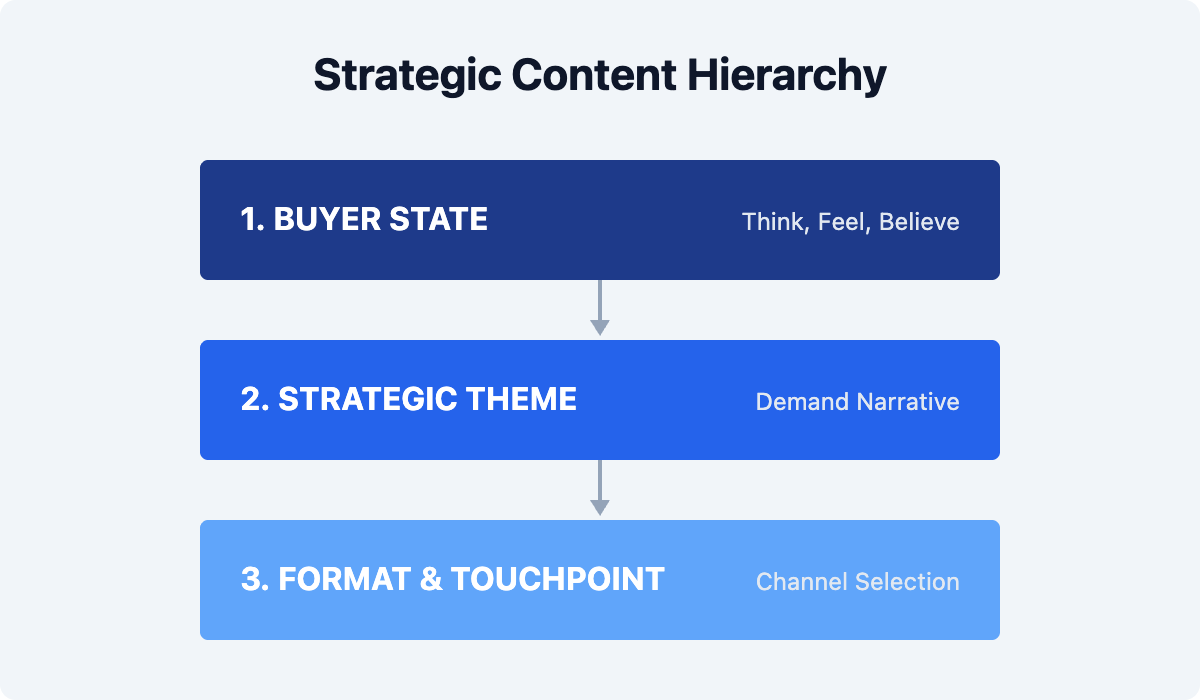 Here's the move that separates strategic content from a content calendar: before you brief anything, name the buyer's cognitive and emotional state at that moment, then ask what the content must do to shift it. This is Content as Strategic Architecture, treating content as the foundational mechanism for delivering psychological influence across funnel stages and touchpoints. The format (blog, webinar, case study) is the last decision, not the first.
In practice, that means every asset gets a job description before it gets a title. A problem-recognition piece exists to make a latent cost feel real; a decision-stage piece exists to strip out risk and supply proof. When you brief by format first ("we need three blogs and an eBook"), you get assets that rank or fill a calendar but never do a psychological job.
- Nova: I've got a slot for two more posts this sprint. What keywords do you want me to target?
- Ryan: Before keywords, where is this buyer in the funnel, and what do they need to believe next?
- Nova: These are top-of-funnel readers, mostly unaware they even have the problem.
- Ryan: Then the job is making that problem feel real and costly. The keyword comes after. Pick the term that lets the piece do that job, not the other way around.
- Nova: So the psychological job drives the brief, and search intent just tells me how to package it.
Notice Ryan doesn't reject the keyword. He subordinates it to the buyer's state.
Design themes that build demand across stages
One-off assets leak; themes compound. Instead of a pile of disconnected pieces, design a content theme for each funnel stage and make each theme carry a specific think, feel, or believe shift.
At problem recognition, the theme should make the buyer think "this is costing us more than we realized." At consideration, it should help them feel confident they can evaluate options without getting it wrong. At decision, it should make them believe the risk of choosing you is low and the proof is credible. At retention, it should reinforce that they made the right call and reveal the next level of value worth expanding into.
The test is continuity: can a buyer move from one theme to the next without a jarring gap? When themes ladder into a single demand narrative, each asset borrows credibility from the ones before it, and you stop starting from zero with every campaign.
Map each asset to a touchpoint and a buyer need
Themes become real when each asset is pinned to two coordinates: the channel touchpoint where the buyer will meet it, and the specific cognitive or emotional need it serves there. The same theme shows up differently on paid social (a scroll-stopping hook) than in a nurture email (a deeper proof point), because the touchpoint changes what the buyer is ready to absorb.
So when you brief, force the double answer: which touchpoint, and which buyer need. An asset that can't name both is either homeless or redundant. This is also how a high-ranking SEO piece earns its keep. It can rank and advance the funnel when it's positioned to serve a defined state at a defined touchpoint, rather than existing only to capture traffic.
The single takeaway: content is not output, it's the delivery mechanism for psychological influence, and it works only when every asset serves a defined buyer state at a defined touchpoint. A few practices build on this. First a quick self-check to confirm you can pick the right role for content given a buyer state and channel context, then a stage-by-stage theme plan you could actually hand to your team, and finally a live coaching conversation where you reposition a standalone asset inside the architecture. Try leading your next content brief with the buyer's state and watch how fast the format question answers itself.
