The Strategic Channel Framework
Welcome to the Course
Everything you've built so far - the discipline, the buyer psychology, the funnel mechanics - now has to survive contact with a budget spreadsheet and a launch calendar. This capstone course is where strategy becomes execution: you'll turn what you know about how buyers think into concrete decisions about where to spend, what to say, and how to prove it worked. For a Digital Marketing Manager scaling a demand function, this is the part that earns the seat at the table.
By the end of this course, you'll be able to:
- Map and prioritize channels based on buyer psychology and funnel dynamics
- Architect content as a demand-building system rather than a pile of one-off assets
- Integrate multi-channel touchpoints into a single, mutually reinforcing buyer experience
- Design measurement that captures both direct and indirect influence
- Align demand generation with sales, customer success, and broader growth planning
This first unit starts with the money question: given more channels than budget, how do you choose the right ones?
Map channels to buyer psychology and funnel progression needs
When a channel list lands on your desk, resist the instinct to ask "which channels perform best?" That question invites last year's habits and the cheapest cost-per-lead. Ask instead: "What does my buyer need to think or feel at each stage, and which channel is built to deliver that?" This is the core move of the Channel Strategy Framework: you select and prioritize channels based on buyer psychology and funnel dynamics, not on familiarity.
Every channel has a native psychological job. Paid social interrupts and creates awareness. Search captures buyers already problem-aware and hunting. Webinars build consideration through depth and authority. Review sites and peer content supply the proof buyers crave at the decision stage. When you match a channel to the buyer's state at a given moment, it does its best work. When you force a channel to do a job it was never built for, results collapse and you blame the channel instead of the mismatch.
- Ryan: Paid social has the cheapest cost per lead, so that's where the budget should go, right?
- Jake: Cheap leads, but what stage are those buyers in?
- Ryan: Mostly cold. Half don't even remember filling out the form.
- Jake: So it's an awareness channel doing awareness work. The problem is we're asking it to close deals it never warmed up. Match the channel to what the buyer needs at that moment, not to the CPL.
- Ryan: So review sites earn the decision-stage spend, because that's when they want proof.
Notice the shift: Jake stops evaluating channels by output metrics and starts evaluating them by buyer need and funnel role. That reframe is what makes the rest of the framework work.
Evaluate channel options against strategic fit, psychological impact, and progression potential
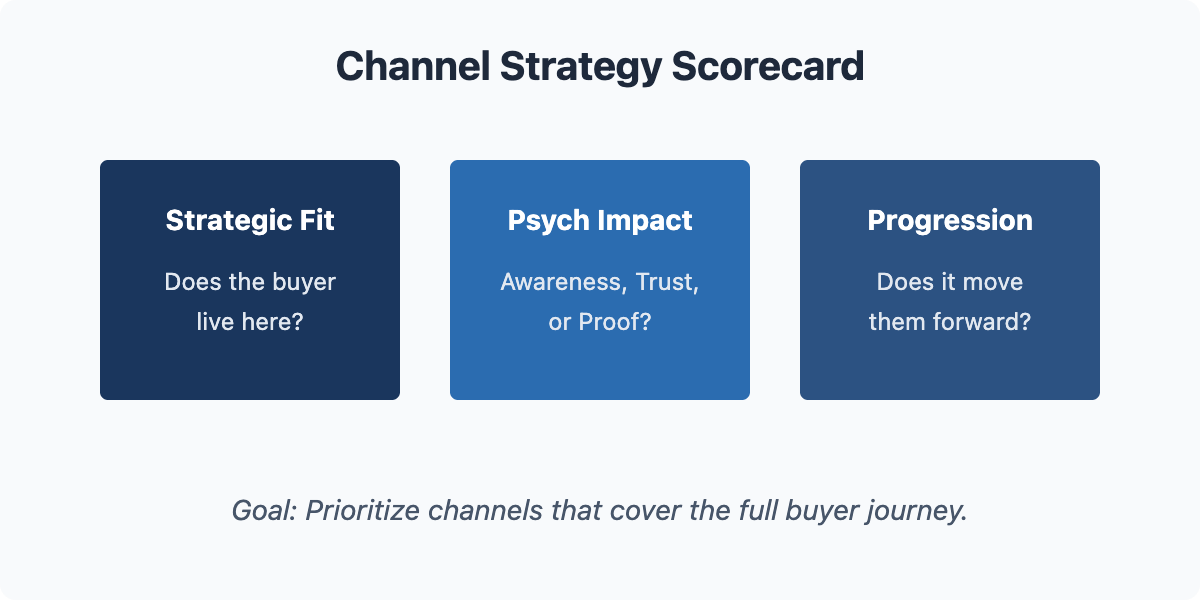
Once you're thinking in buyer needs, you need a consistent way to compare channels side by side. Score each option against three lenses. Strategic fit asks whether your target buyer actually lives on that channel and whether it suits your motion and price point. Psychological impact asks which cognitive or emotional need the channel serves best: awareness, trust, proof, urgency.
Progression potential, the third lens, asks which funnel stage the channel can genuinely advance, from problem recognition through decision. The discipline comes from scoring channels comparably rather than defending each one in isolation. When you run all six or eight options through the same three lenses, two things surface fast. You'll spot overlaps, where two channels fight for the same job (for example, partner content and executive events both serving decision-stage credibility). And you'll spot gaps, where a whole funnel stage has no channel assigned to it. A channel that scores high on fit but only touches one stage is a different bet than one that scores medium across all three. Write the scores down so the comparison is explicit and you're not arguing from gut.
Prioritize the channels that best match target buyer needs across funnel stages
Here's the reality you'll face: the budget funds three channels, not seven. Prioritization is not about keeping everyone happy, it's about coverage. Your goal is a short list that moves the buyer across the whole funnel coherently, not three channels that all crowd the awareness stage while nobody's serving proof at decision.
So lead with the buyer, not the politics. When someone lobbies to keep a legacy channel, ask what funnel job it does that another channel isn't already covering better. If the answer is "it worked last year," that's not a buyer need, that's inertia. Look for the smallest set of channels that spans problem recognition, consideration, and decision, and be willing to scale a channel down rather than kill it outright when the coverage argument is close. Your scorecard is your defense: it lets you say "we're cutting this because it duplicates coverage we already have," which is far stronger than a preference.
The single takeaway: channels are not chosen because they perform, they're chosen because they meet a specific buyer need at a specific funnel stage, and your job is to cover the whole journey with the fewest, best-fit bets.
This is where it gets concrete. Next, a quick matching exercise lets you pressure-test whether you can spot which psychological need and funnel role each channel actually serves before you ever commit a dollar to it.
