Evaluating Switching Costs
Evaluating the Cost of Switching
In the last unit you learned to spot attention residue, that leftover pull that keeps part of your mind on the task you just left. Now let's add up the full bill. A single switch costs you more than a foggy minute or two, and when switches repeat across a work session, those small costs stack into missed deadlines and sloppy output. This unit gives you a way to see the whole price tag so you can decide whether a "quick check" is really worth it.
How Switching Stretches Time and Drops Accuracy
Here's the pattern to hold onto. Every time you jump from one cognitive task to another, you move through a predictable sequence called the Task-Switching Chain.
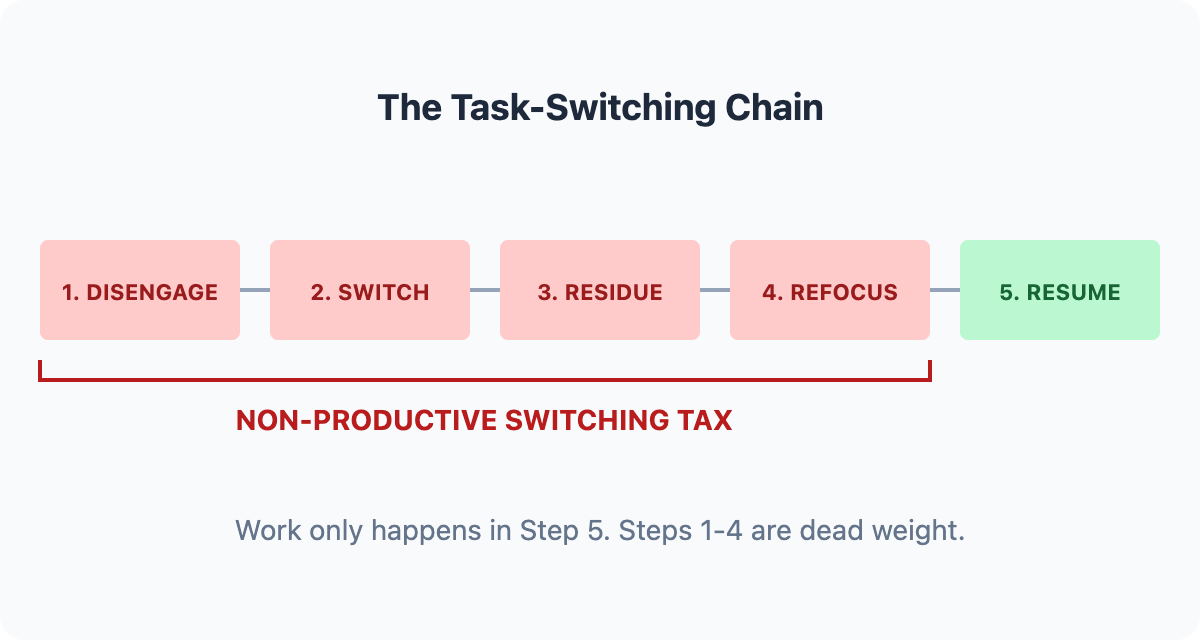
First you disengage from what you were doing. Then you switch mental gears to the new task. You carry attention residue from the old task into the new one. You spend time refocusing. And only then do you get back to work, now running slower and more error-prone than before. Each link adds a small delay, and together they produce the real costs: longer completion times, more mistakes, lower-quality output, and a drained brain by day's end.
The two costs worth watching most closely are time and accuracy. Time stretches because the switch itself, plus the refocusing lag, is dead weight added to every task. Accuracy drops because you resume work while part of your attention is still elsewhere, so you miss a detail, transpose a number, or lose your place. Watch how this surfaces in a normal work moment:
- Natalie: I checked chat maybe six times while writing that report. Each check was thirty seconds, tops.
- Milo: But how long before you were actually back in the report each time?
- Natalie: Honestly, a couple of minutes. I'd reread the last paragraph, lose my thread, fix a typo I'd just made.
- Milo: So the thirty-second check isn't the cost. The cost is disengaging, switching gears, dragging the chat back with you, then warming up again.
- Natalie: And I found a number wrong in the third section. I bet I fumbled that right after a check.
Notice that Milo doesn't count the check itself. He counts the whole chain around it, which is where both the lost time and the error actually live.
Adding Up the Cost of Repeated Interruptions During Report Prep
Now picture that chain firing over and over during something demanding, like preparing a report. You draft a paragraph, glance at chat, answer a quick question, come back, warm up, draft another paragraph, glance again. Each round trip runs the full chain, so the delays and errors don't just happen once. They multiply. By the end of a few hours, the report took longer than planned, a couple of figures are off, the writing feels thinner than your best work, and you're mentally wiped even though you never left your desk.
So why do you keep switching if it costs this much? Because each switch delivers a small novelty dopamine hit that makes it feel rewarding in the moment. Opening chat gives you a little spark of "something new," which is why the pull feels like relief rather than sabotage. That's the trap: the switch feels good right now, while the cost, longer time and lower accuracy, shows up later and quietly. Naming the reward for what it is helps you stop trusting the feeling and start counting the chain.
Putting a Number on It
To make the cost concrete, it helps to have a rough figure. Research on switching suggests that task-switching can increase the time to complete an activity by up to 25%. Treat that as an illustrative ceiling, not a guarantee: it won't be exactly 25% every time, but it tells you the cost is real and sizable, not trivial. Applied to a four-hour block of report prep peppered with chat checks, an increase approaching that ceiling could add close to an extra hour of work, enough to push a comfortable deadline into a scramble, while the divided focus quietly seeds errors that lower the report's quality.
The single takeaway is this: switching isn't free, and the Task-Switching Chain shows you exactly where the time and accuracy leak out. Next you'll do a quick pattern-spotting check to pick out the scenario where repeated switching most clearly lengthens completion time and drops quality, then carry that lens into a live conversation and a short write-up. Before your next report block, try this: count not the interruptions but the warm-ups, because that's where the bill is really being run up.
