Detecting Attention Residue
Detecting Attention Residue After a Switch
In the last unit you saw that multitasking is really your spotlight flicking between tasks, one at a time. But there's a hidden cost that shows up right after the flick, in the seconds and minutes once you've switched. When you move from one demanding task to another, part of your attention stays stuck on the thing you just left. That leftover pull has a name, and learning to spot it is what this unit is about.
What Attention Residue Is
Picture finishing a tense email exchange, then opening a blank document to write a report. Your body is at the report. Your mind is still half-arguing the email. That stuck-behind portion of your focus is attention residue: the part of your attention that lingers on a previous task after you've already switched to a new one.
Here's the relationship to hold onto. Every time you engage in task-switching (moving your single spotlight from one cognitive task to another), you leave residue behind. The switch is never clean. A slice of your thinking stays on the old task, especially when you left it unfinished or emotionally charged. So task-switching produces attention residue, and that residue is the reason a "quick switch" is never actually quick.
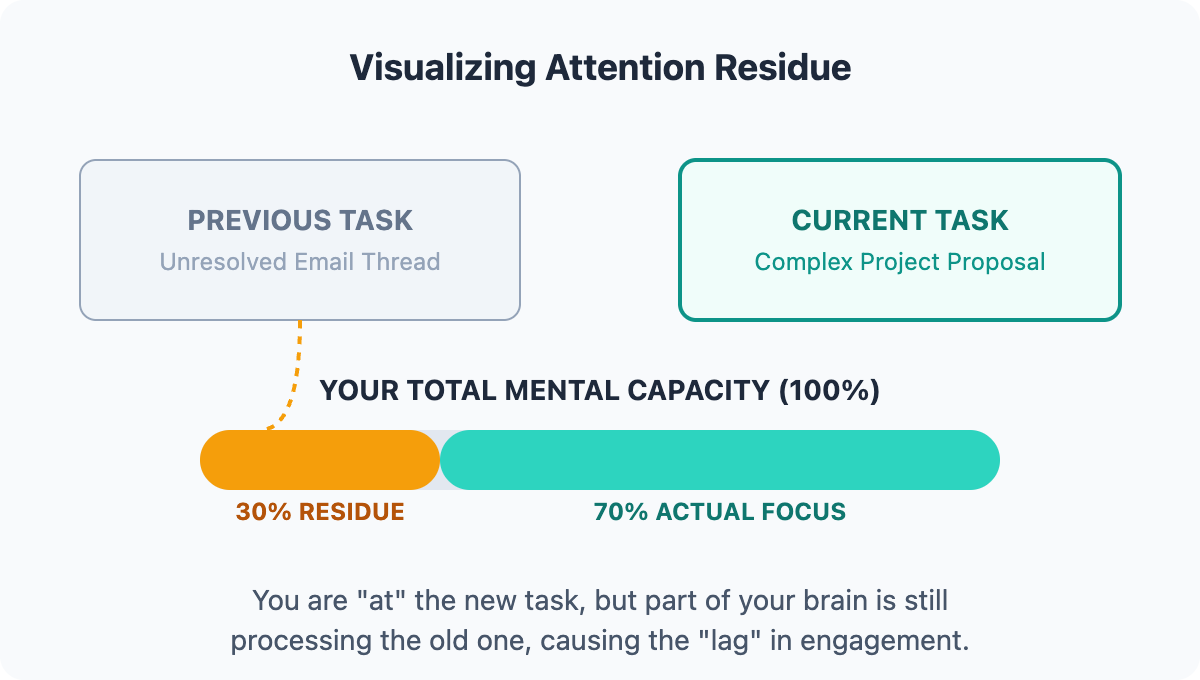
Why does this matter to you? Because you feel the residue as that foggy, half-present sensation in the first minutes of new work: the sense that you're reading the same line three times, or you just can't quite get going.
Catching the Thoughts That Still Follow You
The skill here is noticing exactly what your mind keeps returning to after a switch. Residue isn't a vague mood; it's usually made of specific, nameable thoughts, like an unanswered reply, a comment that irritated you, or a decision you didn't quite finish making.
Watch how naming it helps:
- Jake: I sat down to write this proposal twenty minutes ago and I've got two sentences.
- Nova: What keeps pulling you back?
- Jake: That email thread. I keep drafting what I should've said to him.
- Nova: So your spotlight's on the proposal, but a chunk of it is still on the argument. That leftover pull has a name: attention residue.
- Jake: Huh. It's not that the proposal is hard. It's that I never really left the email.
Notice that Nova didn't tell Jake to "focus harder." She asked what was pulling him, which surfaced the exact thought (the unfinished argument) so he could see it. That's the whole move: name the specific lingering thought instead of treating it as background static you just have to push through.
How Residue Delays Your Full Engagement
Once you can spot residue, the next step is being honest about what it costs, and the cost is time. Residue doesn't vanish the instant you start the new task. It fades gradually, so there's a lag between when you begin and when you're actually all in. During that lag you work slower, your opening is scattered, and reaching real flow takes longer than it should.
You can assess this in yourself with two simple questions. First: what am I still thinking about from the last task? Second: how long is it taking me to feel fully engaged with this one? If you started the report ten minutes ago and you're still circling the email in your head, that's roughly ten minutes of degraded work you can now name and account for. The rule of thumb is that the more unfinished or emotional the previous task was, the thicker the residue and the longer the delay before you engage.
The practical payoff is this: that delay stays invisible until you go looking for it. Once you see it, you can stop blaming yourself for being "slow to start" and start treating the switch itself as the thing to manage.
The single takeaway for this unit is that task-switching always leaves attention residue, and that residue is what quietly delays your full engagement with whatever you do next. Next you'll do a quick fill-in-the-blank check to lock in the exact relationship between those two terms, then move into a live conversation and a short write-up where you'll spot the residue as it happens. For now, try this today: right after your next switch into demanding work, pause and ask yourself what you're still thinking about, then give it its name.
