Reframing Multitasking
Welcome to the Course
You're the person who answers a Slack while half-listening to a stand-up, drafts a reply during a webinar, and skims a report with a call playing in the background. It feels efficient, even impressive. This course shows you why that feeling is misleading and what to do instead, so your most important work gets your best attention rather than your leftover attention.
By the end of this course, you'll be able to:
- Explain why your brain can only run one demanding task at a time
- Detect the "attention residue" that quietly drags on your focus after you switch
- Evaluate how much time, accuracy, and energy repeated switching costs you
- Sequence your work so demanding tasks are protected from expensive interruptions
This first unit starts with the core reframe: what looks like multitasking is really your attention jumping back and forth, handling one task at a time.
Why Your Brain Runs One Task at a Time
Here's the piece most people get wrong. The part of your brain that does focused thinking, the prefrontal cortex, is built to handle one cognitive task at a time. A cognitive task is anything that needs real thought: writing a sentence, following an argument in a meeting, working through a number. Your brain cannot genuinely run two of those at once.
The clearest way to picture it is a spotlight. Your focus is a single beam that can only light up one area at a time. It can swing fast between two spots, but it can never illuminate both at once. When you "multitask," the spotlight is darting back and forth, and each spot goes dark the moment the beam leaves it.
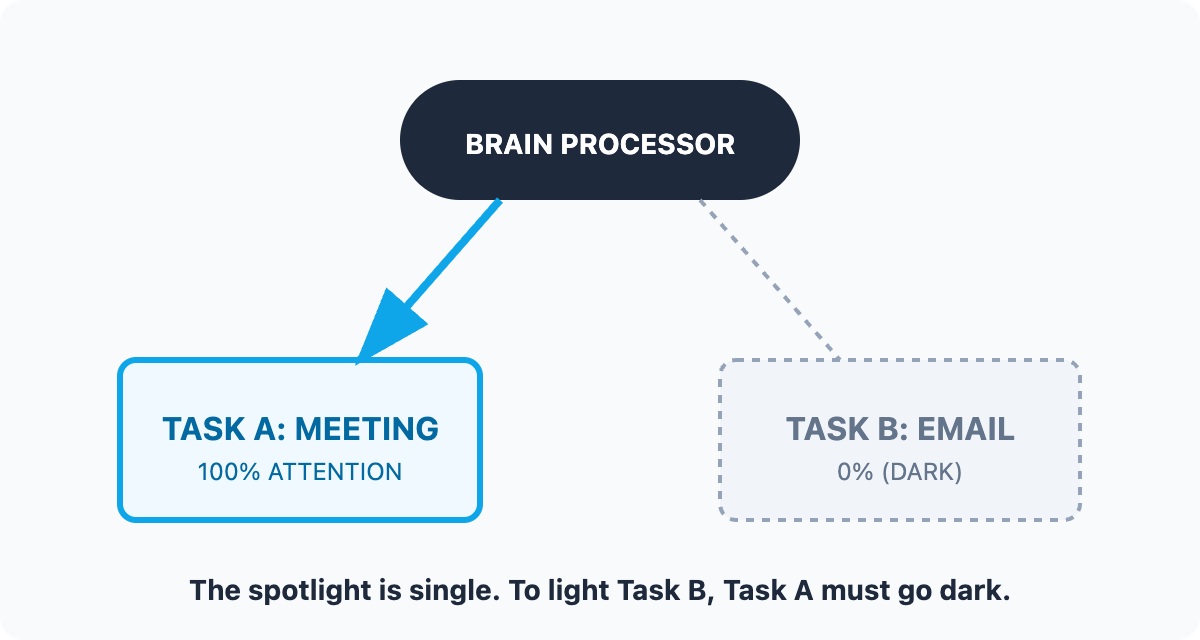 Why does this matter to you? Because the moment you accept that the beam is single, a lot of your daily habits start to look different. The webinar you "attended" while emailing wasn't two tasks happening together. It was one spotlight flicking between two, leaving gaps in both. Naming that honestly is the first move toward fixing it.
Why Drafting Emails During a Meeting Is Rapid Task-Switching
Take the most common example: clearing your inbox during a meeting. It feels like doing two things at once. It isn't. It's task-switching, your spotlight jumping between the meeting and the email, dozens of times, with each jump leaving one of them in the dark.
Watch how this lands when you make it visible for someone.
- Chris: I clear my inbox during every project meeting. Two birds, one stone.
- Victoria: So when you're typing a reply, what's happening with the meeting?
- Chris: I'm still listening. Mostly.
- Victoria: Think of your focus as a single spotlight. When it swings to the email, the meeting goes dark for a second. You're not lighting both, you're flicking between them.
- Chris: Huh. That's probably why I asked a question someone had already answered five minutes earlier.
Notice what did the work there. Victoria didn't lecture or call Chris undisciplined. She asked one question that let him feel the gap himself, then gave him a picture (the spotlight) that made the switching visible. The "missed the answer" moment is the proof: if the meeting had truly stayed lit, he wouldn't have lost it. That lived example is what turns a concept into a reason to change.
Communicating a Single-Task Alternative
So what do you actually do with this? The move is to separate the two tasks in time instead of trying to run them together. For a meeting, that usually means closing the laptop (or the inbox), giving the meeting your whole spotlight, and handling email in a dedicated block right before or after.
When you propose this to someone, frame it as a performance upgrade, not a restriction. Efficiency-minded people bristle at "stop doing that." They lean in when you show them the smarter play. You might say something like: "Try closing the laptop for the client meeting and batching email in the twenty minutes right after. You'll catch every detail the first time, and you won't lose focus flicking back and forth." That connects the change to what they already want: fewer missed details and less mental drain, not more rules.
The key is to name the payoff in their terms. Single-tasking isn't about willpower or being a purist. It's about giving one task a clean, uninterrupted beam so it gets done right the first time, instead of being lit in flickers.
That's the whole reframe for this unit: multitasking is a myth, and what you're really doing is switching a single spotlight back and forth, one task at a time. Before this becomes something you can coach in others, you'll do a quick self-check to lock in exactly what your prefrontal cortex is doing in those moments, then step into a live conversation where you'll teach the spotlight idea to a confident "multitasker," and finally draft a short message that offers a single-task plan for a real meeting. Start noticing today where your own spotlight is flicking, and see how often a spot goes dark without you realizing it.
