Reducing High Cost Switches
Reducing High-Cost Task Switches
By now you know switching isn't free. This unit takes the next step: since you can't avoid switching entirely, you can at least make your switches cheaper. The trick is that not every switch costs the same. Once you can tell the expensive ones from the cheap ones, you can arrange your day so you pay the low price far more often than the high one.
Not All Switches Cost the Same
Here's the first move: start sorting your switches into cheap and expensive.
A switch is cheap when the two tasks are similar, because your brain stays in roughly the same mode. Going from writing one email to writing another, or from editing one paragraph straight into the next, barely disturbs you. You're using the same mental tools, so there's almost nothing to reload.
A switch gets expensive when the two tasks are different types. Jumping from writing to crunching numbers, or from writing to a phone call, forces your brain to drop one whole toolkit and pick up a completely different one. Words and formatting go out; math or live conversation comes in. That swap is where the lost time and leftover residue really pile up.
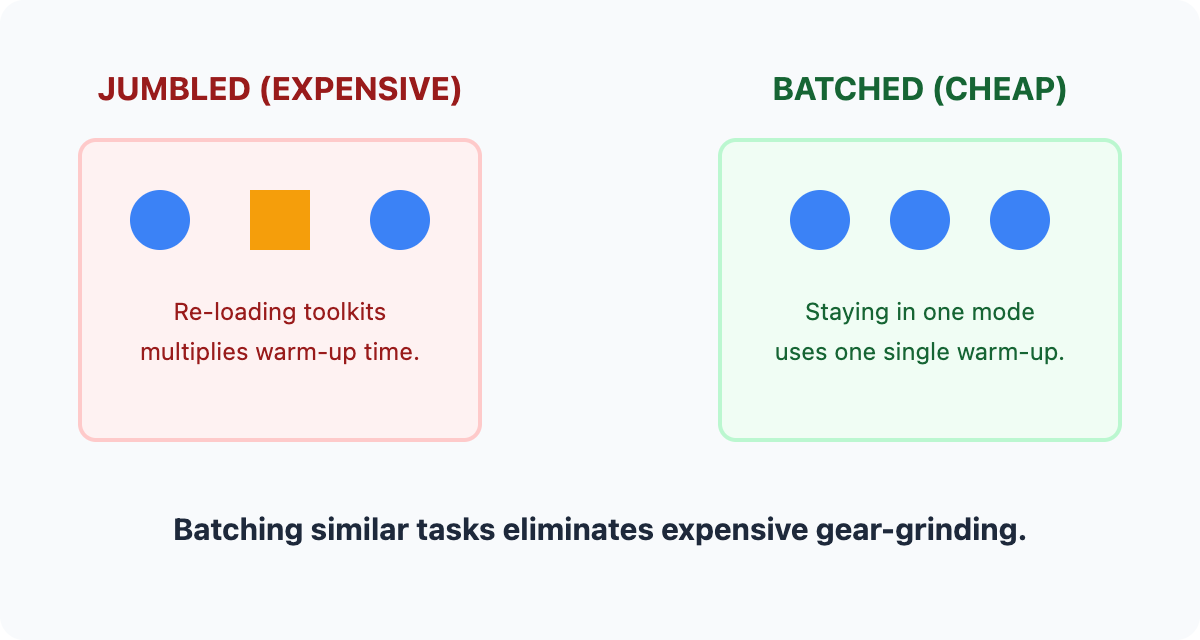
A simple way to feel it: picture each task type as a different room in your head. Moving around inside the same room (writing to writing) is easy. Walking to a whole different room (writing to a call) means leaving, finding the door, and settling into a new space every time.
Protecting Complex Work from Repeated Warm-Ups
Now add the second idea. Complex tasks need warm-up time: the few minutes your brain takes to load the details, find your thread, and reach the absorbed state where the work actually flows. That climb is unavoidable, but you only have to make it once, as long as nothing interrupts you.
Here's the catch. Every time something yanks you out of a demanding task, you don't resume where you left off. You start the climb over. Interrupt a hard writing block five times and you've warmed up five times instead of once.
- Milo: I feel most productive when I'm bouncing between everything, a bit of the report, answer a call, back to the report.
- Natalie: How long after each call before the report feels easy again?
- Milo: Honestly? A few minutes of staring before it clicks.
- Natalie: So every call isn't just the call. It's the call plus another warm-up climb on the report.
- Milo: And I've been doing that climb maybe eight times an afternoon.
Notice the cost isn't the calls themselves. It's re-warming the demanding task over and over around them. So the move is to give complex work one uninterrupted stretch and keep the different-type tasks out of it, so you climb the hill just once.
Sequencing Your Day to Minimize Expensive Shifts
The payoff of both ideas is a smarter order for your day. Instead of interleaving unlike tasks, you batch similar ones together so you rarely jump between rooms.
In practice, group your writing into one block, so you only pay cheap writing-to-writing switches. Then batch your number work separately. Then cluster your calls into one run. Put your most demanding task in a protected block where nothing of a different type is allowed to interrupt, so it gets its single warm-up and stays in flow.
And reassure yourself on the worry everyone has: batching doesn't mean things go undone or people wait forever. Everything still gets handled, just grouped so you stop paying the high switch cost repeatedly. A call answered in your calls block still gets answered. It just no longer costs you a fresh warm-up on your report.
The one takeaway: similar tasks switch cheaply, different task types switch expensively, so batch like with like and shield your hardest work from repeated warm-ups. This is where it gets concrete. First you'll do a quick sorting check, matching everyday switches to cheap or expensive, until the distinction feels automatic. Then you'll take it into a live conversation, helping a colleague untangle a jumbled afternoon, and finally draft a sequence he can actually run. Before then, try one thing: scan tomorrow's task list, circle every place you'd jump between two different task types, and see how many of those jumps you can group away.
