Testing Your Beliefs
Testing Your Beliefs 🧪
Every forecast you approve carries a quiet risk: it may have been built to confirm what someone already wanted to believe. Adoption numbers, launch projections, and pipeline estimates can arrive polished and one-sided because the person who built them is invested in the upside. Your job is to test the belief rather than simply accept it.
In this lesson, you will learn to:
- Tell confirmation bias apart from overconfidence in a forecast you are handed
- Run the Disconfirmation Scan to look deliberately for evidence that could prove a forecast wrong
- State calibrated confidence as a range with its basis, key assumptions, and update triggers
Spotting Confirmation Bias and Overconfidence 🎯
Two distinct distortions show up in a preferred forecast. Confirmation bias is selective attention to evidence. A sales lead may cite rising sign-ups and glowing demo feedback while barely mentioning churn, slipped deals, or soft conversion. Overconfidence is certainty that outruns the evidence. It appears as a precise number stated without a range, caveat, or clear basis.
You will often see both at once. The forecast reads one-sidedly because it gives favorable evidence more weight, then lands as a certain figure. Separating them tells you what to repair: surface the missing evidence, then adjust certainty to match what survives the test.
Running a Disconfirmation Scan 🔬
The Disconfirmation Scan is a deliberate search for the evidence that would change your mind.
- Put the supporting case on the table. Name the evidence that makes the forecast plausible.
- Hunt for conflicts and unknowns. Ask what cuts against the forecast and what you do not know yet.
- Define the reversal signal. Specify what evidence would make the current conclusion no longer hold.
- Adjust confidence. Replace false precision with a range or probability that reflects the evidence left after the scan.
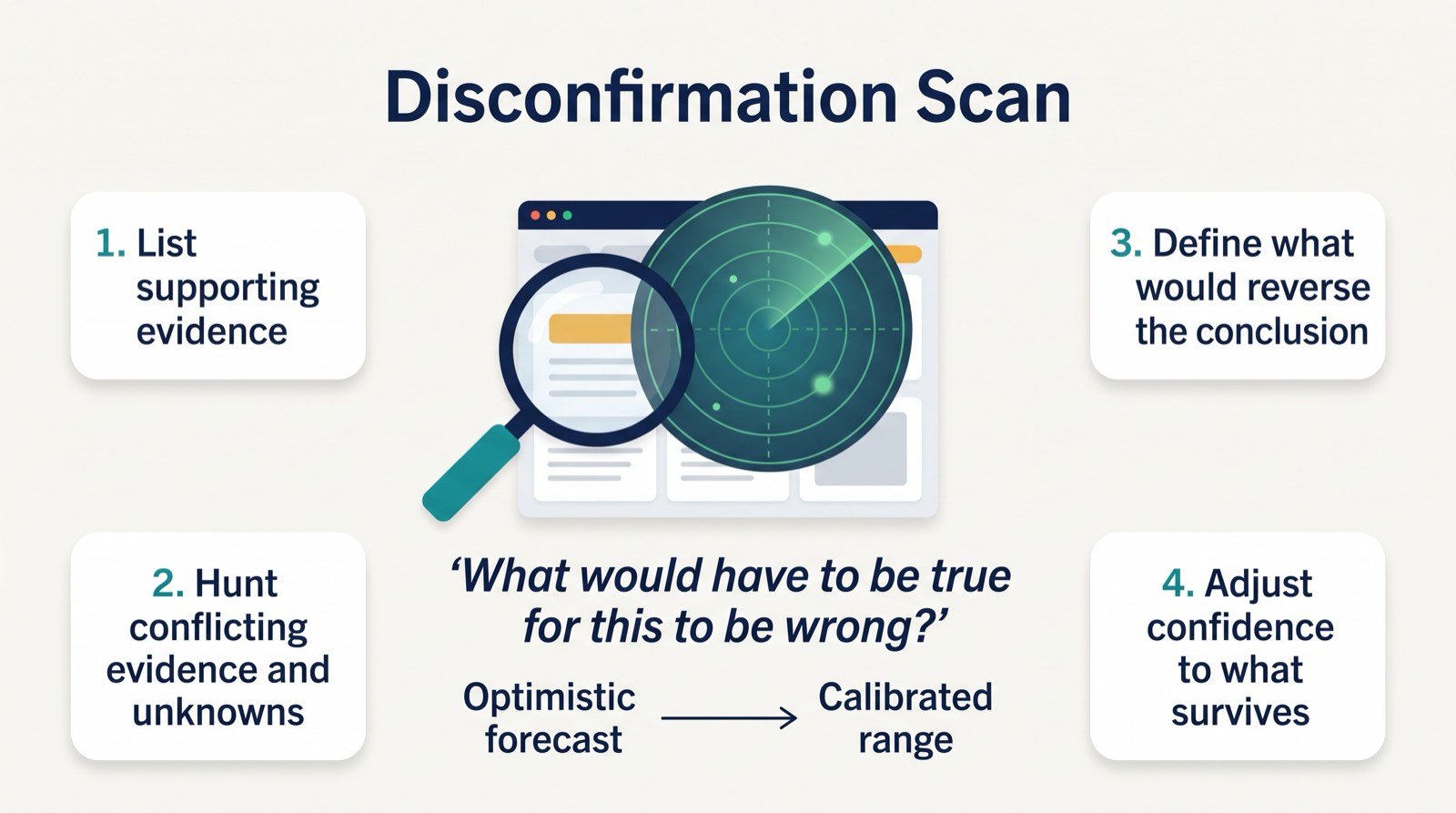
The pivotal question is “what would have to be true for this to be wrong?” It opens a one-sided read without attacking the person who built it.
Instead of debating a forecast, try this: an adoption forecast may be supported by growing sign-ups and strong demos, while higher-than-expected churn and slipped enterprise deals point the other way. If churn stays elevated or conversion remains soft once measured, the original high estimate should not survive. That is not pessimism. It is a clear rule for updating confidence when new evidence arrives.
Stating Confidence You Can Defend 📊
Once the scan has surfaced both sides, use the Calibration Primer to communicate an estimate honestly:
- State a range or probability, not one exact number.
- Name the evidence that supports the range.
- Name the key assumptions behind it.
- State the update triggers that would move it up or down.
This protects the person carrying the forecast, not just you. A range with named triggers means a revision is expected when evidence changes, rather than treated as a failure. To see the principle in action, Marcus and Victoria review a forecast after its risks have been surfaced.
- Marcus: I still see a path to the upper end if sign-ups keep growing.
- Victoria: Then let’s say what must hold for that path: churn needs to return to plan and conversion needs to stabilize.
- Marcus: If either goes the other way, our range should come down.
- Victoria: Exactly. That makes the forecast useful because the update rules are visible before the result arrives.
The takeaway is that a forecast you can defend has survived a deliberate search for what could disprove it and carries a confidence level that matches the evidence. Next, you will sort forecast behaviors, pressure-test a forecast in conversation, and write a calibrated recommendation.
