Beating Availability Bias
Beating Availability Bias 👁️
Anchoring and framing work on the number and wording in front of you. This next bias works on your memory. When you size up risk, your mind reaches first for an example that is easy to remember, rather than carefully counting the full record. A dramatic supplier failure, a recent win, or a story everyone keeps repeating can make one event feel typical even when it is not.
In this lesson, you will learn to:
- Recognize the availability heuristic when a vivid or recent case inflates your read on risk
- Run the Availability Check to put a memorable example beside the broader record
- Weigh a striking case correctly by folding it into the fuller data set of comparable cases
Spotting the Availability Heuristic 🧠
The availability heuristic happens when ease of recall feels like evidence of frequency. In plain terms, if an example is easy to picture, your brain can mistake it for proof that the same thing happens often. The memorable event may matter, but memorability is not a count.
For example, one supplier who missed a deadline last quarter can make every new vendor feel risky. A competitor's splashy launch can make the whole market seem to be moving faster than it is. The tell is always the same: your risk estimate is driven by a story you can vividly picture rather than a count you can actually cite.
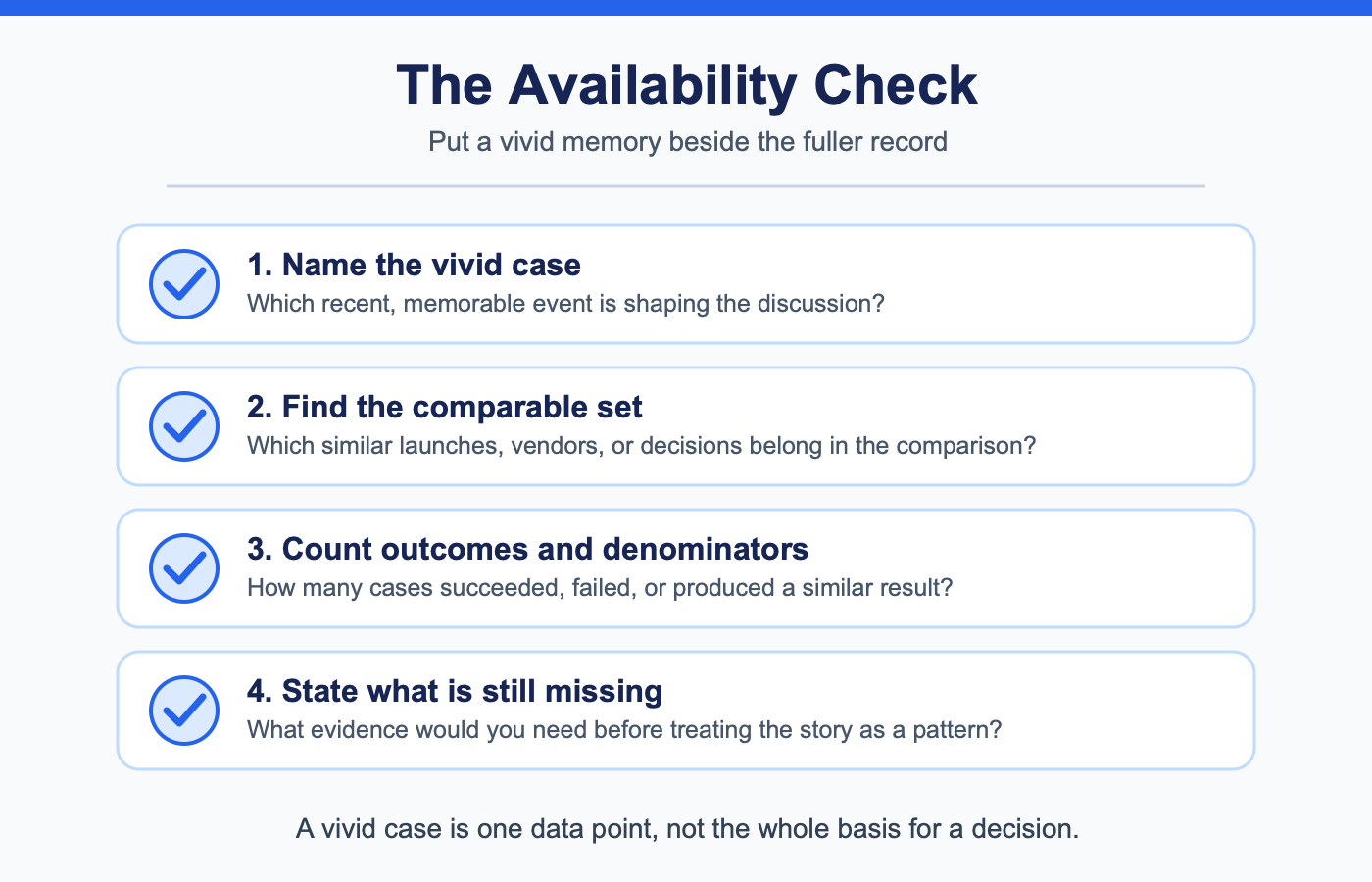
The Availability Check turns a compelling story into a decision you can defend. Use it in order:
- Name the memorable event. Say exactly which recent, vivid, or emotional example is shaping the discussion.
- Find the comparable set. Ask which similar launches, vendors, or decisions belong in the same comparison.
- Count outcomes and denominators. Compare how many cases succeeded, failed, or produced a similar result.
- State what is still missing. Identify the evidence you need before treating the story as a pattern.
Applying the Check to Your Own Intuition 🪞
It is easy to spot when someone else is blinded by a vivid example, but your own memory is just as deceptive. When you feel a strong "gut" instinct for or against a plan, it is often just your most recent or most painful memory shouting louder than the data. Before you enter a meeting to pitch a strategy built on a memorable win or loss, run the Availability Check on yourself. Name the memory, ask for the denominator, and identify what evidence you still need before your instinct becomes a recommendation.
Watch how Nova applies the Availability Check to herself to check her own intuition:
- Nova: I’m hesitant to run the "Flash Sale" play again. That site crash last year was a total nightmare that's still stuck in my head.
- Jake: I remember — we were all in the conference room for three days straight.
- Nova: Actually, let me check my own denominator. That's the one I remember best, but how many total sales did we run that year?
- Jake: We ran twelve sales total, one every month.
- Nova: And only one crashed. I'm letting an 8% failure rate feel like a 100% certainty because it was so stressful.
- Jake: Good catch! It's worth looking at the other eleven successes before we write off the strategy.
By performing the check internally, Nova transforms her "gut feeling" back into a manageable statistic. This prevents her from making a defensive decision based on a single "loud" memory rather than the "quiet" success of the other eleven cases.
Weighing the Vivid Case Against the Fuller Data ⚖️
Once you have the denominator, weigh the memorable case correctly rather than discounting it. In a strategy note or recommendation, acknowledge the vivid case and its real lesson first. Then place it inside the full set of comparable outcomes, state what the broader data supports, and name the specific evidence still needed before you commit.
Weighing well starts with separating two things the vivid case is quietly bundling together: what can happen and how often it happens. A single dramatic event is strong evidence for the first and almost no evidence for the second. Nova's crash proved that a flash sale can take the site down and showed exactly how — that mechanism is real information worth keeping. What it could never establish on its own is the failure rate. So harvest the mechanism from the story, and take the frequency from the set.
The failure mode is the shortcut "it worked once, do it again," or its mirror, "it burned us once, never again." The correct move is to count the case as one data point, not the whole basis. That keeps a single memory from setting a plan it was never large enough to justify.
The takeaway is simple: when a striking example starts steering the room, ask for the denominator. In the next activities, you will first pause to check whether your own memorable experience is steering your judgment, then run the Availability Check in a conversation, and finally write a recommendation that weighs a vivid case against fuller evidence.
