Anchors and Frames
Welcome to the Course 🎉
Welcome to Spotting Cognitive Bias! As a general manager, your gut is fast and usually right, but it is also quietly editable. The number a vendor says first, the way a proposal is worded, or a deal that blew up last quarter can tilt a decision without changing a single underlying fact. Across this course, you'll build bias checks you can apply to real decisions.
In this lesson, you will learn to:
- Spot anchoring and framing when an opening number or a change in wording tilts your judgment
- Restate the same deal as both a gain and a loss so wording alone cannot move your target
- Ground your decision on an independent benchmark using the Independent-Estimate and Reframing Check
Spotting the Anchor and the Frame ⚓
Picture the moment a vendor slides a proposal across the table and names a price before you have said anything. That first figure is now doing work on you whether you like it or not. This is anchoring: the opening number pulls your final judgment toward it, even when the number is arbitrary. Ask for a discount and you will negotiate down from their figure rather than up from what the thing is actually worth. The anchor has become the center of gravity.
Framing changes how identical facts feel by presenting them as a gain or a loss. "Keep 92% of your margin" and "give up 8% of your margin" describe the exact same deal, but one feels safe and the other feels like bleeding. Your suppliers, your team, and your own internal narrator can frame a choice toward the answer they already want.
Here is a procurement conversation between Dan, a vendor account executive, and Jessica, the general manager deciding whether the proposal fits her team's needs. Jessica has not yet built an independent estimate, so she listens for both the anchor and the frame before she treats Dan's offer as a real saving.
- Dan: List is $240K, but I can do $210K if we sign this quarter. I know that is a big number, so I want to make the saving clear.
- Jessica: I appreciate the offer. Saving $30K off list sounds useful, but I need to know what this scope should cost before I call it a win.
- Dan: Fair. The list price is our usual reference point, and the discount is real against that number.
- Jessica: It may be real against list, but I do not yet know whether $210K is fair for our need. I will compare it with our benchmark before we decide.
- Dan: That makes sense. Send me the scope assumptions you use, and I can show where our price differs.
- Jessica: Good. Then we can discuss the difference without letting the opening number decide for us.
Notice Jessica catches both moves at once: the $240K anchor and the "save $30K" gain frame. She does not reject Dan's offer. She simply refuses to use his reference point in place of her own.
Restate the Deal Both Ways 🔄
Once you can spot a frame, say the outcome out loud both ways before you decide. Take the number in front of you and state it as a gain: "we save X against their list." Then state the identical outcome as a loss: "we still overpay by Y versus what this should cost." If your preferred position shifts when only the wording changed, the wording is steering you rather than the facts.
This is a discipline you run in the room, not a theory you nod at. When a rep says "you're walking away from a 15% saving," translate it on the spot: a saving against what, their opening number or a fair price? Naming the loss frame out loud, "we would still be paying above benchmark," restores the half of the picture the gain frame conveniently hid. The point is not to be cynical. It is to keep both frames on the table so wording alone cannot move your target.
| Gain Frame | Loss Frame |
|---|---|
| "We save $30K versus the $240K list price." | "We pay $15K above our $195K benchmark." |
| "We keep 92% of our margin." | "We give up 8% of our margin." |
| "We avoid a $20K implementation fee." | "We still commit to a $210K total cost." |
Grounding Yourself in an Independent Number 📏
Anchoring and framing have less influence when you compare the offer with a number you built independently. The Independent-Estimate and Reframing Check gives you a reference point that comes from your own evidence rather than the vendor's opening figure.
- Build your benchmark before the conversation. Estimate what the scope should cost using your own data, comparable deals, or a cost breakdown.
- State the outcome both ways against that benchmark. Describe the offer as both a gain and a loss, but measure each statement against your estimate, not the vendor's list price.
- Test whether wording changes your preference. If the same facts produce different choices only because the wording changed, return to your benchmark and decide from there.
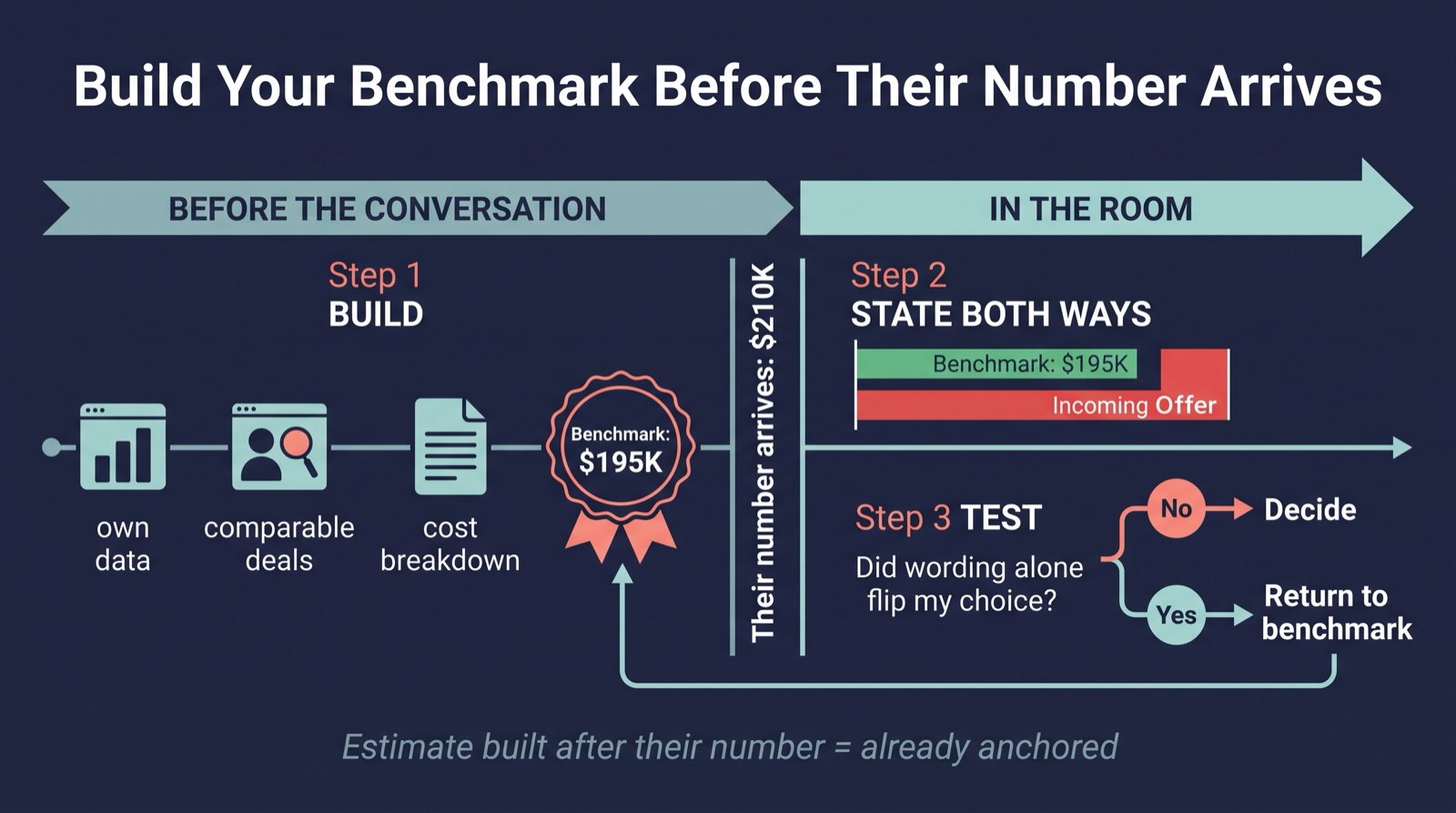
The sequence matters. If you build the estimate after hearing their number, the anchor has already contaminated it, so do the homework before the conversation whenever you can. Walk in with "fair cost is around X," and their opening figure becomes one data point to evaluate instead of the center of gravity.
The first number and the chosen wording are moves, not facts. In the next activities, you will first identify whether an anchor or a frame is distorting a negotiation, then practice keeping a vendor conversation tied to your independent benchmark, and finally write a recommendation with a defensible target and walk-away.
