You have made it to lesson four of five in Solving One-Step Inequalities — the home stretch! So far, you have built a solid set of tools: adding and subtracting to isolate a variable, multiplying and dividing by positives, and applying the sign-flip rule when a negative number is involved. Every one of those skills assumed the variable would end up on the left side of your final answer. But what happens when the variable lands on the right instead? In this lesson, you will learn how to read those results confidently and rewrite them in the familiar "variable on the left" form.
When the Variable Lands on the Right
Most solved inequalities you have seen look like x>3 or x≤10, with the variable sitting neatly on the left. Not every inequality starts that way, though. Consider 9<x+2: the constant 9 is on the left and the variable term x+2 is on the right. When we solve, we get 7<x.
That result is perfectly correct math, but it can feel awkward to read. Most textbooks, answer keys, and real-world applications express solutions with the variable on the left, such as x>7. Learning to rewrite results this way makes them easier to interpret and keeps your work consistent with the standard form you will see everywhere.
Swapping Sides Reverses the Symbol
The key idea is straightforward: if we swap the two sides of an inequality, we must reverse the direction of the symbol. Think of it like a seesaw. If the left side is lighter (<) than the right side, then the right side is heavier (>) than the left. Nothing about the relationship changes; we are simply describing it from the other direction.
Original (variable on right)
Rewritten (variable on left)
7<x
x>7
−4≤x
x≥−4
10>x
x<10
2≥x
x≤2
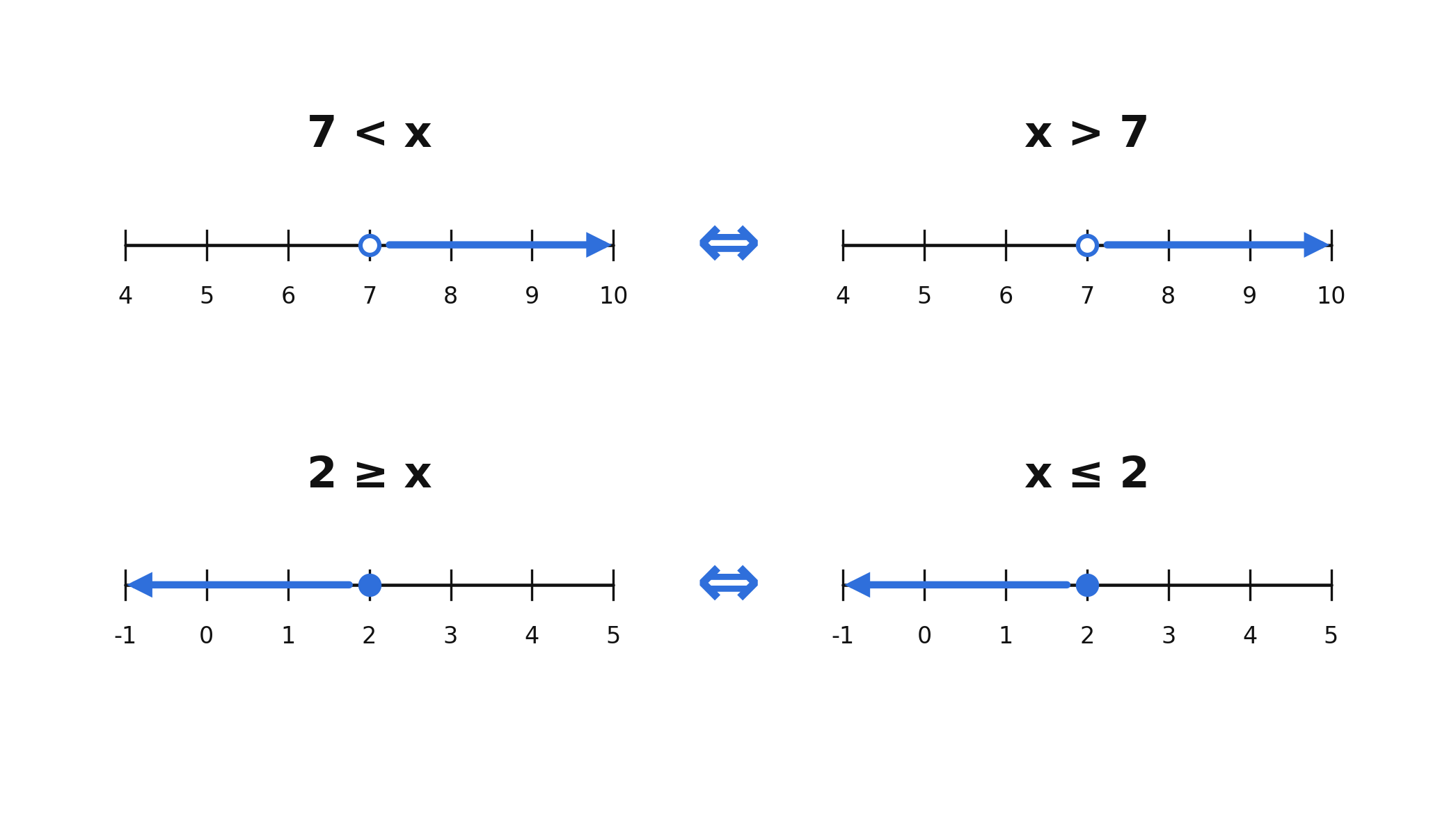
Notice the pattern: < becomes >, ≤ becomes ≥, and vice versa. The two statements in each row describe exactly the same set of values. We are not performing a new operation on the inequality — we are simply reading it from the other side.
A quick number-line check confirms that swapping the sides changes the way we write the inequality, not the values that make it true.
Join the 1M+ learners on CodeSignal
Be a part of our community of 1M+ users who develop and demonstrate their skills on CodeSignal
Solving Additive Cases and Rewriting
Solving Multiplicative Cases and Rewriting
A Real-World Example: Free Shipping
Conclusion and Next Steps
In this lesson, we learned that swapping the two sides of an inequality reverses the direction of the symbol while keeping the solution set identical. This gives us a clean two-stage workflow: first, solve the inequality using the inverse-operation skills from earlier lessons; second, rewrite the result with the variable on the left by swapping sides and reversing the symbol. Whether the original problem involves addition, positive scaling, or negative scaling, the rewriting step works the same way every time.
Now it is your turn to make this skill second nature! The practice exercises ahead will walk you through matching equivalent statements, completing worked solutions step by step, solving a variety of right-side-variable inequalities on your own, and applying the technique to a real-world shopping scenario.
Step 1 — Isolate the variable. Subtract 2 from both sides:
9−2<x+2−27<x
Step 2 — Rewrite with the variable on the left. Swap the sides and reverse the symbol:
x>7
Two stages: solve as usual, then rewrite. Let's try another. Solve −3≥x−5:
Step 1: Add 5 to both sides:
−3+5≥x−5+52≥x
Step 2: Swap and reverse:
x≤2
The solving step uses the same inverse operations you already know. The rewriting step is just a quick rearrangement at the end.
The same two-stage process works when the variable is multiplied. Solve:
12≥4x
Step 1: Divide both sides by 4 (positive, so the symbol stays the same):
3≥x
Step 2: Swap and reverse:
x≤3
Now let's bring in the sign-flip rule from the previous lesson. Solve:
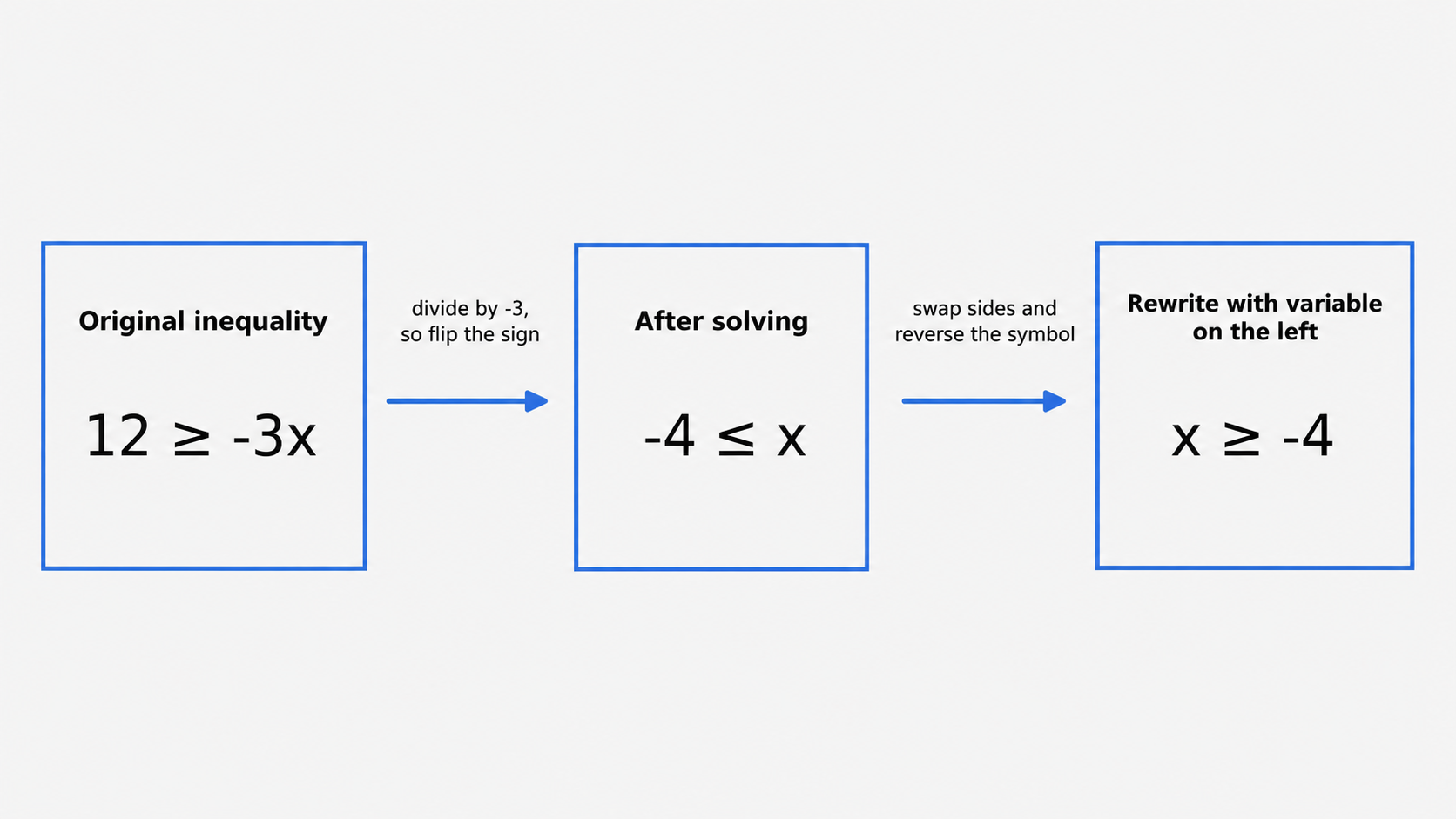
12≥−3x
Step 1: Divide both sides by −3. Because we are dividing by a negative number, we flip the inequality sign:
−312≤−3−3x−4≤x
Step 2: Swap and reverse:
x≥−4
Let's verify with x=0. Substituting into the original gives 12≥−3(0)=0, which is 12≥0. ✓
Notice that the sign flip (from dividing by a negative) and the swap (from moving the variable to the left) are two separate actions. Apply them one at a time to stay organized and avoid confusion.
Imagine an online store offers free shipping when your adjusted subtotal is at least $35. You have a $5 coupon, so your adjusted subtotal is p−5, where p is the price of the items in your cart. The store's rule translates to:
35≤p−5
The threshold (35) naturally appears on the left because the store states the minimum first. Let's solve.
Step 1: Add 5 to both sides:
40≤p
Step 2: Swap and reverse:
p≥40
You need at least $40 worth of items in your cart before the coupon to qualify for free shipping. Writing the answer as p≥40 is much more natural to read than 40≤p, even though both say exactly the same thing.