The Sign Flip Rule
Introduction
Welcome to lesson three of Solving One-Step Inequalities! You are now halfway through this course, and your toolkit has been growing steadily. In the first two lessons, we solved inequalities using addition, subtraction, multiplication, and division — and every time, the inequality sign stayed exactly where it was. Now we face the one situation where that changes: multiplying or dividing by a negative number. This lesson introduces the sign-flip rule, explains why it works, and gives you a clear way to apply it every time.
What Changes with Negative Numbers?
In the previous lesson, we saw that multiplying or dividing both sides of an inequality by a positive number keeps the direction unchanged. Positive scaling preserves order, so the inequality sign stays put.
Negative numbers, however, behave differently. Take the true statement and multiply both sides by . We get and . Is ? Not at all — on the number line, is to the right of , so . The inequality has reversed. Let's explore why this happens before we start solving.
Why Negation Reverses Order
Picture the numbers and on a number line. The number sits to the left of , confirming that . When we multiply both by , each number reflects across zero like a mirror. The lands at , and the lands at .
Notice that , being farther from zero on the positive side, ends up farther from zero on the negative side. That places to the left of , making it the smaller value. The original left-to-right order has flipped.
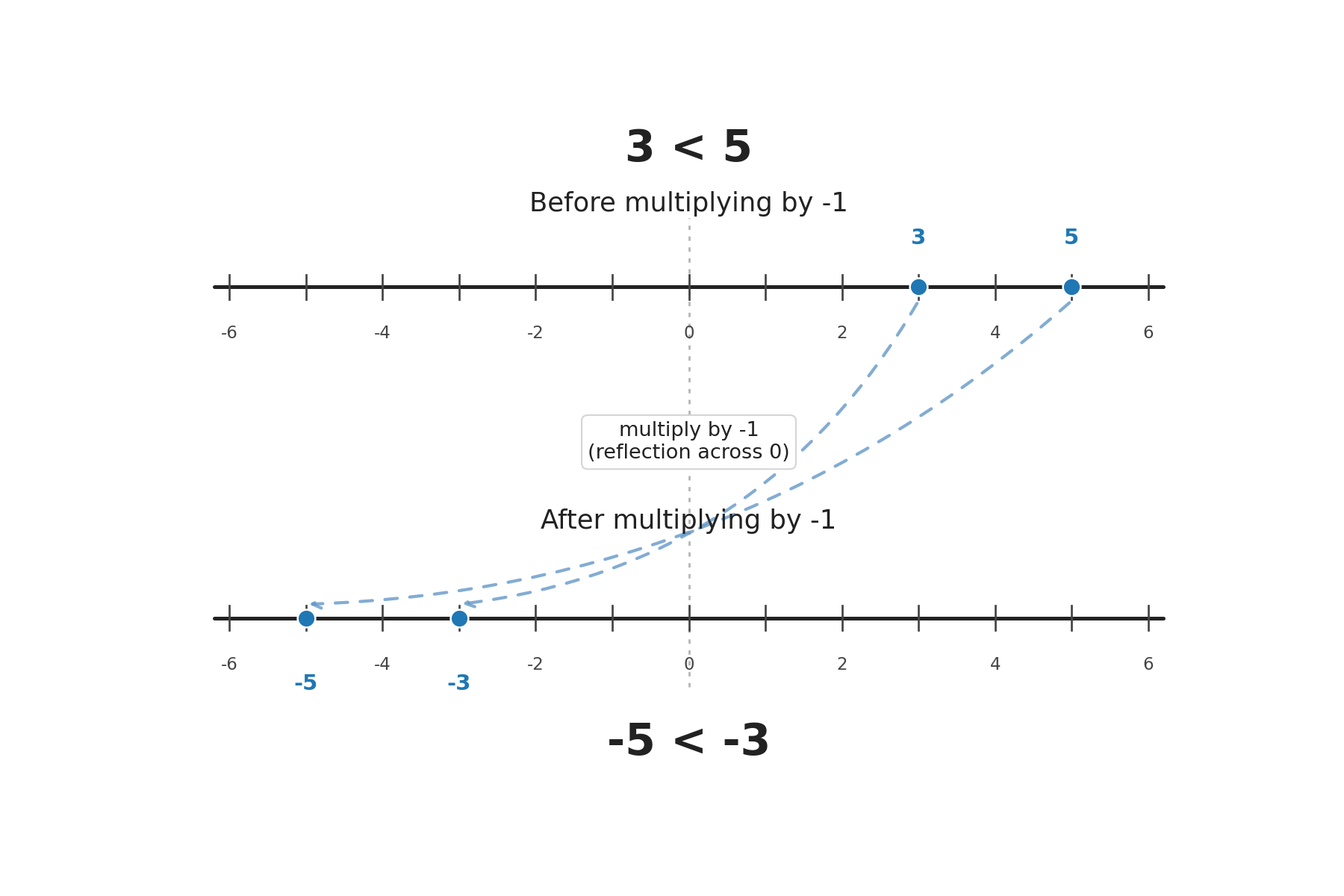
This reflection works the same way with any negative multiplier, not just . For example, multiplying both sides of by :
Since , the order reversed again. Whenever we multiply or divide both sides of an inequality by a negative number, we must flip the inequality sign to keep the statement true.
Dividing Both Sides by a Negative Number
