Welcome to the second lesson of Solving One-Step Inequalities! In the first lesson, we explored how to solve one-step inequalities using addition and subtraction. Now we are ready to take the next step and work with multiplication and division. In this lesson, we will focus specifically on multiplying and dividing by positive numbers and observe why these operations leave the inequality sign pointing in the same direction.
From Shifting to Scaling
As you may recall from the previous lesson, when an inequality like x−5>3 has a number added to or subtracted from the variable, we undo it with the opposite operation. But what do we do when the variable is being multiplied by a number instead?
Consider 3x<12. Here, adding or subtracting won't isolate x because x is being scaled by a factor of 3. To undo that scaling, we need the inverse operation: division. This is the same principle we use when solving equations, and it carries over to inequalities with one important detail to watch: what happens to the inequality sign.
Dividing Both Sides by a Positive Number
When a variable is multiplied by a positive coefficient, we divide both sides by that coefficient to isolate the variable. Let's walk through an example:
3x<12
Divide both sides by 3:
33x<312x<4
Notice that the < sign stayed exactly the same. Because we divided by a positive number, the direction of the inequality did not change. Any value less than 4 satisfies the original inequality.
Let's try one more. Solve 5x≥20:
55x≥520x≥4
The ≥ sign is preserved. The rule is straightforward: dividing both sides by a positive number keeps the inequality direction unchanged.
Why the Direction Stays the Same
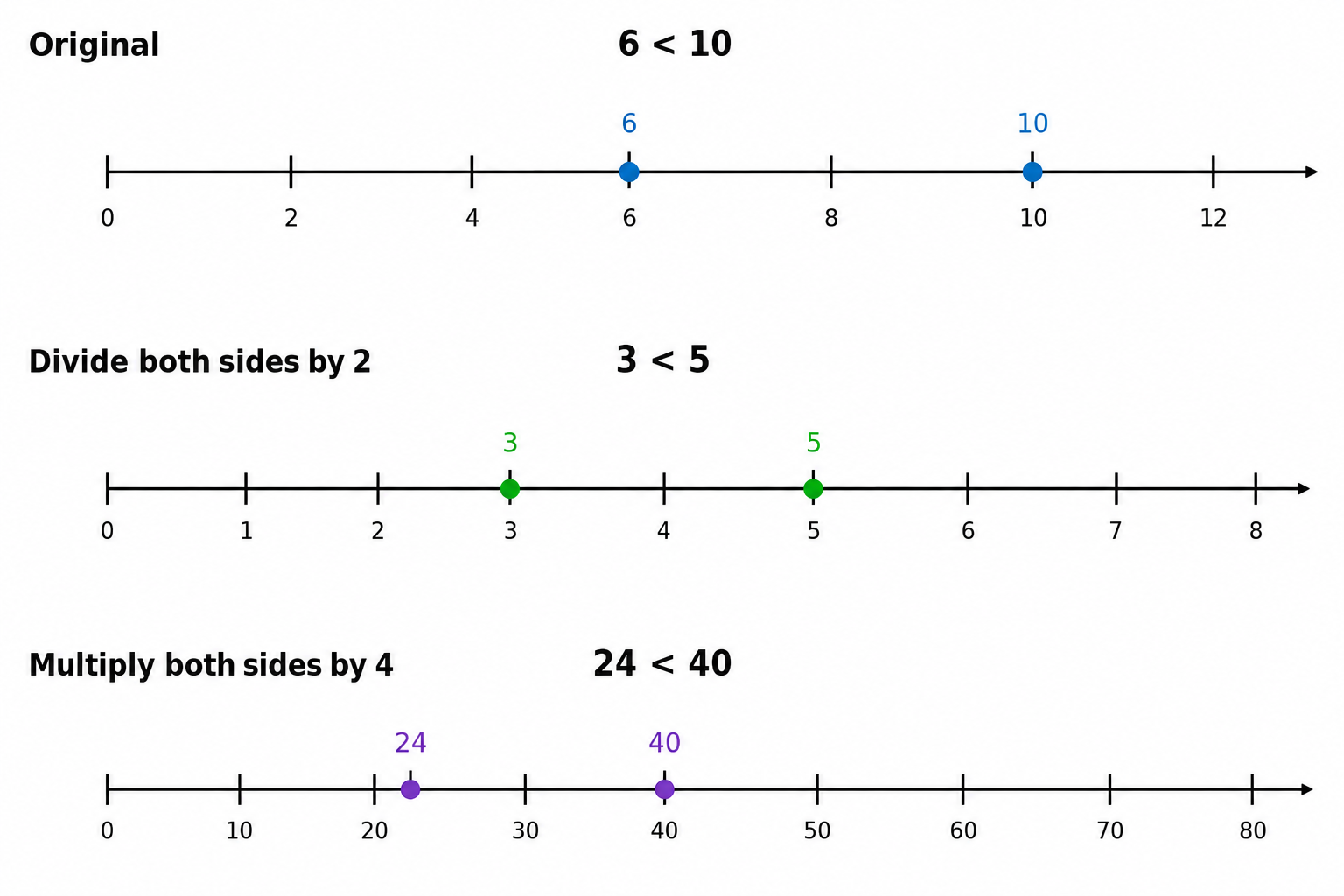
To see why this rule makes sense, think about a simple numerical fact. We know that 6<10. If we divide both sides by 2, we get 3<5, which is still true. If we multiply both sides by 4, we get 24<40, also true.
Scaling two quantities by the same positive factor does not rearrange their order. The smaller value remains smaller, and the larger value remains larger. This is why multiplying or dividing both sides of an inequality by any positive amount keeps the sign pointing the same way.
Join the 1M+ learners on CodeSignal
Be a part of our community of 1M+ users who develop and demonstrate their skills on CodeSignal
Multiplying Both Sides to Clear Fractions
Working with Decimal Coefficients
Applying This to a Budget Scenario
Conclusion and Next Steps
In this lesson, you learned that multiplying or dividing both sides of an inequality by a positive number works just like it does with equations: you isolate the variable, and the inequality sign stays unchanged. This holds for whole-number, fractional, and decimal coefficients alike. The core idea is that positive scaling preserves the order of numbers, so it preserves the direction of the inequality.
Up next, you will practice these skills with exercises ranging from straightforward divisions to fractional and decimal coefficients, plus a real-world budgeting scenario. After that, the next lesson will tackle what happens when you multiply or divide by a negative number — a situation where the inequality sign does not stay the same!
Sometimes the coefficient is a fraction rather than a whole number. For example:
21x≥4
Here, x is multiplied by 21. To undo this, we multiply both sides by its reciprocal, 2:
2⋅21x≥2⋅4x≥8
Since 2 is positive, the inequality direction stays the same. The same approach works for any positive fractional coefficient. To solve 43x>9, we multiply both sides by 34:
x>9⋅34=12
The > sign is unchanged because 34 is positive. The key idea with fractions is to always multiply by the reciprocal — this turns the coefficient into 1 in a single step.
Decimal coefficients follow the exact same logic. Consider:
0.5x>6
Since 0.5 is equivalent to 21, we can multiply both sides by 2 (or equivalently, divide by 0.5):
x>2⋅6=12
Let's try another one: 0.25x≤3. Multiplying both sides by 4 (the reciprocal of 0.25):
x≤4⋅3=12
Whether the positive coefficient is a whole number, a fraction, or a decimal, the process is the same. Identify the inverse operation, apply it to both sides, and keep the inequality sign as it is.
Let's see how this works in an everyday situation. Suppose concert tickets cost $15 each, and you have a total budget of $90. If x represents the number of tickets you can buy, your total spending cannot exceed the budget:
15x≤90
Dividing both sides by 15:
x≤6
You can buy at most 6 tickets. Because 15 is positive, the ≤ sign stays the same, confirming that purchasing 6 or fewer tickets keeps you within budget. Notice how naturally the inequality captures the constraint — it tells you not just one answer, but the entire range of affordable options.