Adding and Subtracting Inequalities
Introduction
Welcome to Solving One-Step Inequalities! This is the very first lesson of the course, and we are starting with a skill that builds directly on everything you learned in the previous course, Understanding Inequalities. There, you explored what inequality symbols mean, how to check whether a value is a solution, and how to read inequalities on a number line. Now it is time to put that knowledge to work and learn how to solve inequalities on your own. In this lesson, we will focus on solving one-step inequalities using addition and subtraction.
A Quick Refresher Before We Start
Because solving inequalities relies on "undoing" operations, it helps to be comfortable with a couple of ideas from earlier math. Take a moment to make sure these feel familiar:
- Inverse operations undo each other. Addition and subtraction are inverses, so to undo "" we subtract , and to undo "" we add . This is the same move you used when solving one-step equations like .
- Signed-number arithmetic. You will often add or subtract with negative numbers, so remember that and . If working with negatives feels shaky, it is worth reviewing that first, since the arithmetic — not the method — is where most mistakes happen.
If both of these ideas make sense, you are ready to solve inequalities. If not, a short review of one-step equations and signed-number arithmetic will make everything that follows much smoother.
From Equations to Inequalities
If you have ever solved a simple equation like , you already know the core idea: do the same operation to both sides to get the variable alone. Solving an inequality works almost the same way. The only difference is that instead of an equals sign, we have a symbol like , , , or , and our answer describes a range of values rather than a single number.
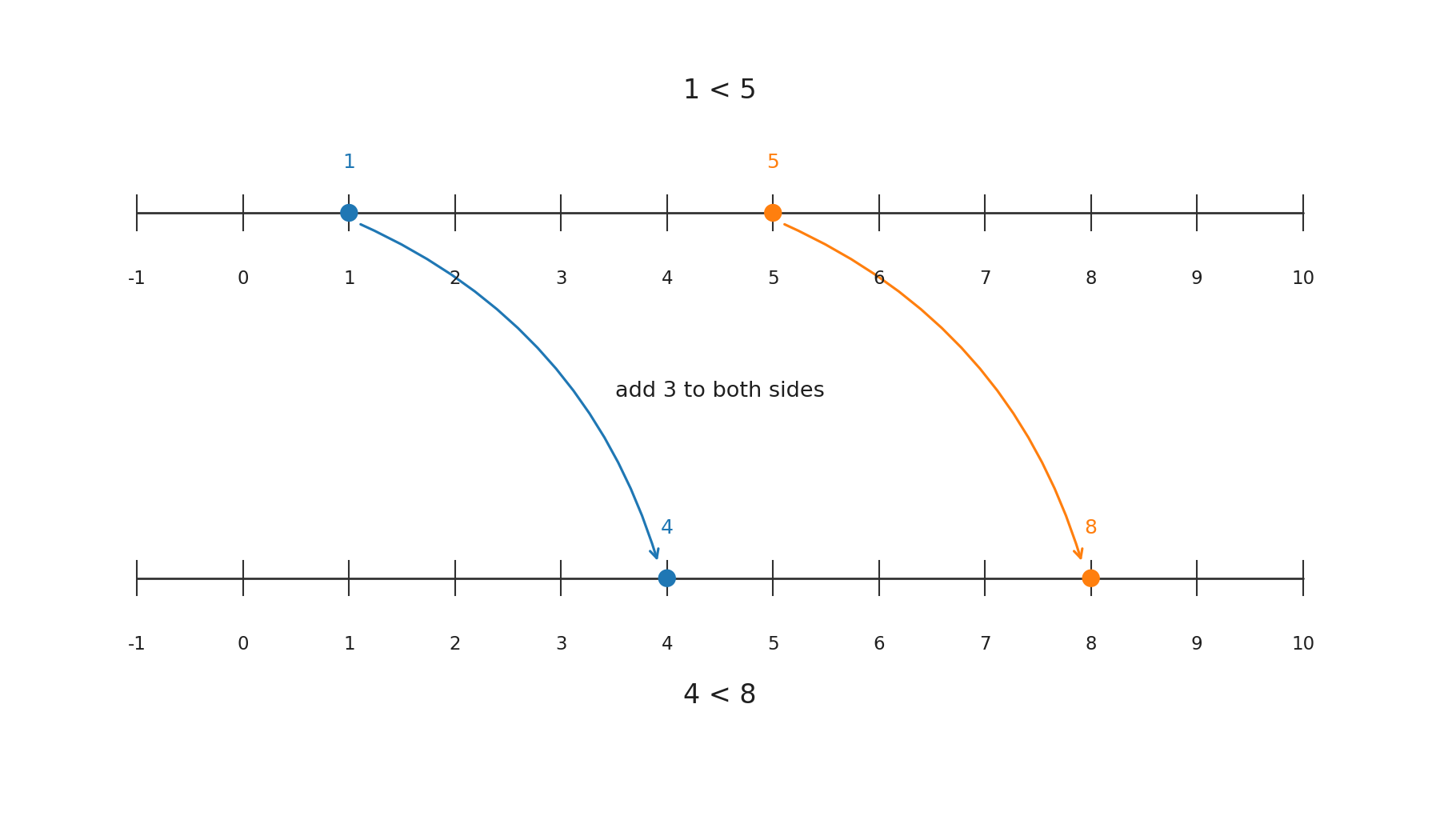
The good news for this lesson is that when we add or subtract the same number on both sides of an inequality, the direction of the inequality symbol does not change. That makes the process feel just like solving an equation. Let's see exactly how it works.
Solving by Adding to Both Sides
When a number is being subtracted from the variable, we undo it by adding that same number to both sides. Consider the inequality:
We want by itself on the left. Since is being subtracted from , we add to both sides:
The solution tells us that every value greater than satisfies the original inequality. Notice that the symbol stayed exactly the same throughout the process.