Welcome to the fifth and final lesson of Solving One-Step Inequalities! Over the previous four lessons, you built up a toolkit of individual techniques: adding and subtracting, multiplying and dividing by positives, flipping the sign when negatives are involved, and rewriting results when the variable ends up on the right. Each time, you knew in advance which technique to use because the lesson told you. Starting now, the training wheels come off. This lesson shows you how to look at any one-step inequality, figure out what it needs, and solve it correctly — all on your own.
Three Cases, One Decision
Every one-step inequality you will encounter falls into one of three categories. The category depends entirely on what is being done to the variable, and it determines both the inverse operation you need and whether the inequality symbol changes direction.
Case
What is happening to x
Inverse operation
Flip the sign?
Additive
A number is added to or subtracted from x
Subtract or add that number
No
Positive scaling
x is multiplied or divided by a positive number
Divide or multiply by that number
No
Negative scaling
x is multiplied or divided by a negative number
Divide or multiply by that number
Yes
Only one of the three cases — negative scaling — requires reversing the inequality symbol. Two out of three leave it alone. Keeping that ratio in mind helps you resist the urge to flip when no flip is warranted. The rest of this lesson turns this table into a quick, repeatable process you can apply to any problem.
Step 1: Identify the Operation on the Variable
Before doing any algebra, pause and read the inequality carefully. Ask yourself: what is being done to the variable?
In x+9≤14, the number 9 is added to x.
In 3x>21, the variable is multiplied by 3 (a positive number).
In −5x≥40, the variable is multiplied by −5 (a negative number).
In −2x<7, the variable is divided by −2 (a negative number).
The operation you identify tells you which inverse operation to apply. Addition undoes subtraction, multiplication undoes division — the same inverse-operation logic you already know from solving equations. Once you have named the operation, you are ready for the critical follow-up question.
Join the 1M+ learners on CodeSignal
Be a part of our community of 1M+ users who develop and demonstrate their skills on CodeSignal
Step 2: Decide Whether to Flip
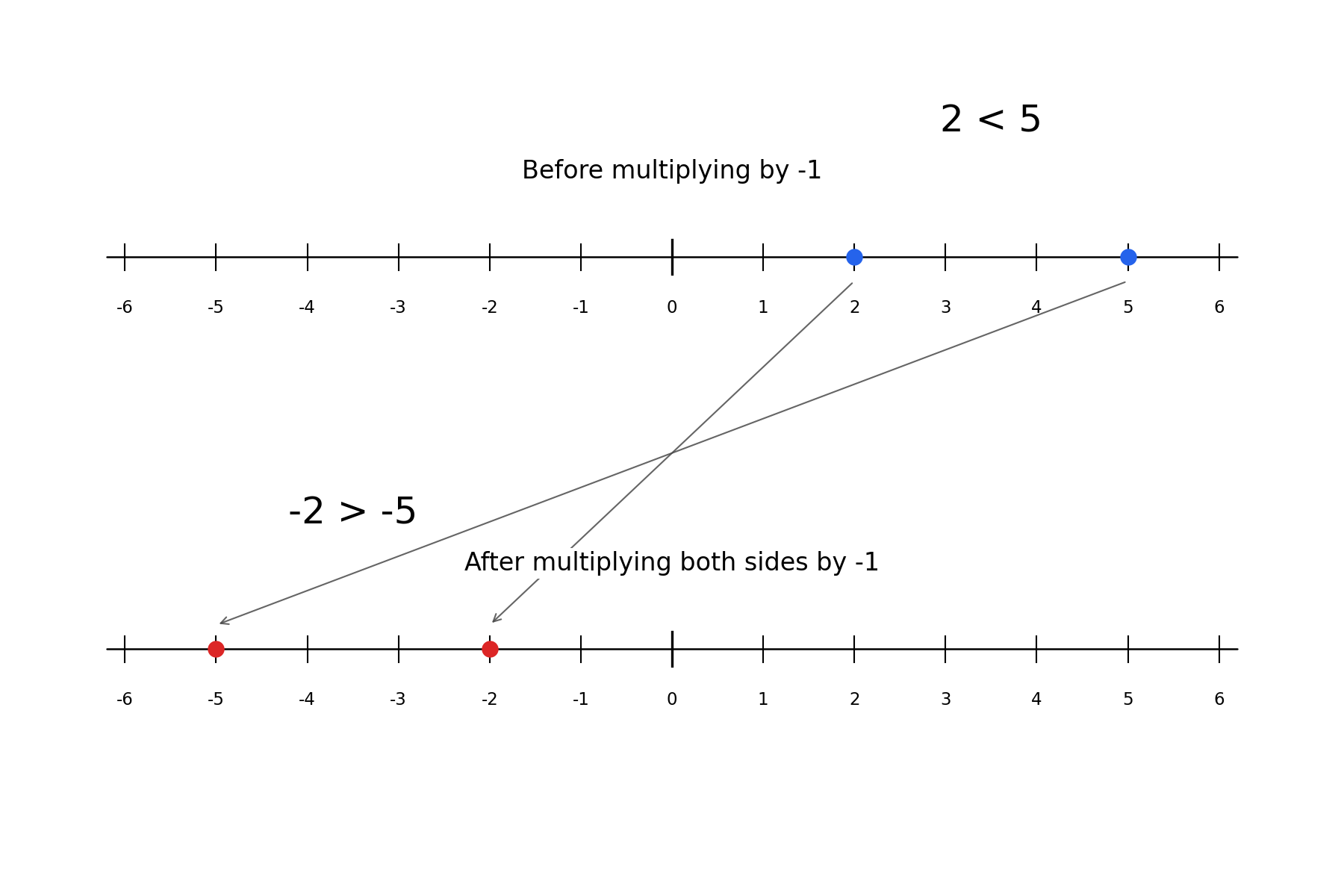
With the operation identified, the flip decision comes down to a single yes-or-no question. Recall from the earlier lesson on the sign-flip rule that multiplying or dividing both sides of an inequality by a negative number reverses the order of values on the number line, so the symbol must reverse too. In every other situation — adding, subtracting, or scaling by a positive — the symbol stays the same.
Here is what that reversal looks like on a number line:
A simple checkpoint captures the entire decision:
Am I multiplying or dividing both sides by a negative number?
Yes → flip the inequality symbol.
No → keep the symbol as it is.
That one question is the most important habit to build. Ask it every time, right before you write your answer, and the sign-flip rule will never catch you off guard.
Walkthrough: Mixed Examples
When the Variable Starts on the Right
A Real-World Application
Common Mistakes to Avoid
Conclusion and Next Steps
In this lesson, you unified every technique from the course into one streamlined decision process: identify what is being done to the variable, apply the matching inverse operation, and check whether that operation involves multiplying or dividing by a negative. If it does, flip the symbol; if it does not, leave it alone. That consistent routine is all you need to handle any one-step inequality with confidence.
Now it is time to put this skill to the test! The practice exercises will ask you to spot when a flip is needed, fill in the steps of mixed worked examples, solve a variety of inequalities on your own, set up and solve a real-world earnings problem, and diagnose a deliberate mistake in someone else's solution. Dive in and see how far you have come!
Let's put the two-step process to work on a series of inequalities, deliberately mixing the three cases so you can see the decision unfold each time.
Example 1 — Additive case. Solve x−6>2.
The variable has 6 subtracted from it, so we add 6 to both sides. No negative multiplier or divisor is involved, so the symbol stays:
x−6+6>2+6x>8
Example 2 — Positive scaling. Solve 4x≤28.
The variable is multiplied by 4 (positive), so we divide both sides by 4. Positive divisor means no flip:
44x≤428x≤7
Example 3 — Negative scaling. Solve −7x>42.
The variable is multiplied by −7 (negative), so we divide both sides by −7. Negative divisor means we flip> to <:
−7−7x<−742x<−6
Quick check: try x=−10. The original gives −7(−10)=70, and 70>42 ✓.
Example 4 — Negative scaling with division. Solve −3x≥5.
The variable is divided by −3 (negative), so we multiply both sides by −3. Negative multiplier means we flip≥ to ≤:
x≤5×(−3)x≤−15
Quick check: try x=−18. The original gives −3−18=6, and 6≥5 ✓.
Across all four examples, the decision always came down to the same question: is the number I am multiplying or dividing by negative? The operation changes from problem to problem, but the reasoning process stays identical.
As we saw in the previous lesson, the variable sometimes appears on the right side of the inequality. The solving strategy does not change — you still identify the operation and decide whether to flip — but you add one final rewriting step: swap sides and reverse the symbol so the variable ends up on the left.
For example, solve 20<−4x:
Step 1 — Divide both sides by −4 (negative, so flip < to >):
−420>x−5>x
Step 2 — Swap sides (reverse > to <):
x<−5
Remember that the swap is a separate reason for reversing the symbol, distinct from the sign-flip rule. In this problem, the symbol reversed twice — once for the negative divisor and once for the side swap — and both reversals were necessary.
Suppose you earn $12 per hour at a part-time job and want to make at least $180 this week. If h represents the number of hours you work, the inequality is:
12h≥180
Identify the operation: h is multiplied by 12, a positive number. Divide both sides by 12 — no flip needed:
h≥15
You need to work at least 15 hours to hit your goal. In one quick step we identified the case (positive scaling), confirmed no sign flip was required, and produced a clear answer. That is the full decision process at work in an everyday situation.
Even with a solid process, a few pitfalls show up frequently. Being aware of them now will save you from errors in the practice ahead.
Flipping when you should not. Adding or subtracting a negative number does not trigger a flip. For instance, solving x+(−3)>5 means adding 3 to both sides — no sign change. The flip rule applies only when you multiply or divide by a negative.
Forgetting to flip when you should. If the coefficient of x is negative, you must reverse the symbol when you divide by it. Skipping this step is the single most common error in one-step inequalities.
Confusing the side swap with the sign-flip rule. Rewriting −5>x as x<−5 is a side swap, not a consequence of dividing by a negative. These are two independent reasons for a reversal, and a single problem can involve both.