Welcome back to Solving Multi-Step Inequalities! In our second lesson, we continue building on the two-step solving skills you developed in Lesson 1. There, every inequality was already in a tidy ax+b□c form, ready for inverse operations. But what happens when one side of the inequality has extra terms that need cleaning up first? In this lesson, you will learn to combine like terms before solving, reducing a cluttered expression to the familiar two-step shape you already know how to handle.
Why Simplify Before Solving?
Picture this: you run a small bakery and order 5 trays of supplies at x dollars each on Monday, then return 2 of those trays on Tuesday. You also pay a flat $1 packing fee. You need the total cost to stay above $7 to qualify for a vendor discount. The inequality is 5x−2x+1>7.
We could subtract 1 from both sides right away — that step is perfectly valid and gives 5x−2x>6 — but we would still be left with two separate x-terms on the left. Combining them first is the more efficient path: recognizing that 5x and −2x can be merged into 3x turns the inequality into 3x+1>7 — exactly the kind of problem we tackled last time. That quick simplification step is what this lesson is all about.
Reviewing Like Terms
Like terms are terms whose variable parts match exactly; only the numerical coefficients differ. Here is a quick reference:
Like Terms
Why
Not Like Terms
Why Not
5x and −2x
Same variable x
5x and 5x2
Different exponents
3 and −8
Both are constants
3 and 3x
One has a variable
7y and y
Same variable y
7y and 7z
Different variables
To combine like terms, add or subtract their coefficients while keeping the variable part unchanged. For example, 5x−2x=3x because 5−2=3.
The Simplify-Then-Solve Workflow
The core idea of this lesson fits into one sentence: combine like terms first, then solve using the two-step process you already know. Combining like terms is pure simplification — we are rewriting one side of the inequality in a shorter form, not multiplying or dividing both sides by anything — so the inequality direction does not change.
Let's walk through the bakery example step by step.
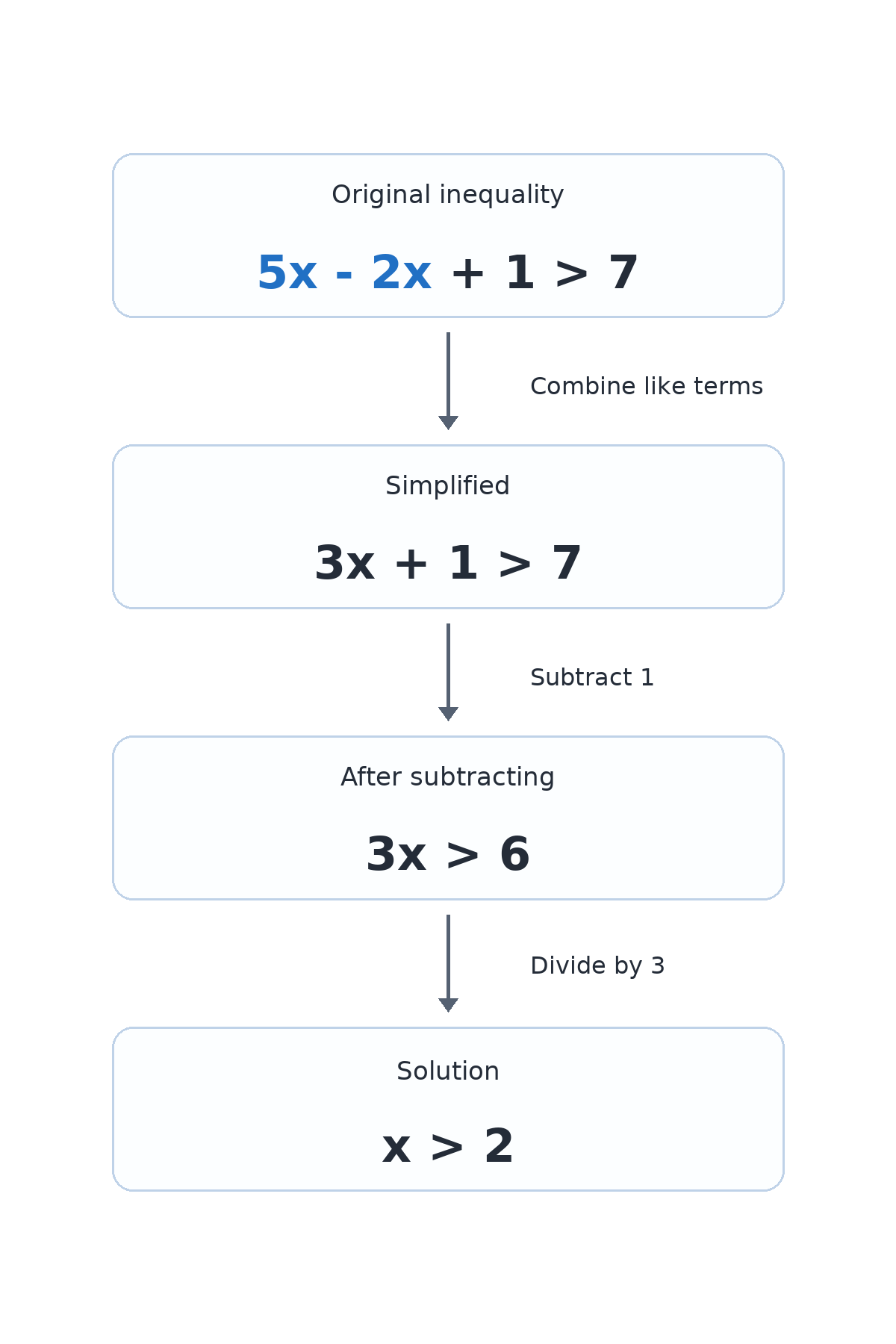
5x−2x+1>7
Step 1 — Combine like terms. The x-terms 5x and −2x merge into one:
3x+1>7
Step 2 — Subtract 1 from both sides:
3x>6
Step 3 — Divide both sides by 3:
x>2
The coefficient is positive, so no sign flip is needed. Every value greater than 2 satisfies the original inequality. The diagram below shows how the three phases connect:
Join the 1M+ learners on CodeSignal
Be a part of our community of 1M+ users who develop and demonstrate their skills on CodeSignal
When Combining Creates a Negative Coefficient
Combining Multiple Groups of Like Terms
A Real-World Budget Scenario
Pitfalls to Avoid
Conclusion and Next Steps
Combining like terms is a small but essential preparatory step that transforms a cluttered inequality into the clean two-step form you already know how to solve. The workflow stays consistent every time: scan for terms with matching variable parts, merge their coefficients, and then apply inverse operations. Keep in mind that simplification alone never changes the inequality's direction — the sign-flip rule only applies when you divide or multiply both sides by a negative number.
Now it is your turn to practice! You will start by identifying correctly combined expressions, work through a fully traced solution filling in each result, solve inequalities on your own, and finish by applying the technique to a real-world ordering scenario. Let's get started!
Sometimes combining like terms leaves a negative coefficient in front of the variable. When that happens, the sign-flip rule from Lesson 1 will kick in during the final division step. Consider:
2x−5x+9≤3
Step 1 — Combine like terms.2x−5x=−3x:
−3x+9≤3
Step 2 — Subtract 9 from both sides:
−3x≤−6
Step 3 — Divide both sides by −3 and flip the sign:
x≥2
Let's verify with x=4: 2(4)−5(4)+9=8−20+9=−3, and −3≤3. ✓
Notice that the combining step itself did not change the inequality direction. The flip happened only when we divided by the negative number in Step 3.
In some problems, both the variable terms and the constant terms need combining. Handle all like-term groups at once before moving on to inverse operations.
4x+3−x−7<10
Step 1 — Combine the x-terms:4x−x=3x.
Step 2 — Combine the constants:3−7=−4.
The inequality now reads:
3x−4<10
From here, add 4 to both sides to get 3x<14, then divide by 3:
x<314
The left side went from four terms down to two, and the rest of the solution followed the familiar two-step pattern.
Suppose you are organizing a company lunch. You order 4 sandwich trays at x dollars each from one caterer and 3 more trays at x dollars each from a second caterer, plus a flat $12 delivery fee. Your total budget is at most $75:
4x+3x+12≤75
Step 1 — Combine like terms:4x+3x=7x:
7x+12≤75
Step 2 — Subtract 12:
7x≤63
Step 3 — Divide by 7:
x≤9
Each tray must cost $9 or less to stay within budget. Notice how naturally the like terms appeared: the two batches of trays shared the same unknown price x, so combining them was the logical first move before isolating the variable.
There is one more real-world detail worth noting. Algebraically the solution is x≤9, but a price cannot be negative, so the practical domain is 0≤x≤9. Keeping the algebraic solution and the practical domain separate helps the answer make sense in context.
Combining unlike terms. Only terms with identical variable parts can merge. Writing 3x+4=7x is incorrect because 4 is a constant, not an x-term.
Losing a negative sign. Pay careful attention to subtraction: 2x−5x equals −3x, not 3x. Treating every coefficient as positive is a frequent source of errors.
Flipping the sign during simplification. Combining like terms does not change the inequality direction. The sign flips only when you multiply or divide both sides by a negative number in the solving steps that follow.