Welcome to Solving Multi-Step Inequalities, the third course in your learning path! Having already mastered inequality basics and one-step solving techniques, you are well prepared to tackle problems that require a bit more work. In this first lesson, we will extend what you know by learning to solve two-step inequalities — problems where isolating the variable takes exactly two inverse operations instead of one. By the end, you will be able to handle these confidently, including the cases where a negative coefficient means the inequality sign must flip.
From One Step to Two
In the previous course, every inequality needed just a single operation to isolate the variable. For example, solving x+3>7 required only subtracting 3 from both sides. Real-world problems, however, rarely wrap up that quickly.
Think about a situation like this: you have $50 saved and you earn $15 each week. How many weeks until you have at least $200? The inequality 15w+50≥200 models that question, and getting w alone clearly takes more than one move. That is exactly the kind of problem a two-step inequality captures.
The General Shape of a Two-Step Inequality
Most two-step inequalities follow the pattern
ax+b□c
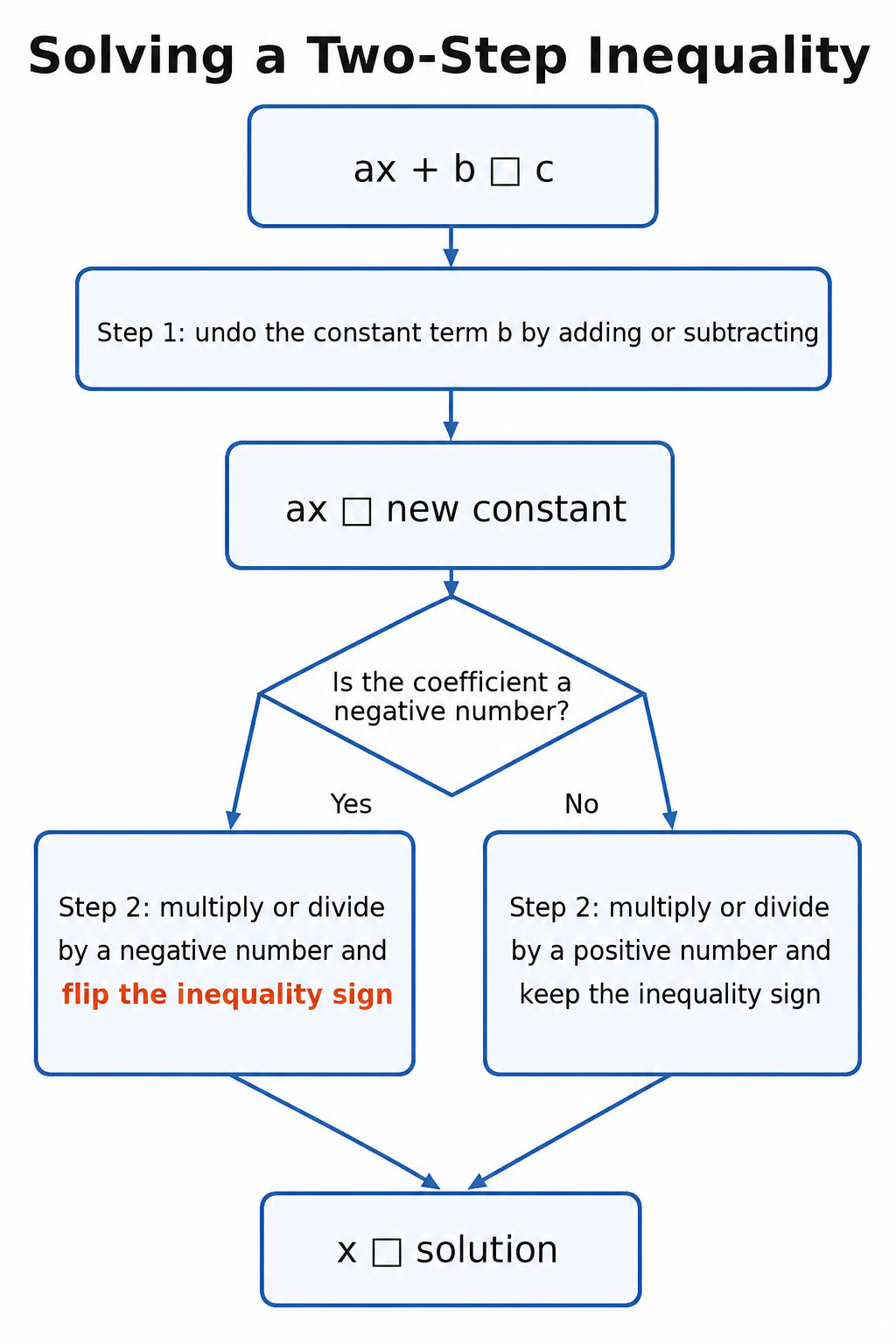
where a is the coefficient multiplied by the variable, b is a number added or subtracted, □ is any inequality symbol, and c is the constant on the other side. Our job is to peel away b first, then isolate the variable by dividing both sides by the coefficient a.
Why that order? The expression ax+b was built by first multiplying x by a and then adding b. To undo it, we reverse the order: undo the addition or subtraction first, then undo the multiplication by dividing both sides by a. This is the same "reverse order" principle you may recall from solving two-step equations.
The flowchart below summarizes the solving order—specifically how to handle dividing by a—and the sign-flip check:
Join the 1M+ learners on CodeSignal
Be a part of our community of 1M+ users who develop and demonstrate their skills on CodeSignal
Solving a Two-Step Inequality (Positive Coefficient)
Handling Negative Coefficients
A Subtraction Variant
Common Mistakes to Watch For
As you start practicing, keep these pitfalls in mind:
Flipping too early. The sign only reverses when you multiply or divide by a negative. Adding or subtracting a negative does not flip the sign.
Wrong operation order. Always undo addition or subtraction before multiplication or division. Tackling the coefficient first leads to messy fractions and frequent errors.
Forgetting to flip at all. If the coefficient of the variable is negative, the flip is required during the division step. Skipping it produces the opposite solution set.
Applying Two-Step Inequalities to Real Life
Conclusion and Next Steps
Two-step inequalities follow a clear, repeatable process: undo the addition or subtraction first, then undo the multiplication or division. The only extra decision point is whether to flip the inequality sign, and the rule is straightforward — flip only when that second step involves a negative number. With just these two moves, you can model and solve a much wider range of problems than one-step inequalities alone could handle.
Up next, you will put these ideas into action with a set of practice tasks. You will start by identifying the correct first operation, work through guided solutions step by step, and then solve complete problems — including a real-world savings scenario — entirely on your own. Let's jump in!
Step 1 — Remove the constant term. Subtract 5 from both sides:
2x≤6
Step 2 — Remove the coefficient. Divide both sides by 2:
x≤3
Because we divided by a positive number, the inequality symbol stays the same. The solution tells us every value of x that is 3 or less satisfies the original inequality.
To verify, pick a value in the solution set, say x=0: plugging in gives 2(0)+5=5, and indeed 5≤11. ✓
As you learned in the previous course, multiplying or dividing both sides of an inequality by a negative number reverses the direction of the inequality sign. This rule still applies in two-step problems — it just shows up during the second step.
Consider:
−3x+4>13
Step 1 — Subtract 4 from both sides:
−3x>9
Step 2 — Divide both sides by −3. Because we are dividing by a negative, we flip the inequality sign:
x<−3
A quick check with x=−5 (which is less than −3): −3(−5)+4=15+4=19, and 19>13. ✓
Not every two-step inequality uses addition on the left side. Here is one with subtraction and a fractional form:
−2x−7≥1
Step 1 — Add 7 to both sides:
−2x≥8
Step 2 — Multiply both sides by −2. Multiplying by a negative means the sign flips:
x≤−16
Notice how the same sign-flip rule kicks in whenever the scaling factor is negative, whether we multiply or divide.
Let's revisit the savings scenario from the beginning of this lesson. You have $50 in your account and deposit $15 each week. You want at least $200. The inequality is:
15w+50≥200
Step 1 — Subtract 50:
15w≥150
Step 2 — Divide by 15:
w≥10
So you need at least 10 weeks of deposits to reach your goal. Because 15 is positive, no sign flip was needed, and the answer makes intuitive sense: more weeks of saving means more money, so the inequality direction naturally stays the same.
One quick note about context. The algebraic solution is w≥10, but weeks are counted in whole numbers, so the practical domain is that w must be a nonnegative whole number — 10,11,12,… Whenever a variable stands for a count or a length of time, it is worth separating the pure algebraic answer from the real-world values it can actually take.