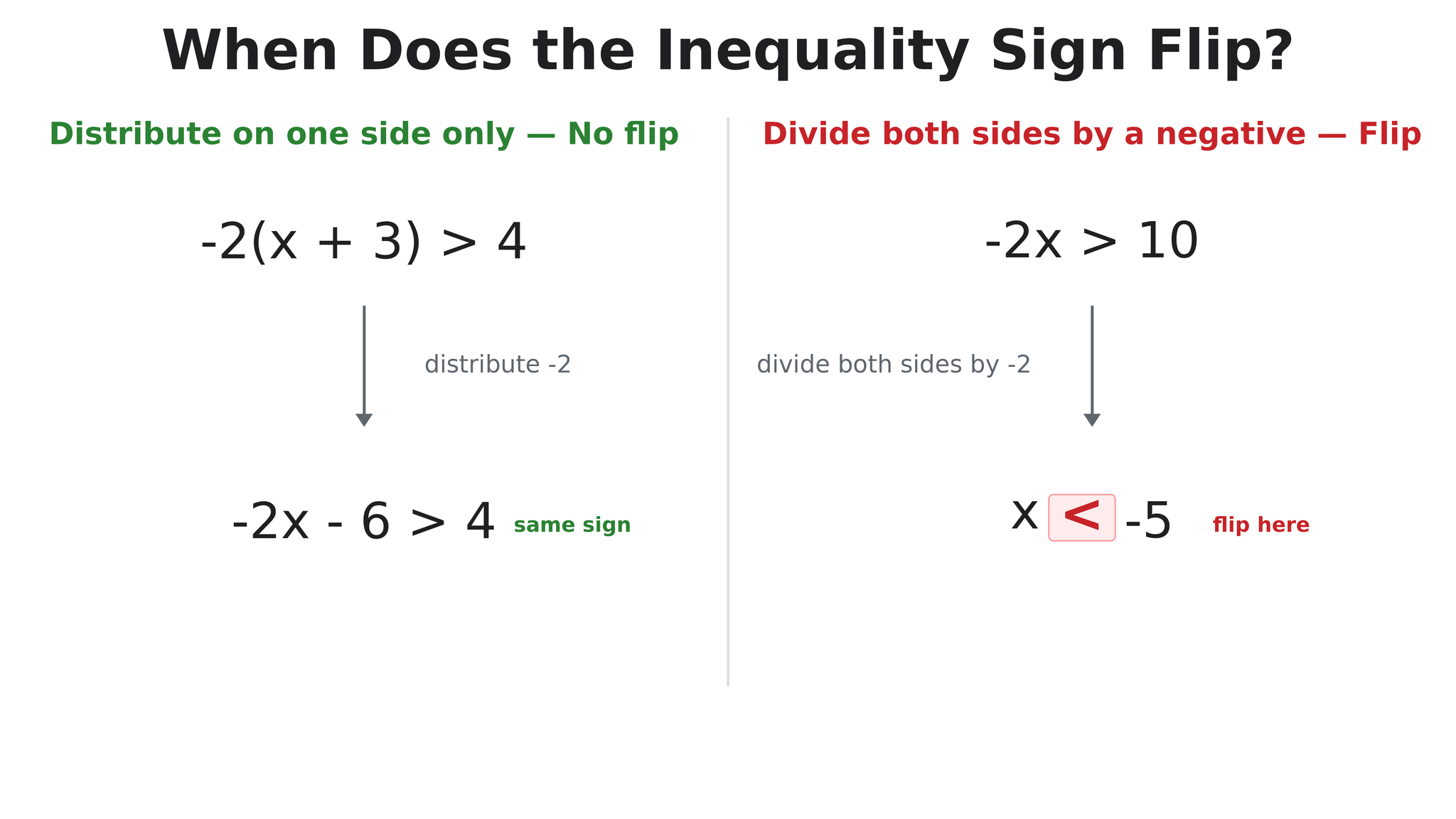
Welcome back to Solving Multi-Step Inequalities! You have already made great progress in this course. In Lesson 1, we tackled two-step inequalities, and in Lesson 2, we learned how to combine like terms before solving. Now, in this third lesson — the midpoint of the course — we face a new kind of clutter: parentheses. When an expression contains a factor multiplied by a group of terms inside parentheses, we need to expand it using the distributive property before we can isolate the variable. We will also pay close attention to what happens when that factor is negative, because this is where a very common misconception sneaks in. Let's get started.
Why Parentheses Need Special Attention
In the previous lesson, we simplified expressions like 5x−2x+1 by combining like terms that were already sitting out in the open. But what if the problem looks like 3(x+4)>9? Now a factor is multiplying an entire group of terms. In a case like this, where the factor divides evenly into every term (including the number on the other side), you could divide both sides by that factor first. But that shortcut will not always be so convenient — the factor might not divide evenly into every term, or you might simply want one reliable method that works every time. Distributing the outside factor is that general-purpose method, and it is the workflow we will practice throughout this lesson.
Think of parentheses like a sealed box. Distributing is one way to open it — always safe, and always available, whether or not the numbers happen to divide neatly. Once the parentheses are gone, we are right back to the two-step solving process we already know.
A Quick Refresher on the Distributive Property
The distributive property says that multiplying a factor by a sum or difference inside parentheses is the same as multiplying that factor by each term individually:
a(b+c)=ab+ac
For example, 5(x+3)=5⋅x+5⋅3=5x+15. The same rule applies when the operation inside is subtraction: 5(x−3)=5x−15.
The key is to multiply every term inside the parentheses by the outside factor, not just the first one. This is easy to forget when a problem has two or three terms inside the parentheses, so always double-check that each term has been multiplied.
Join the 1M+ learners on CodeSignal
Be a part of our community of 1M+ users who develop and demonstrate their skills on CodeSignal
Distributing a Positive Factor
Distributing a Negative Factor
Distribution Does Not Flip the Inequality
Solving After Distributing a Negative
Another Example with Subtraction Inside
A Real-World Example
Mistakes to Avoid
Conclusion and Next Steps
The distributive property lets us clear parentheses so we can get back to the two-step solving process we already know well. The critical rule to internalize is that distributing a negative does not flip the inequality sign. The flip only happens when we multiply or divide both sides by a negative value. The full workflow is now: expand parentheses by distributing, simplify if needed, then solve using inverse operations, flipping the sign only at the step that genuinely requires it.
Up next, you will practice this workflow hands-on. You will start with a guided distribution exercise, move on to solving full inequalities with positive and negative factors, and even spot errors in worked solutions where the sign was handled incorrectly. Let's get to it!
Let's see how expanding fits into the solving workflow. Consider:
3(x+4)>18
Distribute 3 to both terms inside the parentheses:
3x+12>18
Now we have a familiar two-step inequality.
Step 1 — Subtract 12 from both sides:
3x>6
Step 2 — Divide both sides by 3:
x>2
The coefficient is positive, so no sign flip is needed. Check with x=5: 3(5+4)=3(9)=27, and 27>18. ✓
Notice the workflow: distribute first, then solve using the inverse operations you already know.
Things get more interesting when the factor outside the parentheses is negative. The distributive property works exactly the same way, but each multiplication now involves a negative number, which affects the signs of every resulting term. Consider:
−2(x+3)>4
We distribute −2 to each term inside:
−2⋅x=−2x
−2⋅3=−6
So the inequality becomes:
−2x−6>4
Notice that +3 became −6 after being multiplied by −2. This is standard sign arithmetic, not anything special about inequalities. Keep track of every sign during distribution, and you will avoid errors.
Here is the most important idea in this lesson: distributing a negative factor does not reverse the inequality sign. The sign-flip rule, as you may recall from previous lessons, applies only when we multiply or divide both sides of the inequality by a negative number. Distribution is different — when we write −2(x+3)>4 and expand the left side to −2x−6>4, we are rewriting one side of the inequality in an equivalent form. We are not multiplying the entire inequality by anything.
To be crystal clear:
Action
Flip the sign?
Distributing a negative on one side
No
Multiplying both sides by a negative
Yes
Dividing both sides by a negative
Yes
The flip happens only when a negative is applied to both sides as an operation. Keep this distinction in mind, because mixing up these two situations is one of the most frequent mistakes in solving inequalities.
Let's finish the inequality from the earlier section:
−2(x+3)>4
Distribute −2:
−2x−6>4
No sign flip here — we only rewrote the left side. Now solve as usual.
Step 1 — Add 6 to both sides:
−2x>10
Step 2 — Divide both sides by −2. Now we are dividing both sides by a negative, so we flip the sign:
x<−5
Check with x=−7: −2(−7+3)=−2(−4)=8, and 8>4. ✓
The sign flip happened at the division step, not at the distribution step. That is the takeaway to remember.
Let's try a problem where the parentheses contain a subtraction:
−4(2x−5)≤12
Distribute −4 to each term:
−4⋅2x=−8x
−4⋅(−5)=+20 (a negative times a negative gives a positive)
−8x+20≤12
Step 1 — Subtract 20 from both sides:
−8x≤−8
Step 2 — Divide both sides by −8 and flip the sign:
x≥1
Check with x=2: −4(2⋅2−5)=−4(4−5)=−4(−1)=4, and 4≤12. ✓
Notice the two spots where signs needed care: expanding −4⋅(−5) into +20 during distribution, and flipping ≤ to ≥ during division by −8.
Suppose you are printing custom T-shirts for a charity event. Each shirt costs p dollars to print, but the shop offers a $2 per-shirt discount for orders of five or more. You order 5 shirts and need the total to stay under $60:
5(p−2)<60
Distribute 5:
5p−10<60
Add 10:
5p<70
Divide by 5:
p<14
Each shirt's base printing cost must be under $14 for the total to stay within budget. The parentheses appeared naturally because each shirt's discounted price, p−2, was multiplied by the quantity — a pattern you will see often in planning and budgeting problems.
As with any pricing problem, it helps to separate the algebra from the context. The algebraic solution is p<14, but a printing cost cannot be negative, so the practical domain is 0≤p<14.
Flipping the sign during distribution. Distributing a negative rewrites one side of the inequality. It does not multiply both sides, so the inequality direction stays the same.
Forgetting to distribute to every term. In −4(2x−5), both 2x and −5 must be multiplied by −4. Skipping the second term is a common oversight.
Losing track of signs inside parentheses. When distributing a negative over a subtraction, you are multiplying two negatives, which gives a positive. Write out each multiplication separately if it helps.