Finding the Hypotenuse
Introduction
Welcome back to Solving for Unknown Sides! In the first lesson of this course, you focused on setting up the Pythagorean equation from a diagram — identifying which side is the hypotenuse and writing correctly. Now, in this second lesson out of seven, we are going to put that equation to work. Our goal today is simple and satisfying: given both legs of a right triangle, calculate the hypotenuse and get an actual number.
From Equation to Answer
Recall that the Pythagorean Theorem relates the three sides of any right triangle:
Here, and are the legs (the two sides that form the right angle) and is the hypotenuse (the longest side, opposite the right angle). In the previous lesson we practiced writing this equation from a diagram. Now our focus shifts to solving for so we can find its actual length.
Starting from , we isolate by taking the square root of both sides:
This formula is the engine behind everything we do in this lesson. Let's break it down into a clear, repeatable procedure.
The Three-Step Procedure
Finding the hypotenuse comes down to three steps you can follow every single time:
- Square each leg.
- Add the two squared values together.
- Take the square root of that sum.
Square, add, root — that's it. The order matters, and sticking to it keeps your work organized and your answers correct. Let's see the procedure in action with real numbers.
Worked Example: Legs 3 and 4
Imagine a right triangle whose legs measure and . We want the hypotenuse .
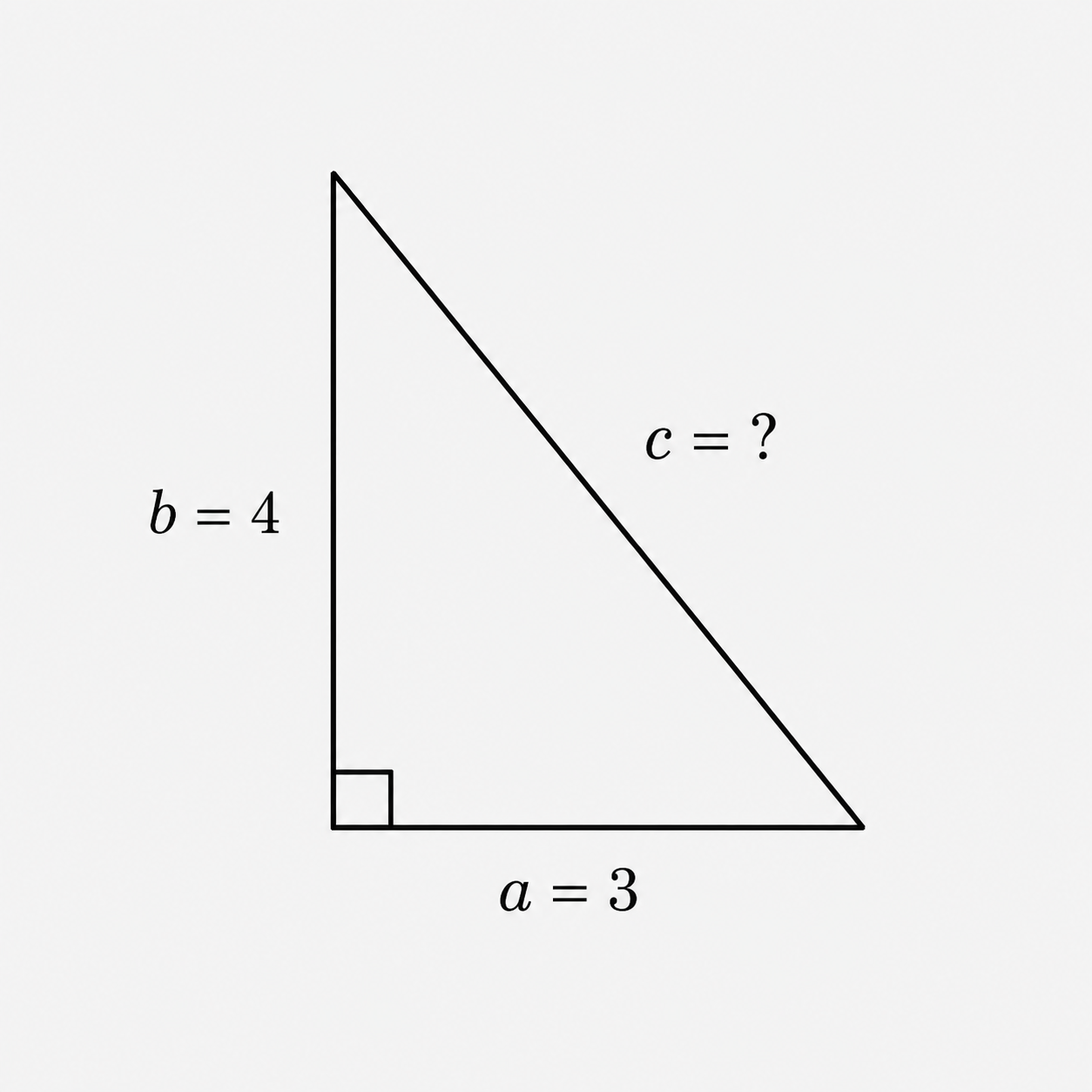
Step 1 — Square each leg.
Step 2 — Add the squares.
Step 3 — Take the square root.
The hypotenuse is 5. Notice how each step feeds cleanly into the next — we never skip ahead, and the procedure keeps things error-free.
Trying Bigger Numbers
The beauty of this method is that it works the same way no matter how large the numbers get. Let's try a right triangle with legs and .
Step 1: and
Step 2:
Step 3:
The hypotenuse is 13. Bigger legs, same three steps, same reliable result. As you practice, the arithmetic becomes second nature, but the procedure never changes.
Why This Matters in Everyday Life
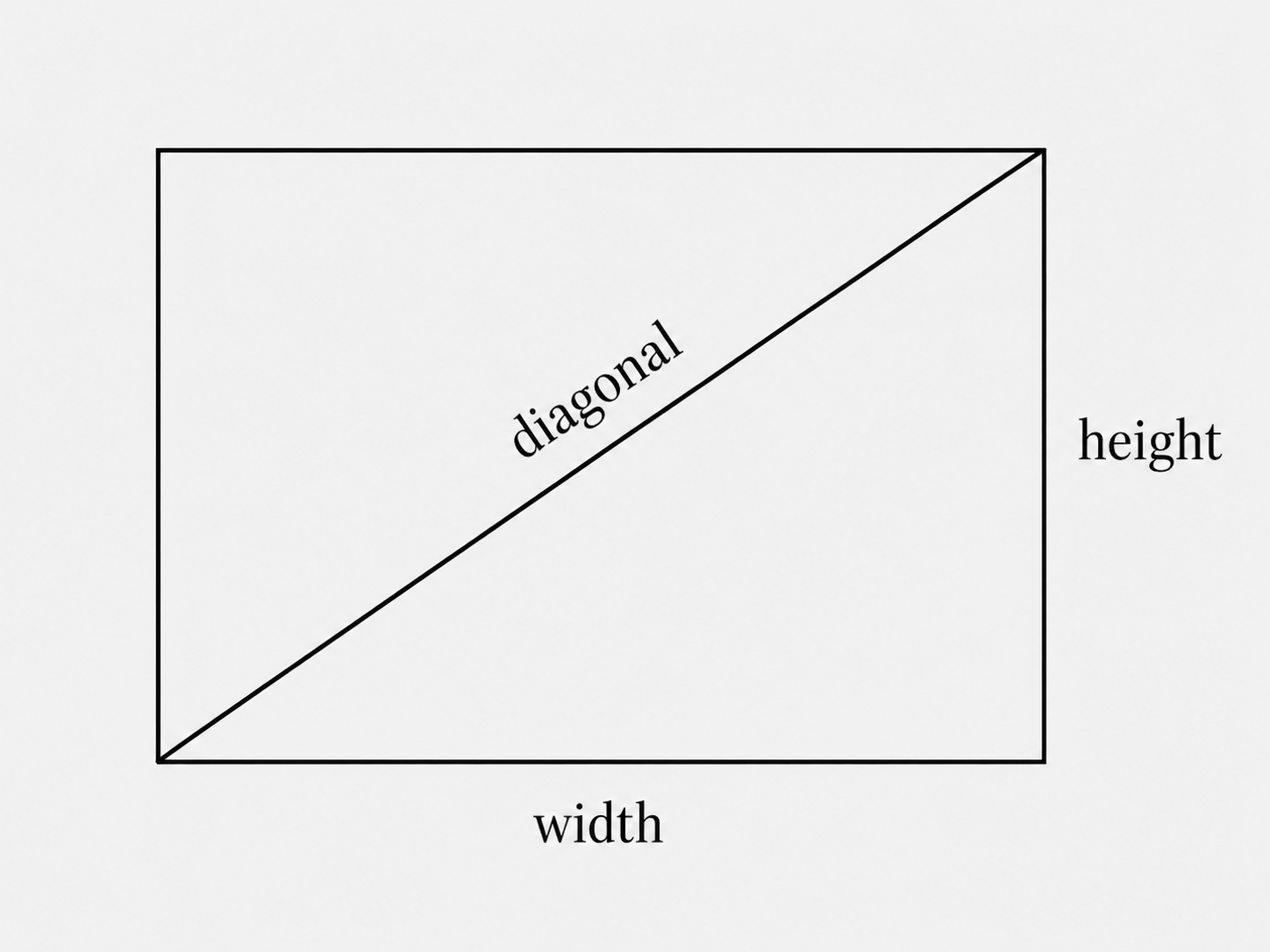
This procedure shows up in many real situations you might not expect. When a TV is sold as a "55-inch screen," for example, that measurement is actually the screen's diagonal — the hypotenuse of the right triangle formed by its width and height.
If the screen is inches wide and inches tall, you would calculate , giving a 45-inch diagonal. Construction workers rely on the same math to verify that walls meet at true right angles. Anytime you need the straight-line distance across a rectangle or any right-angle corner, these three steps give you the answer.
Common Pitfalls
Two mistakes come up often when learners are getting started:
- Forgetting to take the square root. After adding the squares you have , not itself. Always finish with the square root to get the actual side length.
- Adding the legs before squaring. You must square first, then add. With legs 3 and 4, the correct path is , not .
Keeping the order square → add → root firmly in mind prevents both of these errors.
Conclusion and Next Steps
In this lesson you learned a clean three-step procedure for finding the hypotenuse: square each leg, add the results, and take the square root. We applied it to two worked examples and saw that the method stays exactly the same whether the numbers are small or large. We also connected the procedure to a familiar real-world context — measuring a TV screen's diagonal.
Up next, you will put this skill into practice with guided exercises. You will start by completing the steps of a familiar triangle, then work through progressively larger numbers, and finish by calculating a TV diagonal on your own. Time to make square, add, root feel like second nature!