Welcome back to Solving for Unknown Sides! You are now on lesson three of seven, and your skills are building nicely. In the previous lesson, we learned a reliable three-step procedure for finding the hypotenuse: square each leg, add, and take the square root. That works perfectly when both legs are known. But what happens when the hypotenuse is given and one of the legs is missing? That is exactly what we tackle today. Our goal is to rearrange the Pythagorean equation so it isolates a leg, and to understand why this rearrangement looks different from what we did before.
A Different Situation
So far, every problem we have solved gave us the two legs and asked for the hypotenuse. In those problems, we always added the squared leg values. It is tempting to think that the Pythagorean Theorem is always about adding, but that is only half the story.
Consider this scenario: a ladder leans against a wall. You know how long the ladder is (the hypotenuse) and how far the base sits from the wall (one leg). You need the height the ladder reaches up the wall (the other leg). The unknown side is no longer the hypotenuse — it is a leg. This changes the algebra we need to do, and understanding why it changes is the key insight of this lesson.
Thinking in Squares
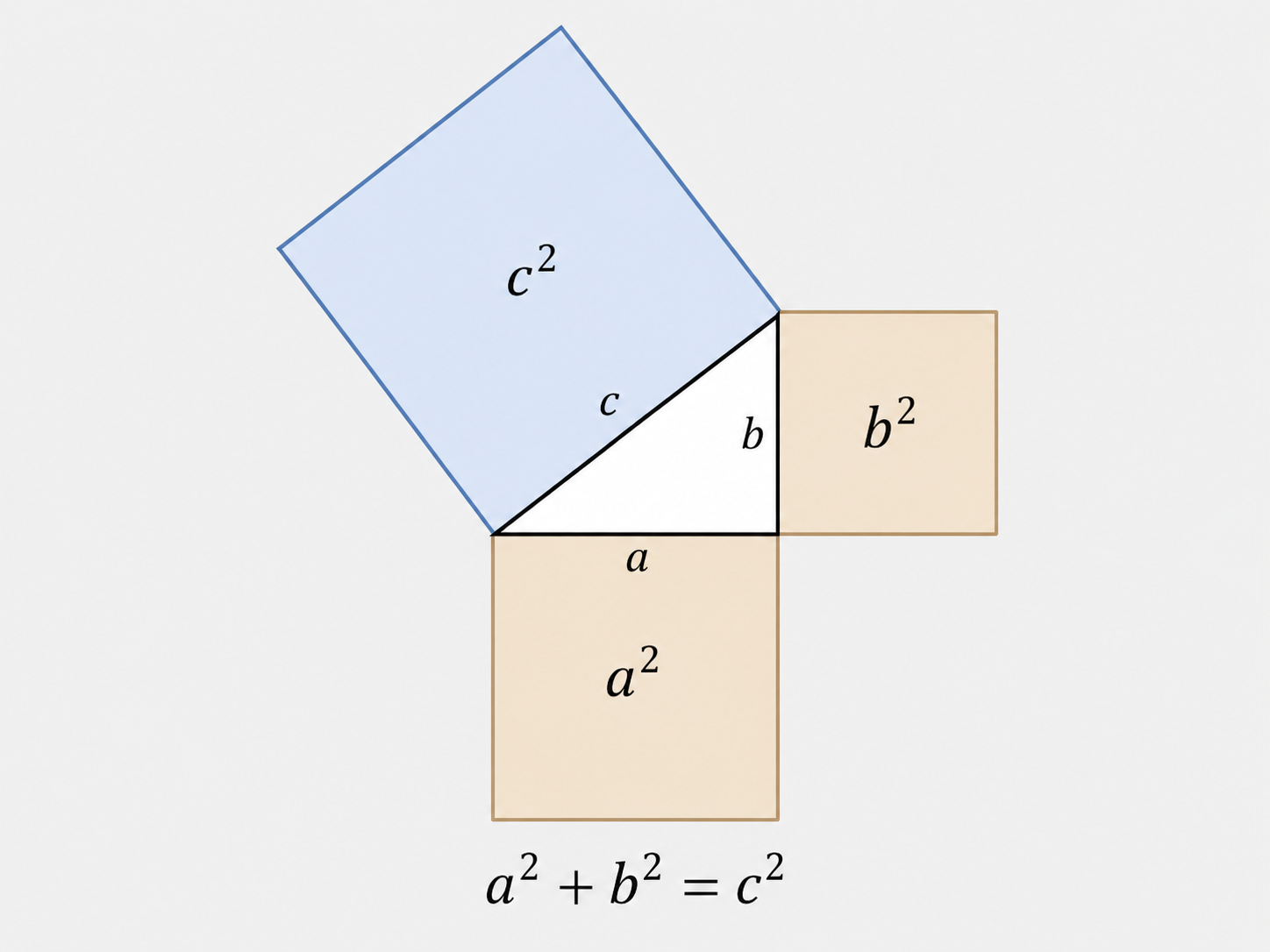
As you may recall from the first course, each term in a2+b2=c2 represents the area of a square built on that side of the triangle. The square on the hypotenuse has an area equal to the combined areas of the two leg-squares.
Now picture the three squares in your mind.
If the hypotenuse-square is the whole and the two leg-squares are its parts, then finding a missing leg-square is like finding a missing part. To get a part from a whole, we subtract the known part from the whole. This area picture makes the upcoming algebra feel natural rather than arbitrary.
Rearranging the Equation
Let's start from the standard form of the theorem:
a2+b2=c2
Suppose we know c (the hypotenuse) and b (one leg), and we need to find a (the other leg). We want a2 alone on one side. To do that, we subtract b2 from both sides:
a2=c2−b2
That single move is the entire rearrangement. Notice the key difference from hypotenuse problems:
Finding the hypotenuse
Finding a missing leg
c2=a2+b2
a2=c2−b2
Add the two known squares
Subtract the known leg-square from the hypotenuse-square
The operation flips from addition to subtraction whenever the unknown side is a leg instead of the hypotenuse.
Join the 1M+ learners on CodeSignal
Be a part of our community of 1M+ users who develop and demonstrate their skills on CodeSignal
This result is not just an algebra trick — it has a logical reason behind it. In the equation a2+b2=c2, the hypotenuse-square c2 is always the largest value because c is the longest side. When we solved for c2 in the last lesson, we added two smaller values to get the larger one — parts combining to form a whole.
Now we are going the other direction. We already have the whole (c2) and one part (b2), so we must take the known part away to recover the missing one. Adding would give us a number bigger than c2, which cannot be the square of a leg that is shorter than the hypotenuse. Subtraction is the only operation that produces a value smaller than c2, which is exactly what a leg-square must be.
Let's verify this with a triangle we already know well. In the last lesson we confirmed that legs a=3 and b=4 give hypotenuse c=5. Now pretend we know only c=5 and b=4, and we need a.
Using our rearranged equation:
a2=c2−b2=52−42=25−16=9
Since a2=9, we know a=3. That matches perfectly. If we had mistakenly added (25+16=41), we would get a2=41, which gives a leg longer than the hypotenuse — an impossible result for a right triangle.
The most frequent error at this stage is automatically adding the two known squared values, just because that is what we practiced in the hypotenuse lesson. Before doing any arithmetic, always ask yourself: Which side is unknown?
If the hypotenuse is unknown → add the leg-squares.
If a leg is unknown → subtract the known leg-square from the hypotenuse-square.
Getting this decision right before you calculate is more important than any arithmetic skill. The rearranged formula a2=c2−b2 is your guide whenever the missing side is a leg.
In this lesson, we rearranged the Pythagorean equation from a2+b2=c2 into a2=c2−b2, and we explored why subtraction is necessary: the leg-square is a part of the hypotenuse-square, so we remove the known part to find the missing one. We verified the rearrangement against familiar numbers to confirm it works. This understanding will keep you from falling into the common trap of always adding.
Now it is time to put this insight to the test! In the upcoming practice exercises, you will decide between addition and subtraction, fill in the rearranged formula, and connect the algebra back to the area picture — building confidence so this new equation feels just as natural as the original.