Welcome to Solving for Unknown Sides, the second course in our Pythagorean Theorem learning path! In the first course, you learned how to spot right triangles, label their sides, and state the theorem itself. Now we begin putting that knowledge into action, and this first lesson focuses on the critical starting move: setting up the equation from a diagram.
In the lessons ahead, we will compute missing hypotenuses, find unknown legs, and choose between exact and approximate answers. But none of that works unless the equation is built correctly from the start. So let's make sure we get this step right.
Why the Setup Step Matters
Before we square any numbers or reach for a calculator, we need to decide which value goes where in a2+b2=c2. Placing a leg length into the c slot, or putting the hypotenuse where a leg belongs, will produce a wrong result every time.
Think of it like reading a recipe before cooking. If we confuse salt with sugar, the dish won't turn out right no matter how carefully we measure. The same idea applies here: a correct setup is what makes every later calculation trustworthy.
Identify the Hypotenuse First
The single most important habit when facing a right triangle diagram is to find the hypotenuse before writing anything. As you may recall from the previous course, the hypotenuse is always:
The side opposite the right angle (the 90° angle).
The longest side of the right triangle.
These two checks should always agree. Look for the small square symbol that marks the right angle in the diagram. The side that does not touch that square corner is the hypotenuse, and it gets the role of c.
Assign Each Side to the Equation
After identifying the hypotenuse (c), the remaining two sides are the legs, and they fill the a and b positions. The good news is that the order of the legs does not matter. Because addition is commutative, a2+b2 gives the same result as b2+a2.
Here is a quick way to organize the assignment:
Role
How to spot it
Place in the equation
Hypotenuse
Opposite the right angle; longest side
c
Leg 1
Either of the two remaining sides
a
Leg 2
The other remaining side
b
Once every side has a role, we simply write the theorem with the actual values or labels substituted in:
a2+b2=c2
Join the 1M+ learners on CodeSignal
Be a part of our community of 1M+ users who develop and demonstrate their skills on CodeSignal
Let's package the method into three clean steps so it's easy to remember:
Spot the right angle in the diagram and identify the side opposite it. That side is the hypotenuse, c.
Label the legs. Assign the other two sides to a and b in whichever order you like.
Write the equation. Plug the side lengths (or variable names) into a2+b2=c2.
That's the entire procedure. Let's see it in action with a concrete example.
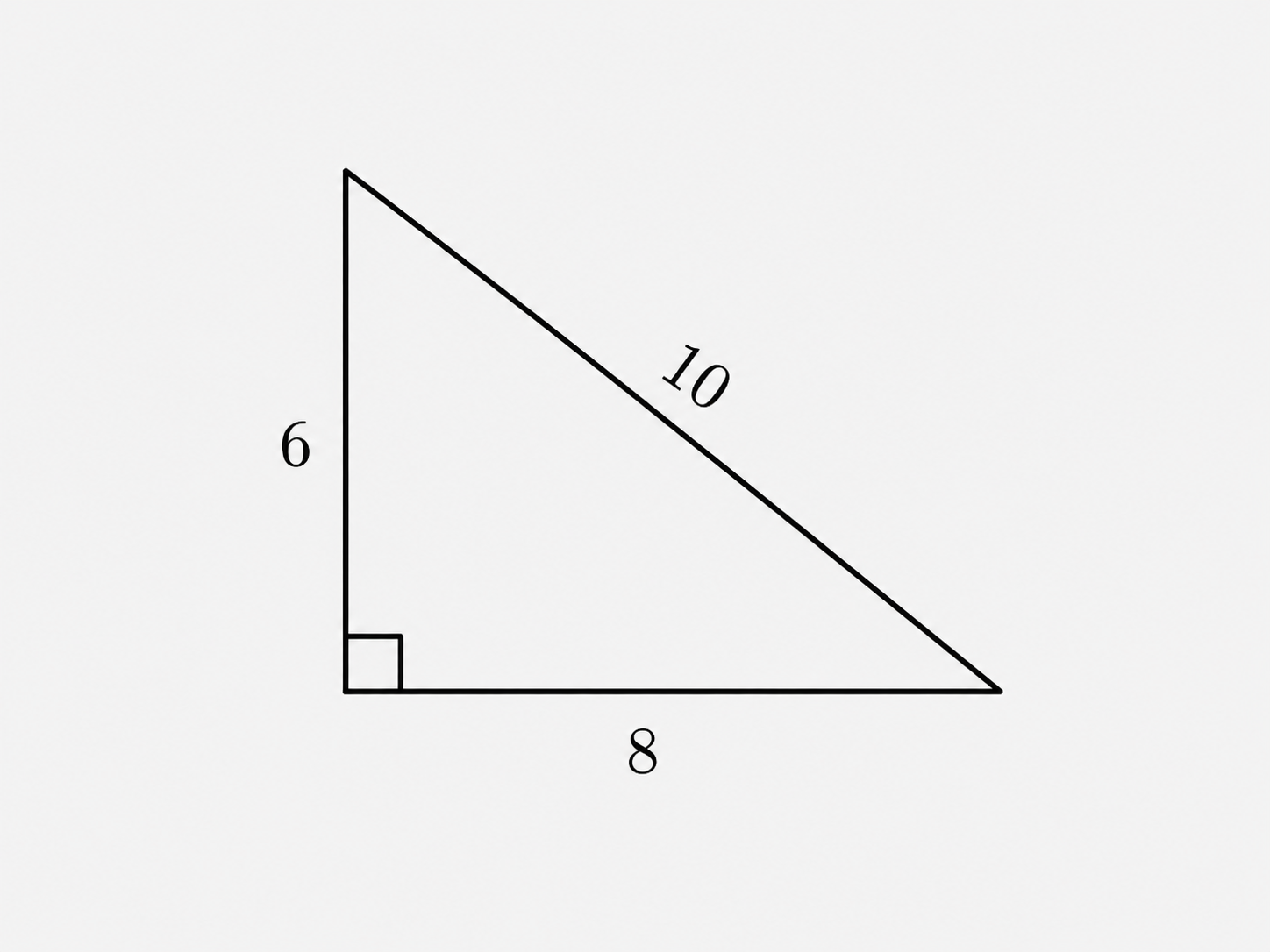
Suppose we see a right triangle whose sides are labeled 6, 8, and 10, with the small square (right angle marker) sitting between the sides of length 6 and 8.
Step 1. The right angle is between 6 and 8, so the side opposite that angle is 10. We set c=10.
Step 2. The two sides forming the right angle are 6 and 8. We let a=6 and b=8.
Step 3. We write the equation:
62+82=102
Notice that we have not calculated anything yet. Our only goal was to place each number in the right slot, and we have done exactly that.
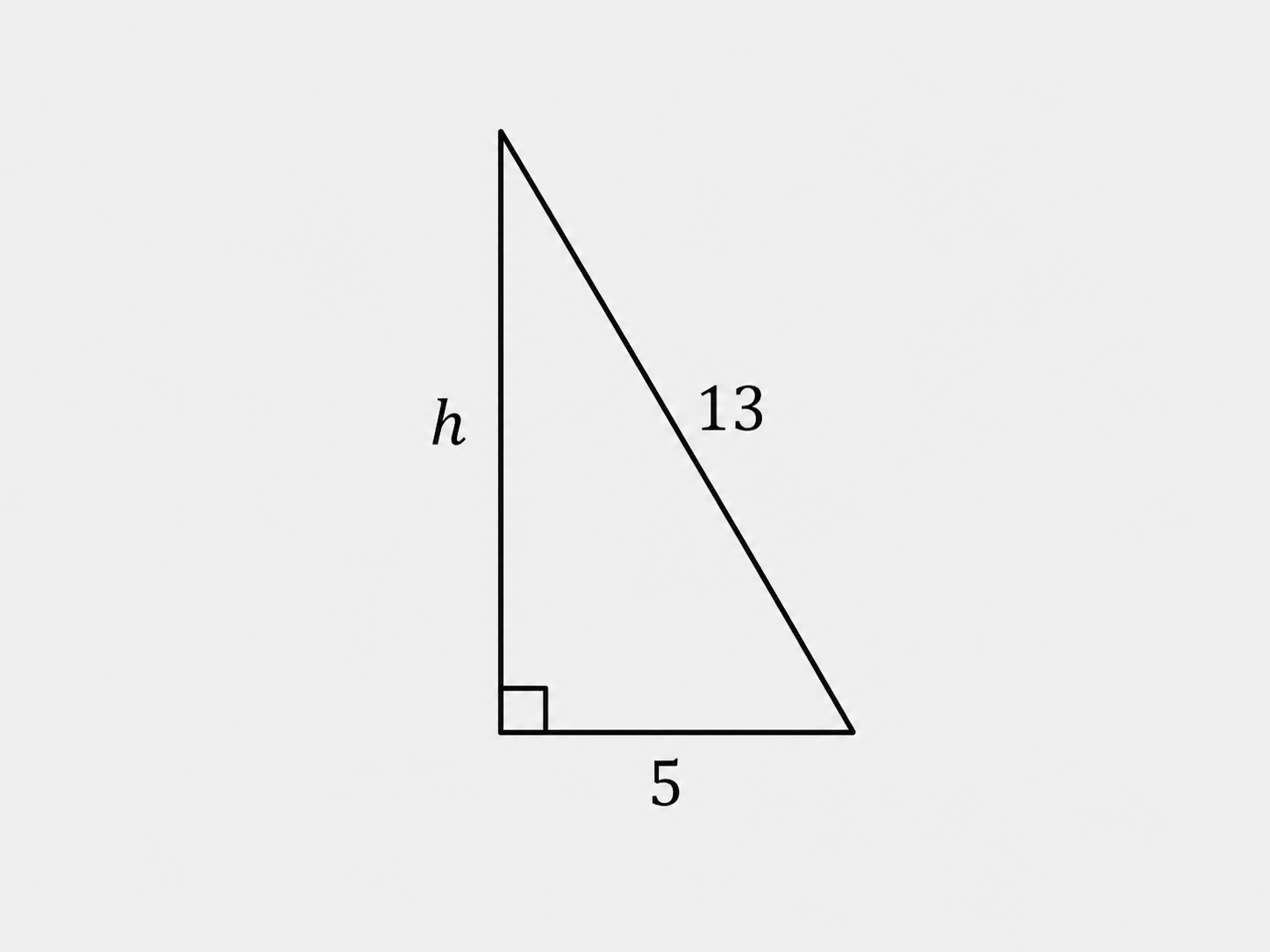
Right triangles are not always drawn neatly on a page. Picture a ladder leaning against a wall. The wall and the ground meet at a right angle, and the ladder stretches diagonally from the base on the ground up to the wall.
In this scene, the ladder is the hypotenuse because it sits opposite the 90° angle where the wall meets the ground. The wall height and the ground distance are the two legs. If a ladder is 13 feet long, the base is 5 feet from the wall, and the top reaches a height h, our three-step process gives us:
52+h2=132
The same three steps work whether you are looking at a textbook diagram or a real-world situation. Find the right angle, name the hypotenuse, then write the equation.
Before we move on to practice, here are a few pitfalls worth keeping in mind:
Swapping a leg and the hypotenuse. If the longest side ends up on the left side of the equation, something has gone wrong. Always identify the hypotenuse first.
Worrying about leg order. It does not matter which leg is a and which is b. For example, 32+42 and 42+32 both equal 25.
Dropping the squares. The theorem is a2+b2=c2, not a+b=c. Every term needs that exponent of 2.
In this lesson, we established a reliable three-step process for setting up the Pythagorean equation from any labeled right triangle. The key idea is straightforward: find the hypotenuse first, assign the two legs to a and b, and then write a2+b2=c2 with the correct values in place. This setup skill is the foundation for every calculation we will tackle throughout the rest of this course.
Now it's time to put the process to the test! In the upcoming practice exercises, you will identify hypotenuses, fill in equation blanks, write full equations from scratch, and even set up a real-world ladder problem. Let's jump in and make this skill second nature.