Welcome back to Solving for Unknown Sides! You have reached lesson six of seven, which means we are just one step away from completing this course. So far, we have built a reliable toolkit: we can find a missing hypotenuse, find a missing leg, and decide which procedure to use simply by reading the triangle. In every example up to now, the number under the square root sign worked out to a tidy whole number. But what happens when it does not? That is the focus of today's lesson. We will learn how to express a side length exactly using a square root, rather than reaching for a calculator and rounding.
Not Every Square Root Comes Out Clean
Think about the numbers we have seen so far: 169=13, 225=15, 64=8. Each of these turned into a neat whole number because the value inside the radical was a perfect square. In real problems, though, perfect squares are the exception rather than the rule.
Consider a right triangle with legs 2 and 3. Following our procedure, we get:
c=22+32=4+9=13
No whole number multiplied by itself gives 13. We could grab a calculator and write something like 3.6055..., but that trailing string of digits never ends and never repeats. By writing 13, we capture the exact length in a compact, perfectly precise way. This is what mathematicians call radical form, and it is the cleanest possible answer.
Quick Review: Perfect Squares
Before we go further, let's make sure we can quickly tell whether a number under the radical simplifies to a whole number or not. Here are the perfect squares you will encounter most often:
n
1
4
9
16
25
36
49
64
81
100
n
1
2
3
4
5
6
7
8
9
10
If the number under the square root appears in this list (or continues the pattern: 121,144,169,…), the answer is a whole number. If it does not, the answer stays in radical form. Being comfortable with this short list makes the decision almost instant.
Exact Hypotenuse in Radical Form
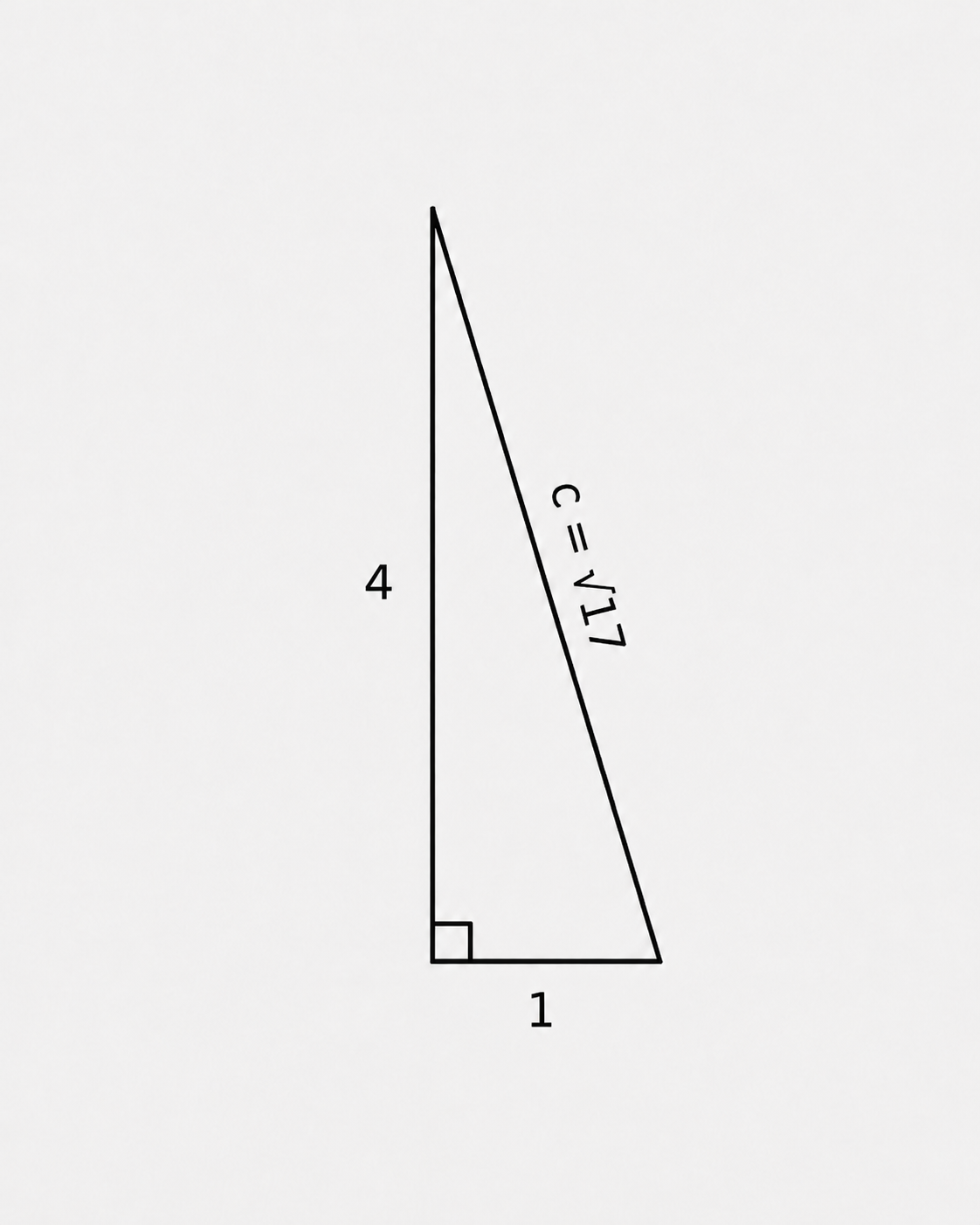
Let's work through a full example where the hypotenuse is not a whole number. A right triangle has legs of length 1 and 4. As you may recall from Lesson 2, we square each leg, add, and take the square root:
Square each leg: 12=1, 42=16.
Add: 1+16=17.
Square root: 17.
Is 17 a perfect square? Scanning our list, we see it falls between 16 (42) and 25 (52), so no whole number works. Our exact answer is simply:
c=17
That is the final, complete answer. There is no need to "do more" with it. Writing 17 is just as valid as writing 13 when the answer happens to be 169.
Join the 1M+ learners on CodeSignal
Be a part of our community of 1M+ users who develop and demonstrate their skills on CodeSignal
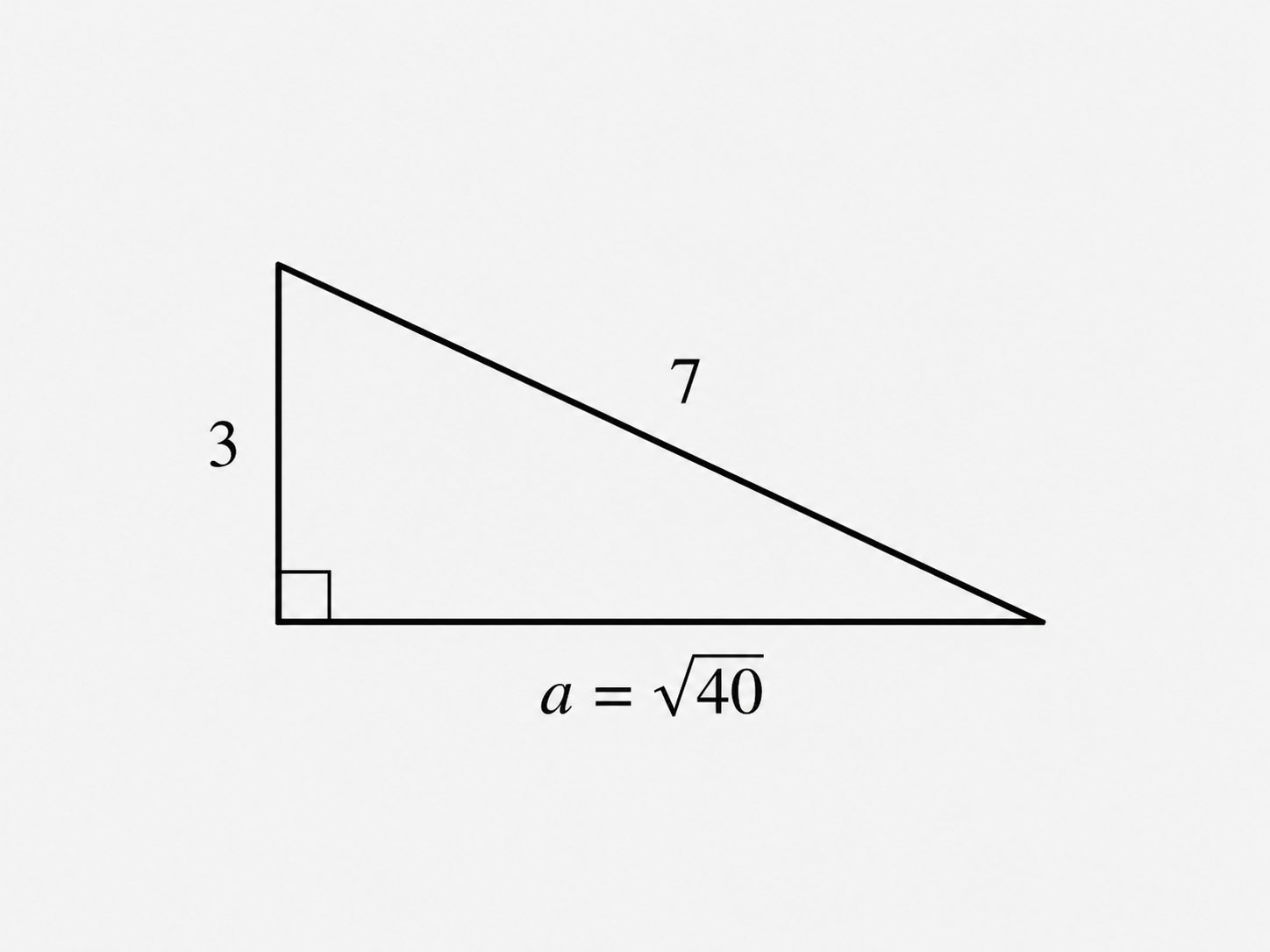
The same idea applies when the unknown side is a leg. Suppose a right triangle has a hypotenuse of 7 and one leg of 3. From Lessons 3 and 4, we know to square, subtract, and take the square root:
Square the known sides: 72=49, 32=9.
Subtract (hypotenuse-square minus leg-square): 49−9=40.
Square root: 40.
Is 40 a perfect square? It sits between 36 (62) and 49 (72), so the answer does not simplify to a whole number. Our exact answer is:
a=40
The procedure is identical to what we have practiced before. The only difference is the final step: instead of writing a whole number, we leave the square root symbol in place.
Now that radical answers feel routine, it is worth pointing out that two of the most famous triangles in all of mathematics live in exactly this radical world. You may run into them by name in later courses, and when you do, you will already understand why they look the way they do.
The 45-45-90 triangle. Picture a right triangle whose two legs are equal — say, both of length 1. Using the very same procedure from Lesson 2:
c=12+12=1+1=2
Since 2 is not a perfect square, the hypotenuse is 2. That is the entire reason people say a 45-45-90 triangle has sides in the ratio 1:1:2 — the radical is simply unavoidable.
The 30-60-90 triangle. This one has sides in the ratio 1:3:2, where 2 is the hypotenuse. We can confirm the middle side ourselves. If the short leg is 1 and the hypotenuse is 2, then the longer leg is:
a=22−12=4−1=3
Once again, an ordinary right triangle produces a perfectly clean radical answer, 3.
You do not need to memorize these ratios for this course — our general "square, add or subtract, take the root" method handles every triangle, named or not. The point is simply that these celebrated triangles are the most recognizable everyday cases where you cannot avoid a radical. They are a satisfying reminder that radical form is not a special exception; it is the natural, exact way to describe a huge family of real triangles.
You might wonder, "If I can just type 40 into a calculator and get 6.3245..., why bother with the radical?" There are two practical reasons.
Precision. A decimal like 6.3245 is already rounded. Every time we round, we lose a tiny bit of information. If that value feeds into another calculation later, the small error can grow. The radical 40 carries zero rounding error.
Communication. In many fields — engineering blueprints, mathematical proofs, standardized tests — an exact radical is considered the "official" answer. Writing 40 tells anyone reading your work that no approximation was made. Of course, there are also times when a decimal is more useful, such as when you need to measure and cut a real piece of wood. We will explore that side of the coin in the next lesson.
Let's combine today's skill with the decision-making skill from Lesson 5. A right triangle has sides 5, x, and 6, where the side of length 6 is opposite the right angle. We need to find x.
First, identify the unknown. The side opposite the right angle (6) is the hypotenuse, and x is one of the sides forming the right angle, so x is a leg. That means we subtract:
x=62−52=36−25=11
Since 11 is not a perfect square (9<11<16), the exact answer is 11. Notice how every skill we have built — identifying the unknown, choosing add or subtract, and now leaving the answer in radical form — comes together in a single smooth workflow.
Today we added an important finishing touch to our side-solving toolkit: when the number under the square root is not a perfect square, we express the answer in radical form rather than forcing it into a decimal. Writing 13 or 40 is exact, concise, and widely accepted as a complete answer. Combined with the procedures and decision rules from earlier lessons, you now have everything you need to solve a right triangle and report the result with perfect precision.
Up next, the practice exercises will give you hands-on experience writing radical answers for both hypotenuse and leg problems. You will also think about when an exact radical is preferable over a rounded decimal — a question we will explore fully in the final lesson of this course.