Decimal Approximations and Rounding
Introduction
Welcome to the seventh and final lesson of Solving for Unknown Sides! Over the previous six lessons, you have assembled a powerful set of skills: setting up the Pythagorean equation from a diagram, solving for a hypotenuse or a missing leg, choosing the correct method at a glance, and expressing non-whole answers in exact radical form. At the end of that last lesson, we hinted that radicals, while perfectly precise, are not always the most practical format. Today we close out the course by learning how to convert any square-root answer into a decimal rounded to whatever precision a problem requires.
When a Radical Is Not Enough
A radical like is the most precise way to express a non-whole side length. No information is lost, and no rounding occurs. That precision is valuable on paper, but it does not always translate to the physical world.
Picture yourself at a hardware store, trying to buy a wooden brace that needs to be feet long. The tape measure has no marking. You need a number like feet to actually measure and cut. Decimal approximations trade a tiny amount of precision for a format that works with rulers, maps, and everyday thinking. Learning when and how to round is the finishing touch on our side-solving toolkit.
From Radical to Decimal
Converting a square root to a decimal is straightforward: evaluate it with a calculator. For example:
The digits continue forever without settling into a repeating pattern. Because we can never write them all, we round to a stated number of decimal places.
One important notation detail: we use the symbol (read "approximately equal to") whenever a value has been rounded. So we write , not . This small habit tells anyone reading our work that rounding took place.
Rounding to a Stated Precision
Most problems will ask you to round to the nearest tenth (one decimal place) or the nearest hundredth (two decimal places). The process is the same either way: look at the digit one place beyond where you need to round.
- If that digit is 5 or greater, round up.
- If that digit is less than 5, keep the rounding digit as it is.
Let's apply this to
Nearest tenth. We want one decimal place. The tenths digit is . Look one place further: the hundredths digit is . Since , we round up:
Nearest hundredth. We want two decimal places. The hundredths digit is . Look one place further: the thousandths digit is . Since , we keep :
Notice how the same radical produces different decimals depending on the requested precision. Always check what the problem asks for before you round.
Worked Example: Hypotenuse to the Nearest Tenth
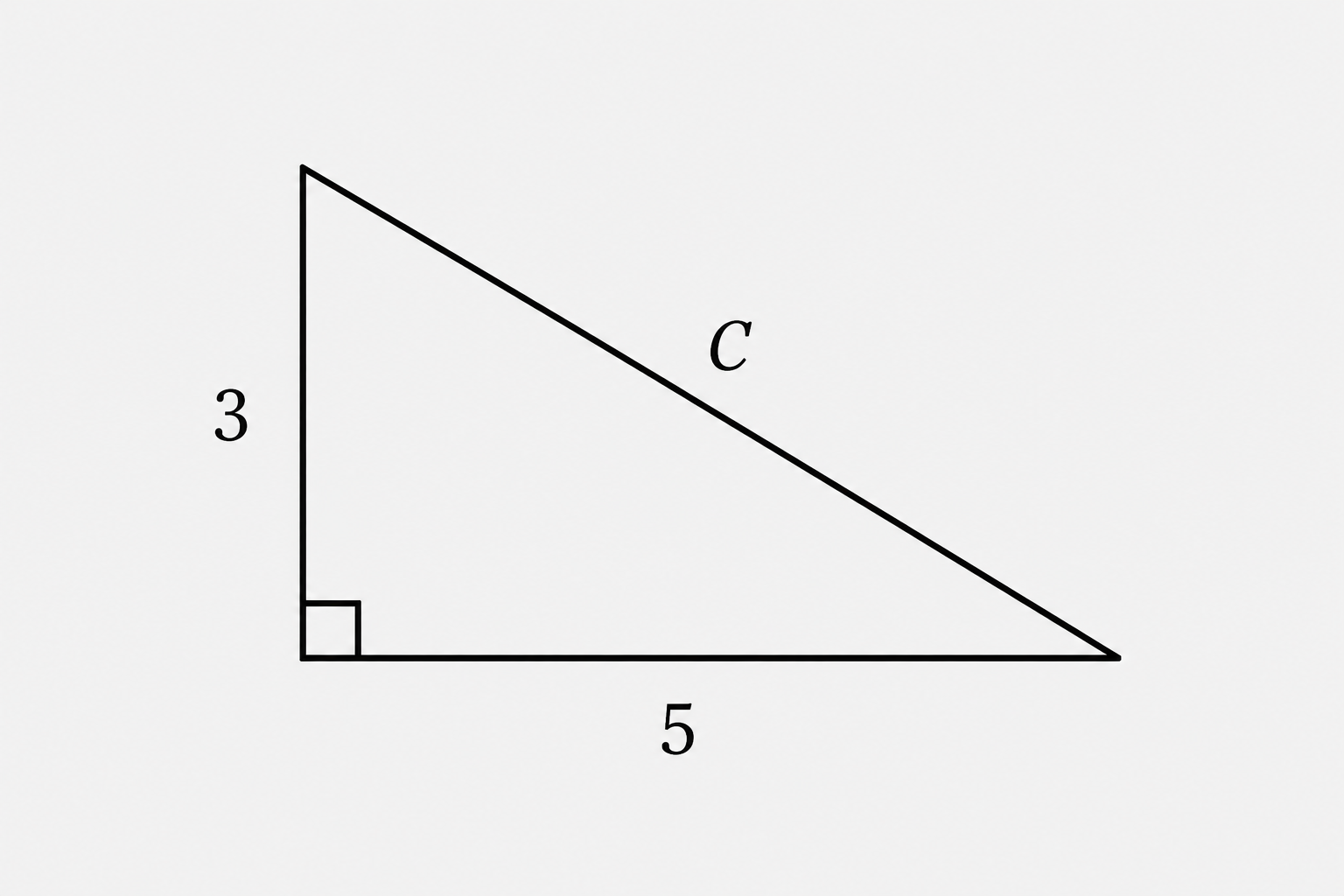
A right triangle has legs of length and . Find the hypotenuse rounded to the nearest tenth.
We follow the familiar procedure from earlier lessons, then add a rounding step at the end:
- Square each leg: , .
- Add: .
- Square root (exact): .
- Approximate:
- Round to the nearest tenth: The tenths digit is . The hundredths digit is , which is less than , so we keep .
The exact answer is and the approximate answer is . Many problems ask for both, so it is good practice to write the radical first and the rounded decimal second.
Worked Example: Diagonal of a Rectangular Park
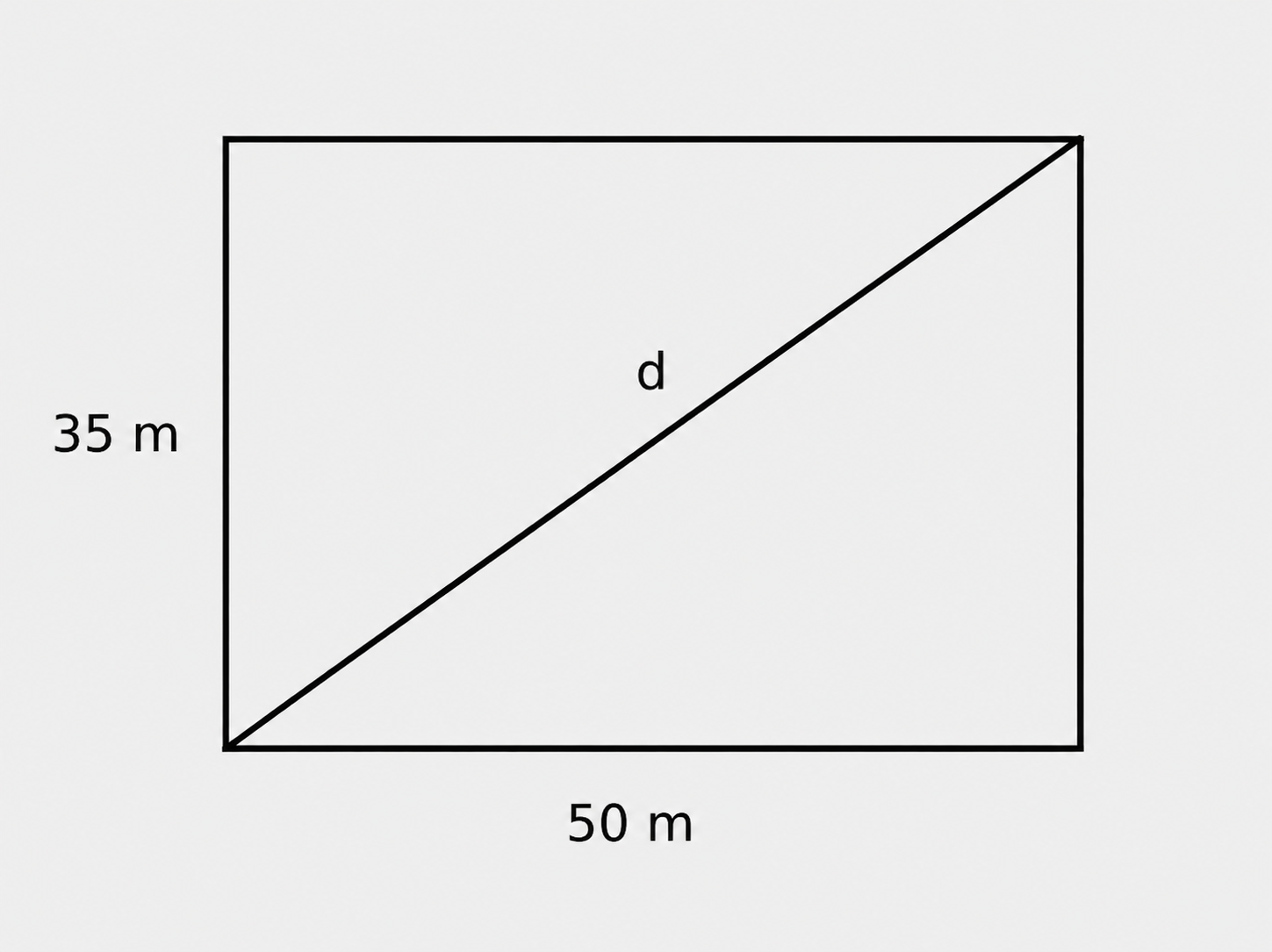
A rectangular park measures m by m. You want to walk diagonally from one corner to the opposite corner. How long is that diagonal path? Round to the nearest tenth of a meter.
The diagonal of a rectangle splits it into two right triangles. The diagonal is the hypotenuse, and the two sides of the rectangle are the legs. With that picture in mind, we apply the full pipeline:
- Square each leg: , .
- Add: .
- Square root (exact): .
- Approximate:
- Round to the nearest tenth: The tenths digit is . The hundredths digit is , which is less than , so we keep .
Notice we write rather than just . Keeping the trailing zero shows that we deliberately rounded to the tenths place, as the problem requested. In a real-world scenario like planning a park shortcut, this decimal answer is far more useful than meters.
Exact vs. Approximate: Knowing What to Report
We now have two ways to report a non-whole side length. The table below summarizes when to use each.
| Format | Example | Precision | Best used when... |
|---|---|---|---|
| Exact radical | Perfect (no rounding error) | The problem asks for "exact form," or the value feeds into further calculations | |
| Rounded decimal | Approximate (small rounding error) | The problem says "round to…," or you need a physical measurement |
One good habit to carry forward: always compute the exact radical first, then round as the very last step. Rounding too early — such as rounding a leg length before plugging it into the next calculation — can introduce unnecessary error into the final answer.
Conclusion and Next Steps
With this lesson, our Solving for Unknown Sides course is complete. We can now set up the Pythagorean equation from a diagram, solve for any missing side, express the result as an exact radical, and convert that radical into a decimal rounded to any requested precision. The core takeaway is simple: the radical is exact, the decimal is practical, and knowing when to use each makes our work both accurate and useful.
Head into the practice exercises to put these skills to work. You will identify correct decimal approximations, complete rounding steps in worked solutions, label triangles with both exact and rounded values, and tackle a real-world scenario where a clean decimal answer is exactly what you need.