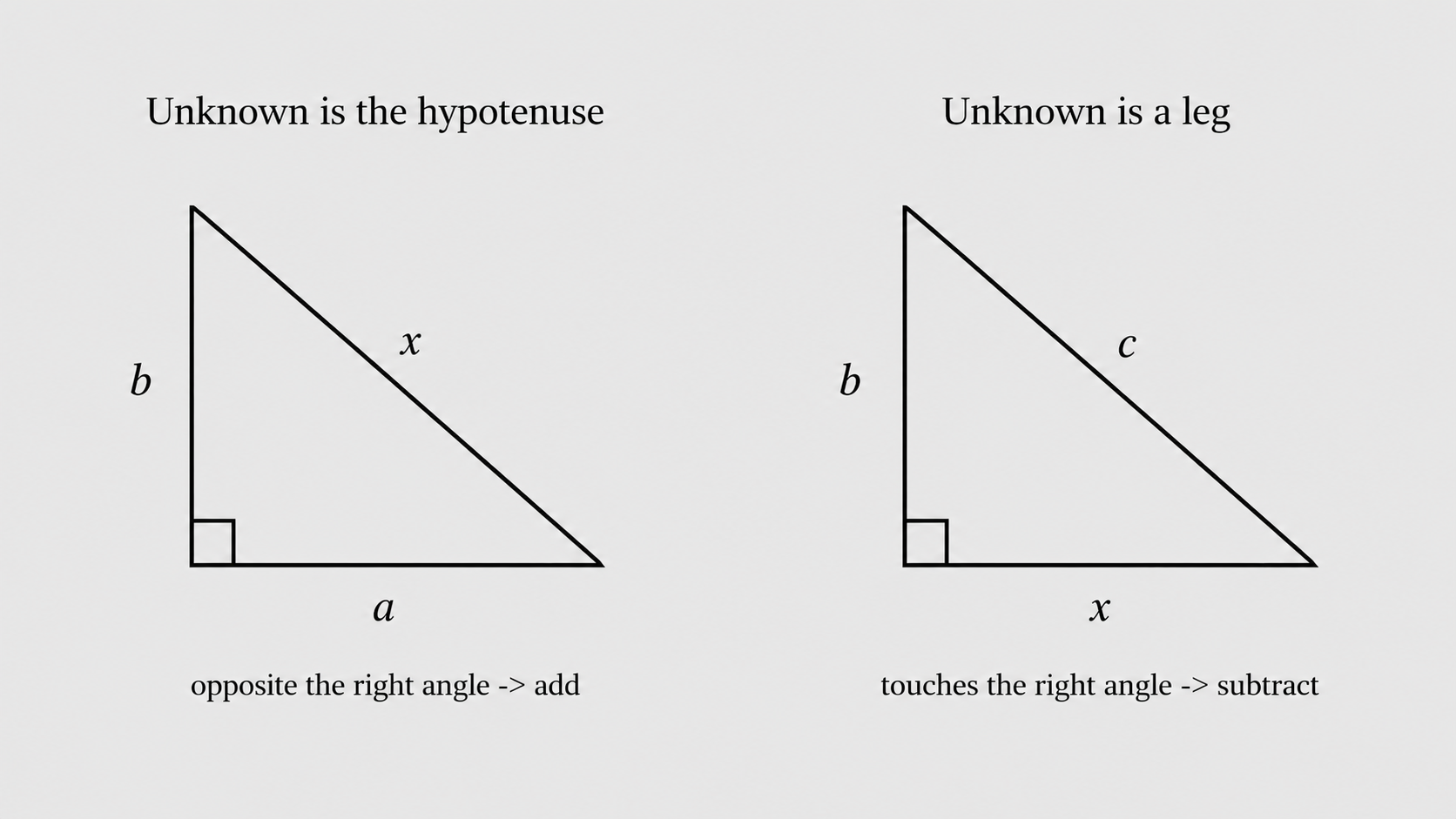
Welcome back to Solving for Unknown Sides! You are now on lesson five of seven, so the finish line for this course is well within sight. Over the past three lessons, we built two separate procedures: one for finding the hypotenuse (square, add, square root) and one for finding a missing leg (square, subtract, square root). Each procedure works perfectly on its own. But when you face a new problem, the very first question is: which procedure do I use? That decision point is exactly what we focus on today.
Why the First Move Matters Most
Imagine you are about to cook a meal and you have two recipes in front of you. Picking up the wrong recipe means every step that follows produces the wrong dish, no matter how carefully you measure. The same idea applies here.
Both of our side-solving procedures share an identical first and last step (square, then square root), but the middle step is different: add for the hypotenuse, subtract for a leg. Choosing the wrong middle step gives a wrong answer every time, even if the arithmetic itself is flawless. So before we touch a single number, we need to pause and read the triangle.
Spotting the Unknown Side
The hypotenuse is always the side directly opposite the right angle, and it is always the longest side of the triangle. The two remaining sides are the legs, and they form the right angle. When a diagram shows one side as unknown — often marked with a variable like x or a question mark — our job is to classify that side before we calculate.
Here is the two-step check:
Find the right-angle marker. Look for the small square symbol that indicates the 90° angle.
Check the position of the unknown side. Is the unknown across from that right angle, or is it one of the two sides that touch it?
If the unknown is across from the right angle, it is the hypotenuse. If it touches the right angle, it is a leg. That single observation tells us everything we need about which formula to apply.
Two Paths, One Quick Rule
Join the 1M+ learners on CodeSignal
Be a part of our community of 1M+ users who develop and demonstrate their skills on CodeSignal
Worked Example: Deciding to Add
Worked Example: Deciding to Subtract
Real-World Scenario: Same Shape, Different Unknown
The Most Common Beginner Mistake
The single most frequent error at this stage is automatically adding the two known squared values, regardless of which side is missing. This habit often forms because hypotenuse problems are usually taught first, so "square and add" feels like the default. When the unknown is actually a leg, adding the squares produces a number that is too large, and the final answer ends up longer than the hypotenuse — which is impossible for a leg.
A reliable self-check takes only a moment: after calculating, ask yourself, "Is my answer shorter than the hypotenuse?" If the unknown is a leg and your result is equal to or greater than the hypotenuse, go back and verify that you subtracted rather than added. This one habit can catch the mistake before it sticks.
Conclusion and Next Steps
Today's lesson was all about the decision that happens before any calculation: look at the diagram, locate the right angle, and determine whether the unknown side is the hypotenuse or a leg. That single observation tells us to add (hypotenuse) or subtract (leg), and the rest of the procedure follows naturally. Combined with the techniques from Lessons 2 through 4, you now have a complete start-to-finish strategy for solving any right triangle with two known sides.
Up next, the practice exercises will put this decision-making skill to the test with a variety of triangles and real-world setups. You will identify unknown sides, match diagrams to the correct operation, spot common errors, and solve complete problems from start to finish. Get ready to diagnose each triangle, pick the right path, and solve with confidence!
Once we know what the unknown side is, the choice becomes straightforward. Here is the complete decision rule in a compact table:
Unknown side
Middle step
Formula
Hypotenuse (c)
Add the leg-squares
c=a2+b2
Leg (a or b)
Subtract from the hypotenuse-square
a=c2−b2
Notice the pattern: when the two known sides are both legs, their squares come together through addition. When one known side is the hypotenuse and the other is a leg, we use subtraction (hypotenuse-square minus leg-square). A handy phrase to remember is: both known sides are legs → add; one known side is the hypotenuse → subtract.
A right triangle has legs of 5 and 12, and the side opposite the right angle is labeled x. Because x sits across from the right angle, it is the hypotenuse. That tells us to add:
x=52+122=25+144=169=13
The unknown side is 13. Both known values were legs, so addition was the correct middle step.
Now consider a right triangle whose hypotenuse is 17 and one leg is 8. The other leg is labeled x. Because x is one of the sides that forms the right angle, it is a leg. That tells us to subtract:
x=172−82=289−64=225=15
The unknown side is 15. Both examples used the same three-step rhythm — square, combine, square root. The only difference was whether "combine" meant addition or subtraction, and that choice came entirely from identifying the unknown side before doing any math.
Real problems rarely announce which formula to use, so let's practice the decision in two everyday situations.
Situation A — Diagonal of a tablet screen. A tablet screen measures 9cm wide and 12cm tall. What is the diagonal? The diagonal stretches from one corner to the opposite corner, cutting across the right angle formed by the width and height. That makes the diagonal the hypotenuse, so we add:
d=92+122=81+144=225=15cm
Situation B — Height of a loading ramp. A 10-foot ramp reaches a platform, and its base sits 6 feet from the wall. How high is the platform? The ramp is the longest side, stretching from the ground to the platform — that is the hypotenuse. The height is a leg, so we subtract:
h=102−62=100−36=64=8ft
Same three-step rhythm, same types of triangles, but the decision step pointed us in opposite directions. Getting that first call right made each solution straightforward.