Combining Discounts and Tax
Introduction
Welcome back to Shopping and Spending with Percentages! We have arrived at the sixth and final lesson of this course. Over the previous five lessons, we built up individual skills: calculating discounts, computing sales tax, figuring tips, estimating mentally, and working with markups. Now it is time to combine two of those skills into a single, realistic transaction: applying a discount and then calculating sales tax on the same purchase. This is exactly what happens at checkout when we grab a sale item and the register still adds tax on top.
Two Percentages, Two Different Bases
As you may recall from Lessons 1 and 2, a discount is a percentage taken off a price, while sales tax is a percentage added on. When both appear in the same transaction, the key question becomes: which amount does each percentage apply to?
The rule is straightforward:
- The discount is applied to the original price.
- The sales tax is applied to the discounted price, not the original.
This makes sense because tax is charged on what we actually pay for the item after the markdown, not on the sticker price. Getting the base wrong at either step will throw off the final total.
The Two-Step Process
Here is the process broken into two clear steps:
- Find the discounted price. Apply the discount to the original price.
- Find the final total. Calculate sales tax on the discounted price and add it.
In formulas:
Notice each formula uses a different base. The discount rate operates on the original price, and the tax rate operates on the result of step one. Let's see this in action with a concrete example.
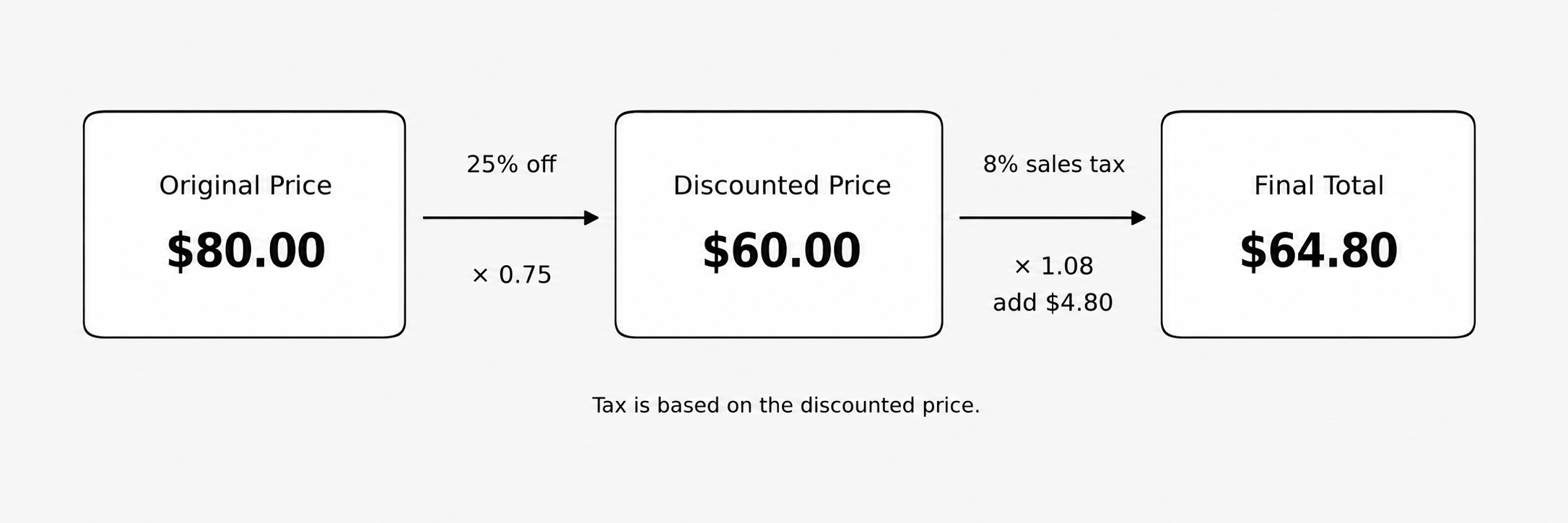
Worked Example: A Pair of Sneakers
A pair of sneakers has an original price of $80.00. The store is running a 25% off sale, and the local sales tax rate is 8%. What do we actually pay at the register?
Step 1 — Apply the discount. Using the remaining-percent shortcut from Lesson 1, we multiply by :
The discounted price is $60.00.
Step 2 — Apply sales tax to the discounted price.
The final total at the register is $64.80. Here is a summary of how the numbers flow through each step:
| Step | Calculation | Result |
|---|---|---|
| Original price | — | $80.00 |
| Discount (25% off) | $80.00 × 0.75 | $60.00 |
| Sales tax (8%) | $60.00 × 0.08 | $4.80 |
| Final total | $60.00 + $4.80 | $64.80 |
