Describe Ranges with Compound Inequalities
🎉 Introduction
Welcome to Describe Ranges with Compound Inequalities! Over the first three lessons, you built a strong toolkit: writing equations for exact targets, matching everyday bound phrases to inequality symbols, and modeling one-sided constraints with ceilings and floors. Now you are ready for the last piece of the puzzle: capturing situations where a quantity must fall between two bounds at the same time. In this lesson, you will learn to:
- Identify the upper and lower bounds of a real-world range constraint.
- Choose the correct inclusive or strict inequality symbols for each endpoint based on everyday language.
- Write a compound inequality that combines both bounds into a single mathematical statement.
Combining these bounds matters because in many everyday situations, one inequality alone cannot tell the whole story. A thermostat must keep a room between 68°F and 74°F. Saying captures the floor but ignores the ceiling, and saying captures the ceiling but ignores the floor. By using a compound inequality, you combine both limits into a single rule, ensuring the quantity stays perfectly within its acceptable range.
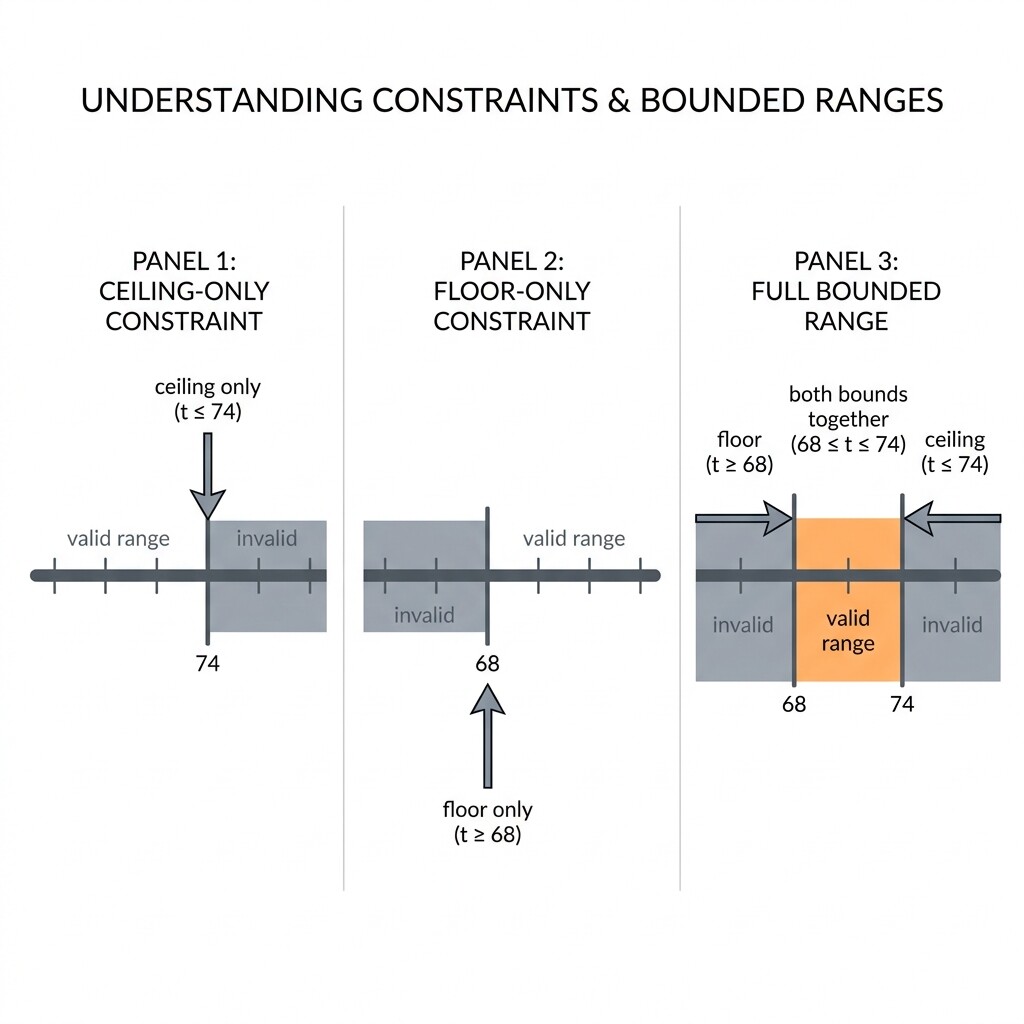
The Three-Part Structure 🏗️
A compound inequality places a variable (or an expression) between a lower bound on the left and an upper bound on the right, connected by two inequality symbols. The general form looks like this:
There are three parts to notice:
- Lower bound — the smallest acceptable value.
- Variable or expression — the quantity that must stay inside the range.
- Upper bound — the largest acceptable value.
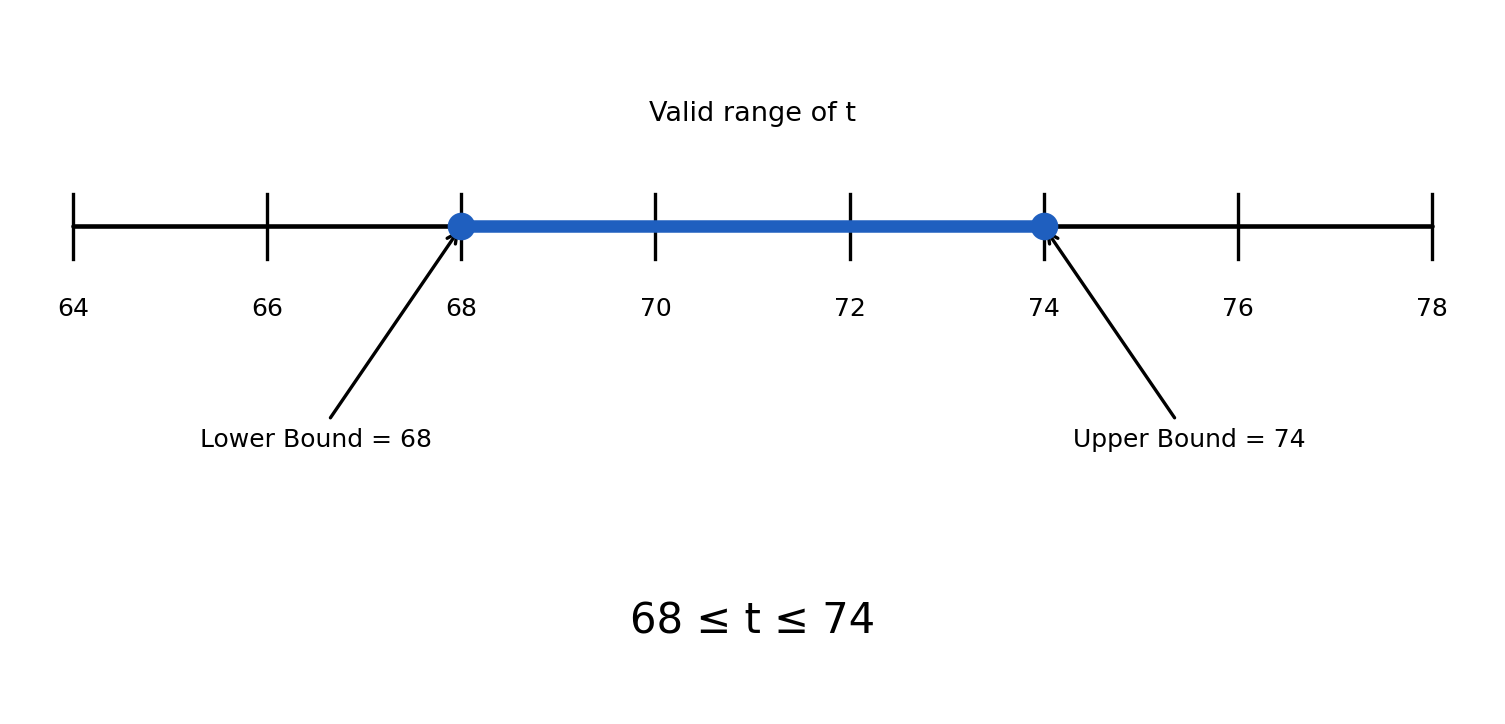
For example, if a thermostat must keep the temperature between 68°F and 74°F inclusive, and we let represent the temperature in degrees Fahrenheit, the compound inequality is:
This single statement says two things at once: is at least 68 and is at most 74. Every value of that satisfies both conditions falls inside the acceptable range.
Choosing Inclusive or Strict Endpoints 🤔
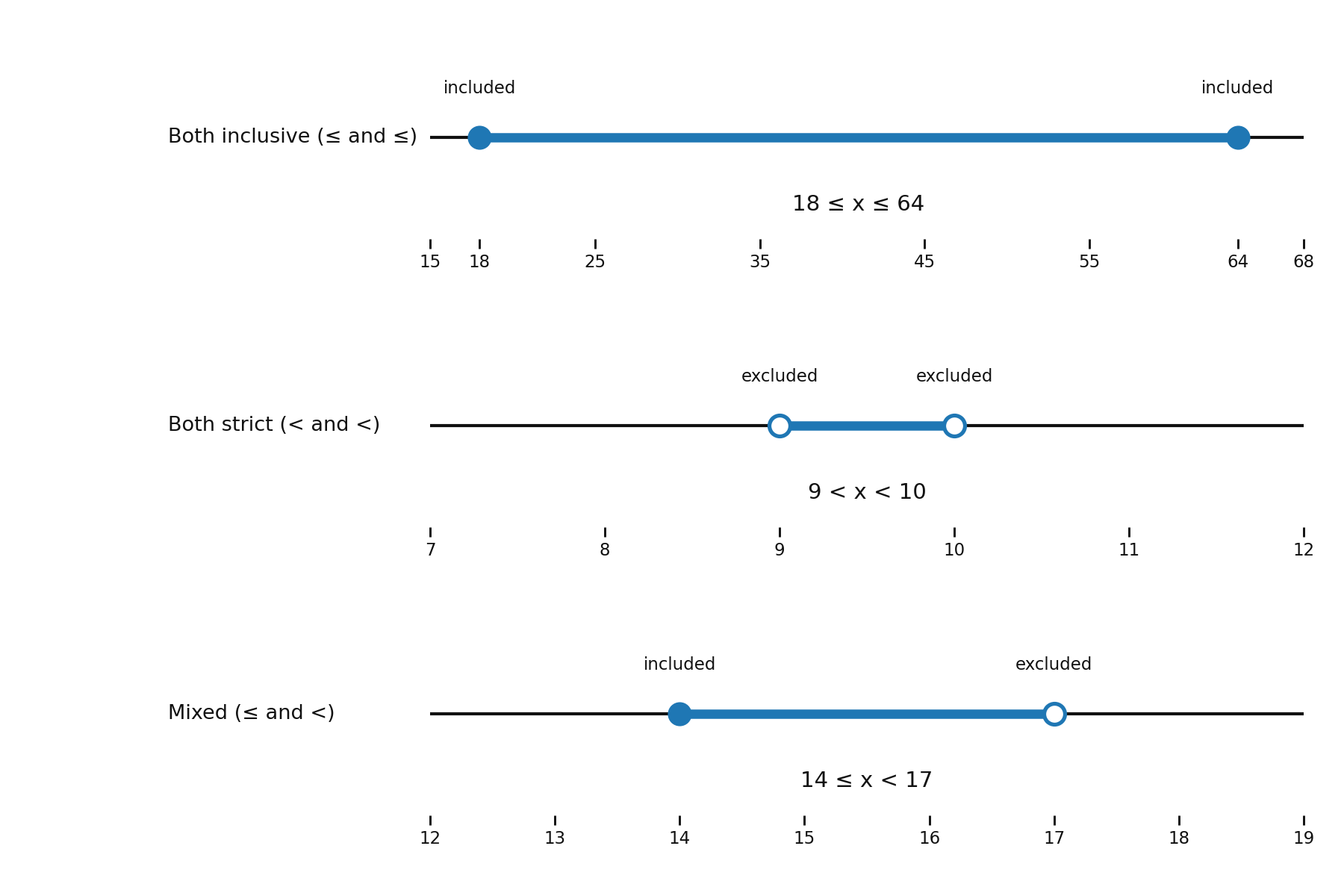
The difference between and comes down to whether the boundary value itself is allowed. The same idea applies to compound inequalities, but now you make that choice twice, once for the lower bound and once for the upper bound.
| Phrase | Lower symbol | Upper symbol |
|---|---|---|
| "between 18 and 64, inclusive" | ||
| "strictly between 9 a.m. and 10 a.m." | ||
| "from 2:00 p.m. up to but not including 5:00 p.m." |
When both endpoints are included, we use on both sides. When both are excluded, we use on both sides. And sometimes one endpoint is included while the other is excluded, giving us a mixed pair of symbols. The language in the problem always guides the choice. Because the two ends act independently, you do not need to use the same symbol for both. Just look for keywords like "inclusive," "strictly," or "not including" and evaluate the lower bound and the upper bound separately to decide which symbol belongs where.
Inclusive Endpoints in Action ⚫
Let's walk through a complete example with inclusive endpoints. Suppose a roller coaster allows riders whose height is between 48 inches and 76 inches, inclusive. We let represent the rider's height in inches.
- Lower bound: 48 (included, because the rule says "inclusive").
- Upper bound: 76 (included for the same reason).
Putting it together:
This tells us that a rider who is exactly 48 inches tall can ride, a rider who is exactly 76 inches tall can ride, and anyone whose height is in between can ride as well.
Here is another example. A package shipped through a certain carrier must weigh between 1 pound and 70 pounds, inclusive. If represents the weight of the package in pounds:
A package weighing exactly 1 pound or exactly 70 pounds is acceptable. Anything lighter or heavier is not.
Strict Endpoints in Action ⚪
Now consider a situation where the boundary values themselves are not allowed. A doctor's office asks patients to arrive strictly between 9:00 a.m. and 9:30 a.m. If represents the patient's arrival time, then:
Arriving at exactly 9:00 a.m. or exactly 9:30 a.m. does not satisfy the rule. Only times strictly inside the window count. The word strictly is the key signal here — it tells you both boundary values are excluded.
Mixed Endpoints 🔀
Real life does not always treat both ends the same way. A store offers a special discount on purchases strictly greater than $50, up to and including $200. If represents the purchase amount in dollars:
- Lower bound: 50 is excluded — "strictly greater than" means exactly $50 does not qualify.
- Upper bound: 200 is included — "up to and including" means exactly $200 is acceptable.
The compound inequality becomes:
Notice the mixed symbols: on the left and on the right. Each endpoint gets the symbol that matches its own inclusion rule. When you encounter mixed language, handle each side independently — decide whether the lower bound is included or excluded, then do the same for the upper bound.
A Quick Checklist for Compound Inequalities 📋
Before finalizing any compound inequality, run through a few quick checks. This extends the four-step process from the previous lesson with one extra step tailored to ranges.
- Identify the variable and build any needed expression. What quantity is being constrained?
- Find both bounds. Which number is the lower bound and which is the upper bound?
- Determine inclusion or exclusion for each bound separately. Look for keywords like "inclusive," "strictly," "at least," "up to but not including," and so on.
- Write the three-part form. Place the lower bound on the left, the variable or expression in the middle, and the upper bound on the right, with the correct symbol on each side.
- Read it back in plain language. Does your inequality say the same thing as the original scenario?
Step 5 is a quick sanity check. For instance, reads as "the temperature is at least 68 and at most 74." If that matches the original rule, you are good to go.
Conclusion and Next Steps
In this lesson, you learned how to describe ranges by writing compound inequalities. The three-part form places a lower bound on the left and an upper bound on the right, with the variable in the middle. You also practiced choosing the correct symbol for each endpoint — both inclusive, both strict, or one of each.
Combined with the equations and one-sided inequalities from earlier lessons, you now have a complete toolkit for translating real-world rules into mathematical statements. Up next is a series of practice exercises where you will write compound inequalities across a variety of everyday scenarios — from eligibility bands and thermostat settings to delivery windows and acceptable weight ranges.
