Understanding Data Association
Introduction
Welcome back to Seeing Relationships in Data! This is lesson two of seven, and you are right on track. In the previous lesson, you learned how to recognize paired data — two quantitative measurements recorded on the same case. Now comes the natural follow-up question: once we have paired data, how do we decide whether the two variables are actually related to each other? That is the focus of this lesson: the idea of association.
From Paired Data to a Bigger Question
Having paired data is a necessary first step, but it does not guarantee that the two variables have anything to do with each other. A school could record each student's height and the distance they live from the school. Both values are measured on the same student, so the data is properly paired — yet there is no reason to expect taller students to live further from the school than shorter students. The two variables simply do not track each other.
This tells us that paired data opens the door to looking for a relationship, but we still need a way to decide whether one actually exists. That is where the concept of association comes in.
What Association Means
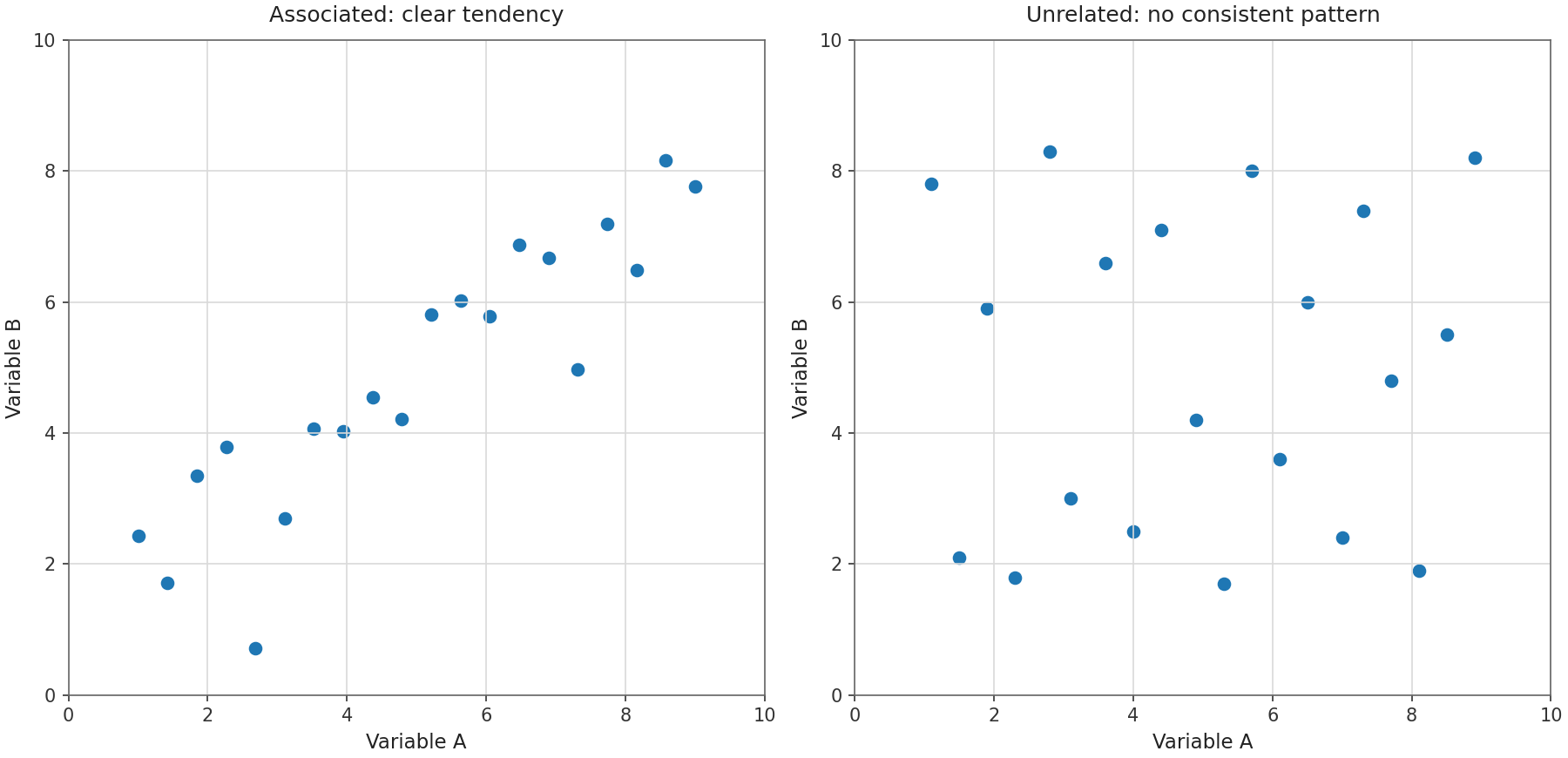
Two variables are associated when knowing the value of one variable tells you something useful about the likely value of the other. More specifically, association means that as one variable changes across cases, the other variable tends to change in a patterned, systematic way rather than bouncing around randomly.
Consider average monthly outdoor temperature and household electricity bills. As the average temperature rises across different months, electricity bills tend to rise too, because people run their air conditioning more. The word tends is important here — it does not mean every single hotter month produces a higher bill, but the overall pattern is clear: higher average temperatures generally go with higher monthly bills.
Now contrast that with a person's birth month and their commute time to work. There is no reason one should track the other. If you sorted people by birth month, their commute times would look essentially random. These two variables are not associated — we say they are unrelated.
Patterned Tendency, Not Perfect Lock-Step