Welcome to Representing and Interpreting Solutions! This is the third of four lessons in the course, which means you are well past the halfway mark. In the first two lessons, you learned how to write solution sets in interval notation and how to translate between number-line graphs and intervals. Now it is time to bring those skills together.
In this lesson, you will learn how to look at two or more representations of a solution set and decide whether they truly describe the same collection of numbers — or whether a subtle difference makes them say something different entirely. This skill is essential because in math, and in real life, the same information can appear in different formats, and you need to recognize when those formats are saying the same thing.
The "Same Set, Different Outfit" Idea
Think of it this way: a temperature of 32°F and 0°C look completely different, but they describe the exact same physical condition — water's freezing point. Inequality solutions work similarly. The inequality x>5, a number line shaded to the right of an open circle at 5, and the interval (5,∞) all describe the identical collection of numbers. The representation changes, but the solution set does not.
Our goal in this lesson is to build confidence in recognizing that kind of match — and, just as importantly, in catching the small differences that make two representations not equivalent. Three details control everything: the boundary value (the number itself), the endpoint type (open or closed, telling us whether the boundary is included), and the direction (which side of the boundary the solutions extend toward). If all three details match across two representations, they are equivalent. If any single detail differs, they are not.
The Three Representations Side by Side
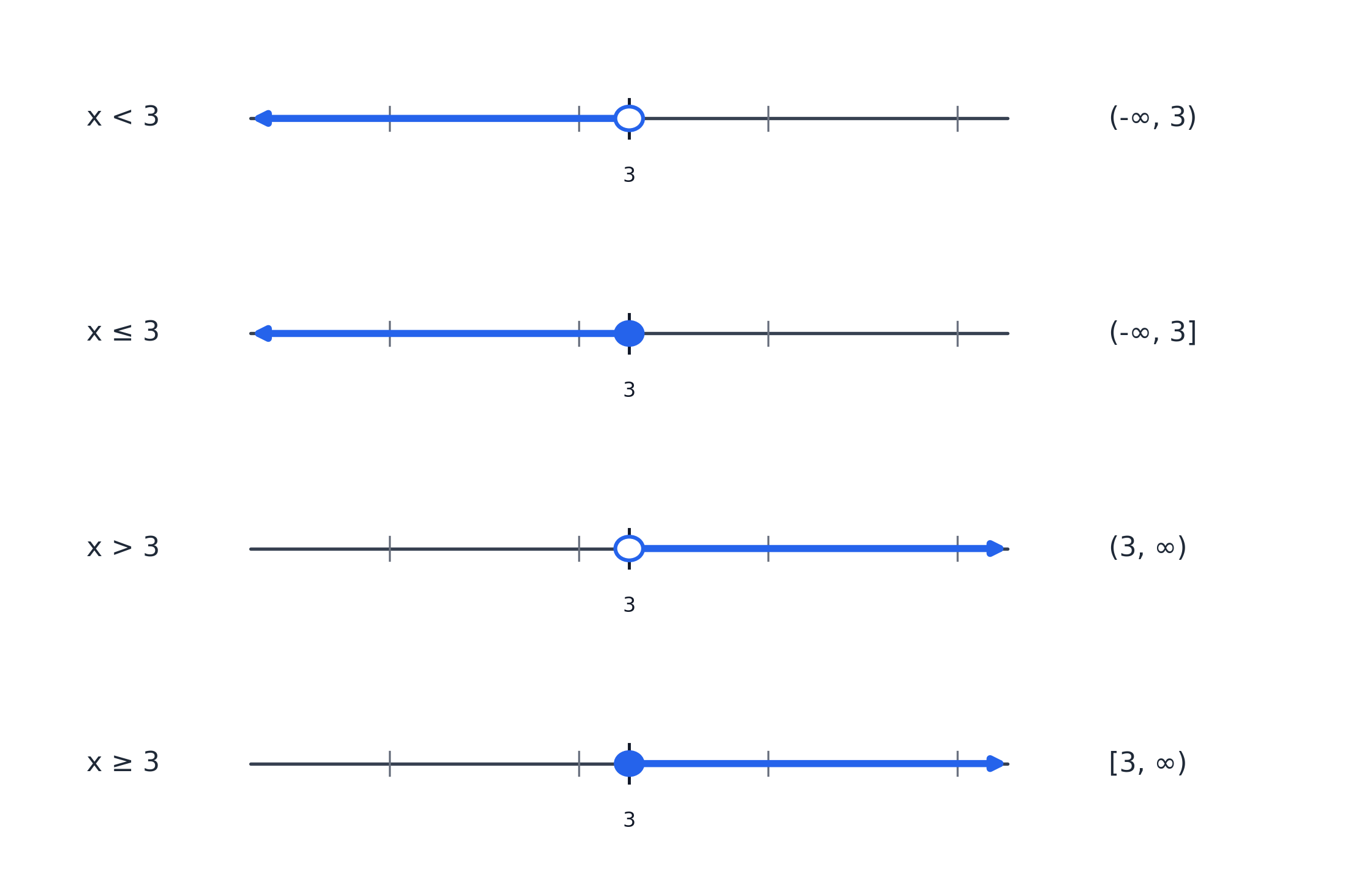
Every one-sided inequality solution can be expressed in three equivalent forms. Let's place them next to each other for a quick refresher:
Inequality
Number-Line Graph
Interval Notation
x<3
Open circle at 3, shaded left
(−∞,3)
x≤3
Closed (filled) circle at 3, shaded left
(−∞,3]
x>3
Open circle at 3, shaded right
(3,∞)
x≥3
Closed (filled) circle at 3, shaded right
[3,∞)
Notice how each row is a complete "family" — the inequality, the graph, and the interval all say the same thing. Changing even one small detail, like swapping an open circle for a closed one, would break that match and produce a different set.
Join the 1M+ learners on CodeSignal
Be a part of our community of 1M+ users who develop and demonstrate their skills on CodeSignal
Beyond One-Sided: Bounded Sets and Special Cases
Checking the Endpoint Type
Checking the Direction
Spotting a Mismatch Across All Three Forms
A Quick Checklist for Equivalence
Conclusion and Next Steps
In this lesson, you focused on what it truly means for two representations of a solution set to be equivalent: they must share the same boundary value, the same endpoint type, and the same direction. You saw how a single small difference, like swapping a parenthesis for a bracket, is enough to make two seemingly similar representations describe entirely different sets, and you extended those checks to bounded two-endpoint sets and to the all-real-numbers and no-solution cases.
Up next, you will put these ideas into action with hands-on practice tasks where you will match inequalities to intervals, judge whether pairs of representations are equivalent, pick the correct match from close alternatives, and spot the odd one out when all three forms are presented together. Jump in and see how sharp your equivalence-checking skills have become!
The same equivalence checks apply to solution sets that are bounded on both ends or that take a special form. A bounded set simply has two endpoints to match, and each one must agree on value and endpoint type across representations.
Inequality
Number-Line Graph
Interval Notation
2≤x<5
Closed circle at 2, open circle at 5, shaded between
[2,5)
all real numbers
Entire line shaded, arrows both ways
(−∞,∞)
no solution
Nothing shaded
∅
When you compare a bounded inequality with an interval, run the three checks on both endpoints. And remember that "all real numbers" always matches (−∞,∞), while "no solution" always matches ∅ — mixing these two up is a quick way to declare a false match.
The most common source of mismatch is the endpoint type. Consider the inequality x≤7 alongside the interval (−∞,7). At first glance they look similar because both involve the number 7 and both point to the left. But x≤7includes7 (the symbol ≤ means "less than or equal to"), while (−∞,7) uses a parenthesis at 7, which excludes it. These two are not equivalent. The correct interval for x≤7 is (−∞,7], with a bracket.
Here is a reliable rule of thumb to keep these straight:
Strict inequalities (< or >) pair with parentheses and open circles.
Non-strict inequalities (≤ or ≥) pair with brackets and closed (filled) circles.
Mixing these up is the single most frequent error when matching representations, so always check the endpoint type first.
The second detail to verify is the direction of the solution set — which side of the boundary number the solutions fall on. For example, x<4 and x>4 share the same boundary and the same open endpoint type, yet they describe completely different sets of numbers. One covers everything to the left of 4; the other covers everything to the right.
On a number line, direction shows up as the side that is shaded. In interval notation, direction is reflected by which side carries ∞ or −∞:
Direction
Interval Pattern
Solutions go left (toward smaller numbers)
(−∞,boundary…
Solutions go right (toward larger numbers)
…boundary,∞)
When comparing two representations, confirm that both point the same way before declaring them equivalent.
Let's walk through a complete example. Suppose you are given three items presented as if they are equivalent:
The inequality x≥−2
A number line with a closed circle at −2, shaded to the right
The interval (−2,∞)
Start by comparing the inequality to the number line. The inequality x≥−2 includes −2 (non-strict), and the closed circle also includes −2. The inequality points right (≥), and the shading goes right. These two match perfectly.
Now compare the inequality to the interval. The inequality x≥−2 includes −2, but (−2,∞) uses a parenthesis at −2, which excludes it. That single-character difference — parenthesis versus bracket — means these two do not match. The correct interval would be [−2,∞).
This example shows why checking all three forms against each other matters. Two of the three can agree while the third quietly carries a mismatch.
Whenever you need to decide if two representations describe the same solution set, run through three quick checks:
Same boundary value? Both representations must reference the same number.
Same endpoint type? Strict (<, >) pairs with open circle and parenthesis; non-strict (≤, ≥) pairs with closed circle and bracket.
Same direction? Both must shade or extend toward the same side of the boundary.
If all three checks pass, the representations are equivalent. If any single check fails, they are not. Think of it like confirming a flight booking: the date, the time, and the destination all have to match — getting two out of three right is not good enough.