Welcome back to Representing and Interpreting Solutions! This is the fourth and final lesson in the course, so you are approaching the finish line. In the previous three lessons, you learned how to write solution sets in interval notation, translate between number-line graphs and intervals, and match equivalent representations by checking the boundary value, endpoint type, and direction. Those skills gave you a strong toolkit for expressing what a solution set looks like. Now it is time to explore what a solution set actually means when it lives inside a real-world situation.
In this lesson, you will take solved inequalities and connect them to everyday scenarios like spending limits, minimum work hours, and weight allowances. You will practice identifying which values are feasible in a given context and learn how to state your conclusions in plain, everyday language that anyone can understand.
Why Context Changes Everything
Imagine you solve an inequality and get x≤50. On its own, that solution set includes every number from 50 all the way down through zero, through the negatives, and onward to −∞. Mathematically, x=−200 is a perfectly valid member of that set.
But now suppose the inequality came from a problem about how much money you can spend at a store. Suddenly, x=−200 makes no sense because you cannot spend negative dollars. The math has not changed, but the context tells you which part of the solution set is actually meaningful. This is the core idea of interpreting solutions in context: you combine the mathematical answer with real-world common sense to identify the values that are truly feasible.
From a Situation to an Inequality
Real-world constraints often arrive as short verbal statements. Consider this example: "An airline allows each checked bag to weigh at most 50 pounds." If we let w represent the weight of the bag in pounds, the phrase "at most 50" translates into:
w≤50
As you may recall from earlier in the learning path, phrases like "at most," "no more than," and "up to" all correspond to ≤, while phrases like "at least," "no fewer than," and "a minimum of" correspond to ≥. Recognizing these phrases is the first step in connecting a situation to its inequality.
Join the 1M+ learners on CodeSignal
Be a part of our community of 1M+ users who develop and demonstrate their skills on CodeSignal
Identifying Feasible Values
Writing Compound Inequalities
Stating Solutions in Plain Language
Watching for Boundary and Edge Cases
Full Walkthrough: The Gym Discount
Conclusion and Next Steps
In this lesson, you learned how to take a solved inequality and interpret it within a real-world situation. You practiced identifying which values in a solution set are truly feasible once context is applied, and you built the habit of restating symbolic answers in clear, everyday language. This skill bridges the gap between abstract algebra and practical decision-making — whether the topic is budgets, work schedules, or weight limits.
You are now ready to put these ideas to the test in the practice section that follows. You will evaluate feasible values in realistic scenarios, write context-driven inequalities, complete plain-language sentences using everyday phrasing, and craft your own real-world interpretations. Dive in and show what you have learned!
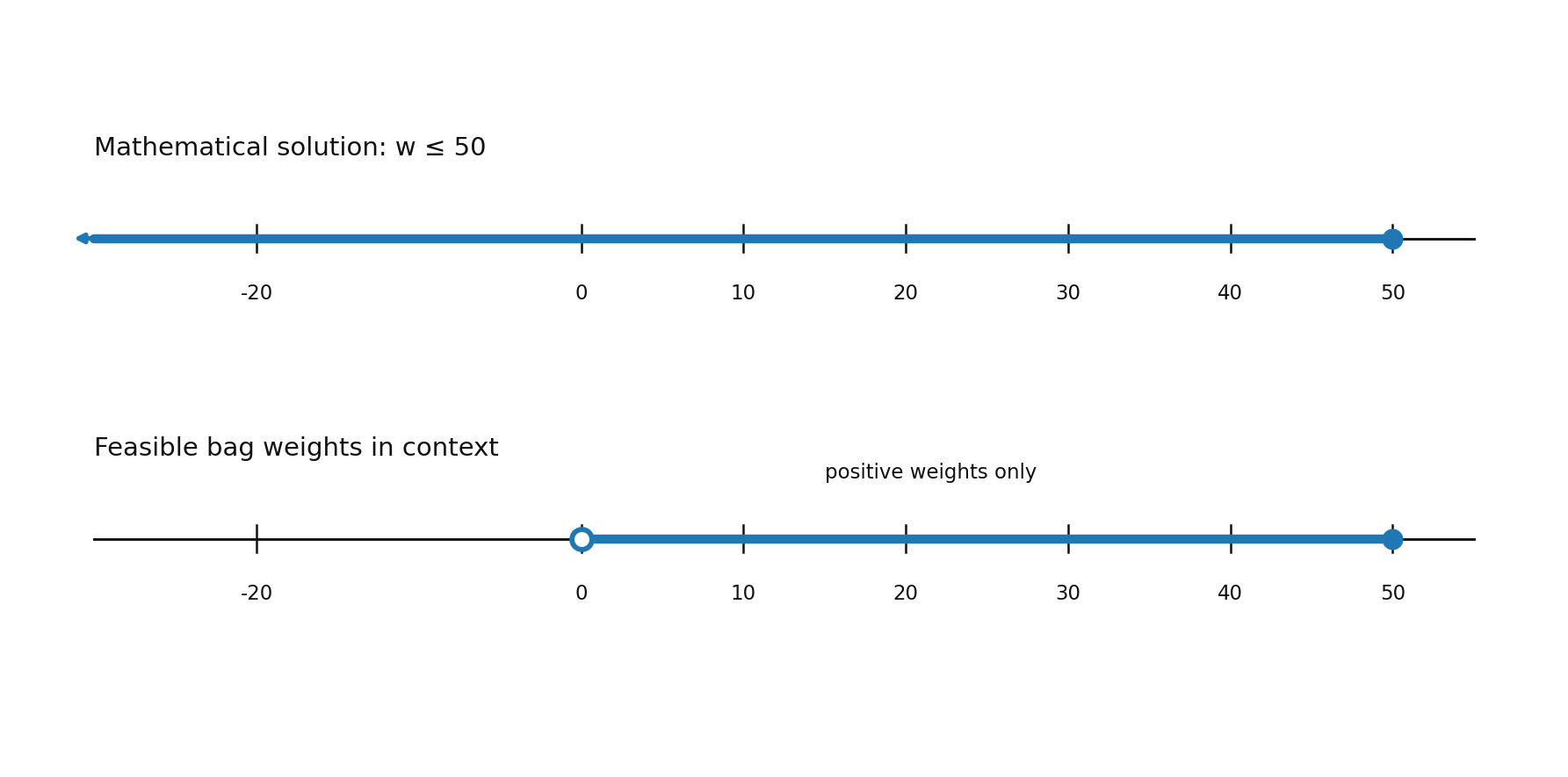
Once you have the inequality, the next question is: which values from the solution set actually make sense in this situation? Let's continue with the luggage example, w≤50. The full mathematical solution set is (−∞,50], but a bag cannot have a negative weight or a weight of zero. In practice, the feasible values are numbers greater than 0 and up to 50.
When a situation has both a lower limit and an upper limit, we combine them into a compound inequality. This "sandwiches" the variable between the two boundary values so you can see the entire allowed range at once.
To build the compound inequality for the luggage (0<w≤50):
Smallest value on the left: Write the lower limit (0).
Variable in the middle: Write the variable (w).
Largest value on the right: Write the upper limit (50).
Connect with signs: Use < or ≤ signs so they both point toward the smaller values (to the left).
When typing this into a practice exercise, you can enter it from left to right. For example, 0<w≤50 would be entered as 0 < w <= 50.
The number lines below illustrate the difference between the full mathematical solution and the feasible values in context.
Here is a simple two-step process you can follow every time:
State the mathematical solution. Write the solved inequality or interval, such as w≤50.
Apply real-world restrictions. Remove values that do not make sense in the situation, such as negative weights or fractional people.
After both steps, you have the collection of values that are both mathematically valid and contextually reasonable.
Being able to solve an inequality is important, but being able to explain the answer in everyday words is just as valuable. When you move from symbols to sentences, aim to communicate three things clearly: what the variable represents, which values are allowed, and why.
Consider this scenario: "A worker needs at least 20 hours per week to qualify for benefits." If h represents weekly hours, the inequality is h≥20. A clear plain-language interpretation might be:
"The worker must work 20 hours or more each week to qualify. Any amount below 20 hours is not enough."
Notice how the sentence avoids math symbols entirely and uses the phrase "20 hours or more," which mirrors the meaning of ≥20. The following table shows common inequality symbols alongside natural phrasing options:
Symbol
Plain-Language Phrasing
x≤30
at most 30, no more than 30, 30 or fewer
x≥20
at least 20, no fewer than 20, 20 or more
x<100
less than 100, under 100, below 100
x>5
more than 5, above 5, over 5
Choosing the right phrase makes your interpretation feel natural and easy to understand for anyone reading it.
Some values sit right on the boundary of the solution set and are mathematically correct, yet they might feel strange in context. These edge cases are worth a closer look because they often trip people up.
Suppose a budget constraint gives you x≤30, where x is the amount in dollars you can spend on lunch. The value x=0 is part of the solution set, and it is technically feasible — spending nothing is allowed. Meanwhile, x=30 is also valid and means you spend every last dollar available. What about x=29.999? Mathematically it satisfies x≤30, and in a money context it rounds to $30.00, so it is still reasonable.
The key point is that feasibility depends on the situation's own rules. For money, we usually round to two decimal places. For counting people, only whole numbers make sense. Always let the context guide which values you accept as realistic.
Let's put everything together with one complete example. A gym requires members to be at least 16 years old, and it offers a student discount for members who are under 25 years old. If a represents a member's age in years, the discount applies when:
a<25
Mathematical solution: all real numbers less than 25, written in interval notation as (−∞,25).
Contextual restrictions: Because the gym policy requires members to be at least 16, the feasible values narrow to ages from 16 up to but not including25.
Compound Inequality:16≤a<25 (Typed as: 16 <= a < 25)
Interval Notation:[16,25)
Plain-language interpretation: "A member qualifies for the student discount if they are at least 16 years old but younger than 25. A member who is exactly 25 does not qualify."
Notice how we combined the math with the specific rules of the situation and then stated the result in a sentence anyone could read and understand. That is the complete process: solve, filter for feasibility, and explain in words.